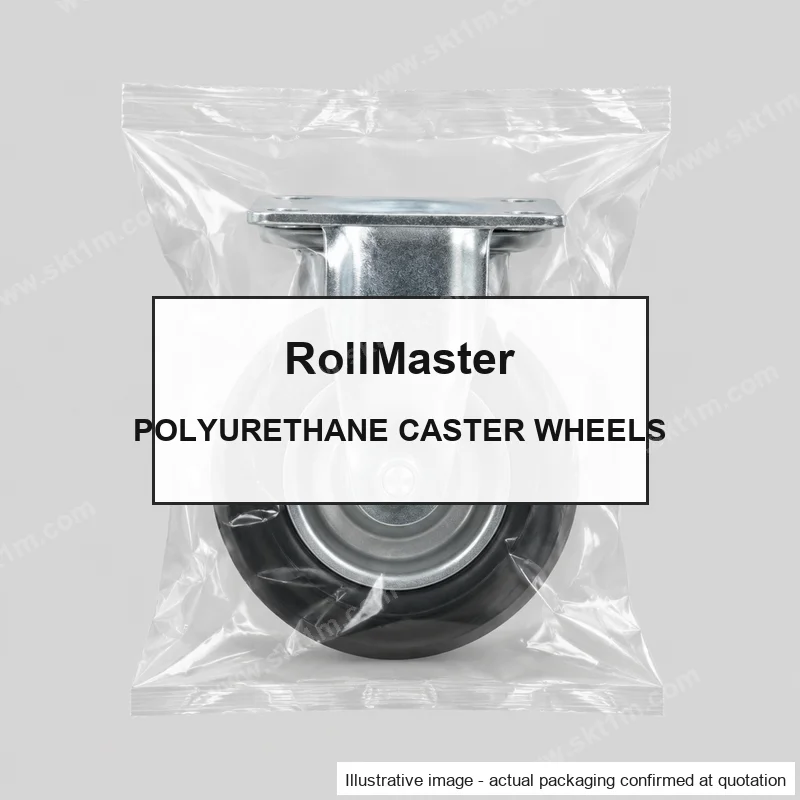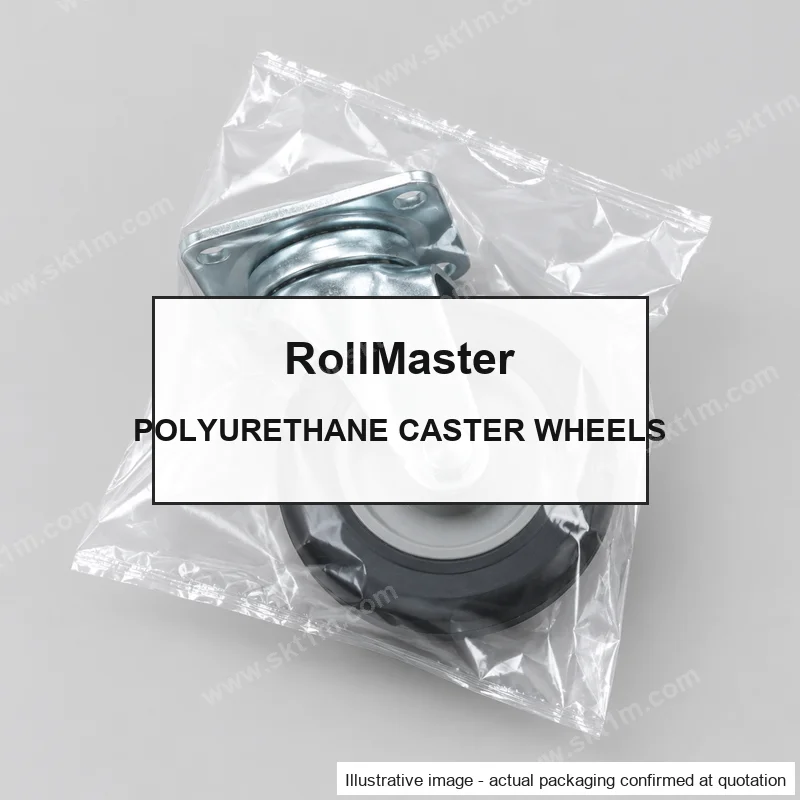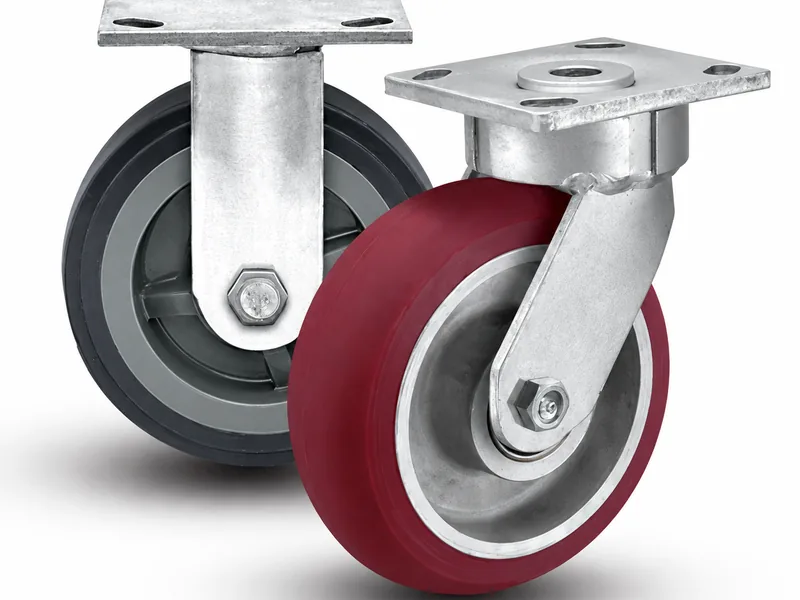
Polyurethane is often selected when buyers need a balance of load capacity and floor protection on painted concrete or epoxy floors. PU wheel options are included in the own-production core range on grey-iron or steel cores; the exact compound, core and model configuration are confirmed at quotation.
Rolling resistance, grip, noise and chemical resistance are compound- and application-dependent. Hardness, core, wheel geometry, load, speed, floor finish and the specific chemical exposure all affect the result; do not treat a general PU description as a universal oil/chemical compatibility rating. Confirm the grade and supporting SKU data for the stated duty at quotation.
Process Overview
Polyurethane caster wheels combine a hard core (grey iron, steel or aluminium) with a cast or injected PU tread. The core carries the load; the tread protects the floor, grips, and rolls with low resistance.
PU tread hardness (Shore A), the bond between tread and core, and the compound recipe determine load capacity, noise and flat-spot resistance — which is why PU quality varies more between suppliers than any other wheel material.
Material Grades & Properties
Polyurethane (PU) Grades We Use
| Grade | Standard | Characteristics |
|---|---|---|
| Shore A 92-95 | cast / injected | default heavy duty tread |
| Non-marking compounds | grey / red | for protected floors |
| AGV-grade PU | batch-documented | stable rolling resistance |
Key Properties of Polyurethane (PU)
- ✓High load capacity with floor protection
- ✓Low rolling resistance, quiet running
- ✓Resists oils and many chemicals
- ✓Typical range -20 °C to +80 °C
Typical tolerances:Batch hardness and adhesion checks
Applications for Polyurethane (PU) Casters
- AGV/AMR
- trolleys on painted floors
- heavy duty carts
- cleanrooms
Engineering Notes for Polyurethane (PU)
Cast PU on grey iron or steel core; injected PU for volume sizes.
Finishes for Polyurethane (PU) Casters
- Zinc-plated bracket
- Stainless bracket
Specifications
- Shore hardness 92A–95A standard, other compounds on request
- PU wheels for the core family are supplied through owner-confirmed own-production arrangements; process and configuration are confirmed by model
- Non-marking grey and red compounds available
- Temperature range typically -20 °C to +80 °C
- Wheel sizes Ø 25-300 mm; dynamic load up to 1,500 kg per wheel (2,500 kg static) in the heavy series
- Quality and inspection scope are confirmed for the actual manufacturer and model at quotation
Finishes
Zinc-plated or stainless brackets
| Bracket finish | What it does | Specify it when |
|---|---|---|
| Zinc plating (blue/white) | Baseline corrosion protection | Standard dry indoor use |
| Chrome plating | Hard, decorative, easy to clean | Visible / cleanroom-adjacent equipment |
| Powder coating | Custom color, good corrosion resistance | Brand colors, outdoor-adjacent use |
| Stainless steel 304 | No plating to fail | Corrosion-resistant option; washdown, food or medical use requires confirmation of grade, finish, welds, bearings, seals and cleaning process |
| Stainless steel 316 | Higher chloride resistance than 304 in many environments; not immune to pitting or crevice corrosion | Confirm chloride concentration, temperature, deposits, crevices and cleaning chemistry before specifying |
Testing
PU-to-core adhesion, hardness criteria and any available inspection records are confirmed for the actual manufacturer and model
| Selection factor | Rule of thumb | Effect on performance |
|---|---|---|
| Load sizing | Total load ÷ 3 (not ÷ 4) | On uneven floors only three wheels carry the cart |
| Wheel diameter | Bigger rolls easier | Larger wheels cut push force and bridge gaps |
| Tread hardness | Softer = quieter, harder = easier rolling | Pick the softest tread that carries the load |
| Bearing choice | Precision ball for manual pushing, roller for heavy loads | Bearings dominate rolling resistance at high load |
| Swivel vs rigid | 2 swivel + 2 rigid is the standard cart setup | All-swivel carts wander; all-rigid carts cannot steer |
| Floor condition | Rough floors need bigger wheels and softer treads | Small hard wheels on bad floors destroy both |
| Speed & duty | Match the wheel rating to travel speed and cycles | High travel speed and continuous cycling lower the effective capacity a wheel can carry |
Common Applications
- Epoxy
- General industrial, trailers, carts where floor protection matters
- Industrial Trolley
- LVP
- Labs
- Outdoor Use
- Rough concrete
- Rough or Uneven Surface
- industrial loads
- outdoor applications
- pallet truck wheels
- smooth concrete
- tugger-towed
Surface Finish Reference
Frequently asked questions
PU or nylon for my floor?
PU often provides a more compliant tread and may protect finished floors better than hard nylon, but the result depends on the PU compound, hardness, wheel size, load and floor. Nylon may suit smooth floors and higher-temperature duties, while its harder tread can mark some finishes. Confirm the actual wheel grade against your floor and operating conditions.
Is every PU wheel resistant to oil and chemicals?
No blanket compatibility should be assumed from the PU label. Resistance varies by formulation and exposure; identify the chemical, concentration, temperature and contact duration, then confirm the selected compound against manufacturer or test data for that configuration.
Does PU flat-spot?
Quality cast PU flat-spots far less than cheap injection PU. Avoid leaving fully loaded PU wheels parked on hot floors for long periods.
Where is PU the wrong choice?
Above +80 °C standard compounds age quickly (special compounds extend to about +120 °C), sharp or debris-covered floors cut the tread, and long parked loads can flat-spot any urethane. For constant extreme heat choose a steel or high-temperature wheel instead.
What should my RFQ include?
Load per wheel, wheel diameter and width, core material preference, bracket type and top-plate dimensions, brake requirement, floor type and operating temperature, plus annual volume. For AGV projects, add speed and duty cycle so the compound is matched to the duty.
What are the ordering terms?
Standard lead time is 15-20 days (custom compounds 30-40 days). Standard catalog MOQ is 200 pieces per model; trial-order quantities are negotiable. Custom-project MOQ is confirmed against the drawing or sample. Packing is individual box, master carton or palletized; sample availability, price, freight responsibility and any credit against a later bulk order are confirmed in the written quotation for the selected model.
How do I calculate the required caster load capacity?
Total load = cart weight + payload. Divide by 3 (not 4) to stay safe on uneven floors. Add margin for speed, shock and rough floors.
What is the typical lead time?
Standard configurations: 15-20 days. Custom configurations: 30-40 days. Samples: 5-7 days; confirm the schedule for the quoted configuration.
What is the minimum order quantity?
Standard catalog MOQ: 200 pieces per model. Trial-order quantities are negotiable. Custom-project MOQ is confirmed against the drawing or sample.
What certifications do you hold?
ISO 9001 certified quality management. The applicable standard depends on intended use and speed: EN 12532 covers manually propelled or power-towed industrial applications up to 4 km/h; EN 12530 is for manually propelled institutional applications. Confirm the standard, edition and test conditions for the quoted configuration. In-house salt spray and dynamic load testing.
Can you manufacture under our brand?
OEM manufacturing, ODM design, private labelling. Custom brackets, compounds, colors and packaging. Samples then pilot then mass production.
Sources · 4
- hankepu.comManufacturer technical documentation
- custompolyurethane.co.ukUnclassified source
- casterresource.comIndustry publication
- casterhq.comIndustry publication
Technical references cited for verifiability — not supplier recommendations.Browse the research library.