
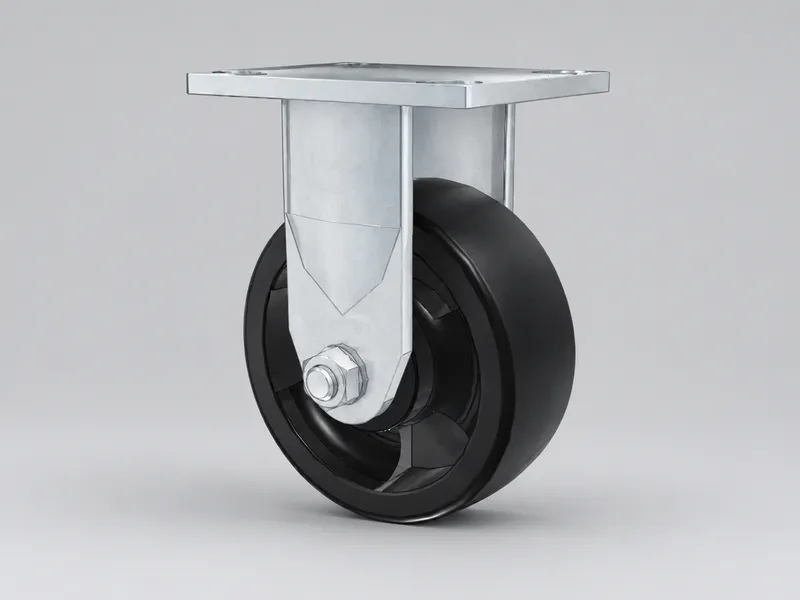
RM-Hot may be evaluated for oven, autoclave, drying-room and curing-line equipment, but these are potential application contexts rather than blanket suitability claims. Owner-declared tread options span +120 °C to +280 °C; confirm the exact material, model and complete-assembly limits against the actual thermal profile before selection.
High-temperature duty can be limited by more than the tread. Bearing expansion, lubricant breakdown, seals, fitment clearances and brake components may each set a lower limit. Specify the actual thermal profile and obtain the manufacturer/model-level configuration before treating a caster as suitable for repeated heat exposure.
The published +120 °C to +280 °C range describes tread options only. It does not establish continuous or intermittent service temperature for every wheel, bearing, brake or assembled caster, and no universal thermal-cycle test result is claimed here.
Process Overview
A high-temperature caster must be specified as a complete assembly. The tread, bearing, lubricant, seals, bracket fitment, brake and swivel components can have different operating limits. The +120 °C to +280 °C owner-declared range applies to tread options only and must not be transferred to the complete assembly.
Published material temperature bands are reference points only and are not a substitute for the exact manufacturer/model rating. State peak and continuous temperature, dwell time, heat-up/cool-down rate, cycles per day, load while hot and whether the brake must engage or hold while hot. Thermal-cycle test evidence is stated only when an applicable model-specific record is available.
Casters by Load Range
| Series | Load per caster | Typical wheel options | Best for |
|---|---|---|---|
| RM-Light | up to 150 kg | Nylon, rubber, elastic | Light trolleys, medical and display carts |
| RM-Medium | 150–500 kg | Polyurethane, nylon | Warehouse carts, racks, AGV/AMR platforms |
| RM-Heavy | 500–1500 kg | Polyurethane on steel, forged steel | Die carts, machinery moving, heavy trolleys |
| RM-Extreme | 1500 kg and up | Forged steel, double wheel | Steel mills, ovens, extreme-load skates |
Specifications
- Owner-declared tread options in the +120 °C to +280 °C range; exact material and model rating confirmed at quotation
- Bearing, grease, seals and fitment confirmed against the stated thermal profile for the selected model
- Brake and swivel suitability for hot duty confirmed for the quoted configuration
- Tread material and exact model options are confirmed in the quotation; no universal material-to-temperature mapping is assumed
Typical materials
Heat-resistant tread options; exact material confirmed by model and quotation
| Wheel material | Typical hardness (grade-dependent) | Floor protection | Where it fits |
|---|---|---|---|
| Cast polyurethane (PU) | Shore A 92–95 | Very good: non-marking compounds | AGV/AMR, trolleys on painted or epoxy floors, heavy duty |
| Injected PU | Shore A 90–95 | Good | Cost-sensitive medium duty, light equipment |
| Cast nylon (PA6) | Shore D 70+ | Fair: hard tread | High load on suitable smooth floors; wet or cleaning use only after confirming the exact nylon grade, bearings, seals and cleaning-agent compatibility |
| Glass-filled nylon | Shore D 75+ | Fair | Application-specific; do not assume higher load or temperature than unfilled PA6 without exact grade and model data |
| Solid rubber | Shore A 65–75 | Good | Shock absorption, outdoor thresholds, economy |
| Super-elastic rubber | Shore A 55–65 | Excellent | Quiet running: medical, hotel, laboratory |
| Phenolic resin | — | Fair | Heat-resistant applications; confirm continuous and intermittent temperature limits for the exact wheel, bearing and complete caster |
| Forged steel | — | None: needs steel plate or heavy concrete | Extreme loads, heat, harsh floors |
| Stainless (wheel/bracket) | — | Good | Hygiene and corrosion-sensitive applications only after checking all wetted parts, bearings, seals, fasteners and cleaning chemistry |
| Assembly-level compatibility check | — | — | A wheel material or stainless bracket alone does not establish washdown, food-contact, chemical or temperature suitability; verify the complete caster configuration and exact cleaning process |
Finishes
Confirmed for the selected wheel and bracket configuration
| Bracket finish | What it does | Specify it when |
|---|---|---|
| Zinc plating (blue/white) | Baseline corrosion protection | Standard dry indoor use |
| Chrome plating | Hard, decorative, easy to clean | Visible / cleanroom-adjacent equipment |
| Powder coating | Custom color, good corrosion resistance | Brand colors, outdoor-adjacent use |
| Stainless steel 304 | No plating to fail | Corrosion-resistant option; washdown, food or medical use requires confirmation of grade, finish, welds, bearings, seals and cleaning process |
| Stainless steel 316 | Higher chloride resistance than 304 in many environments; not immune to pitting or crevice corrosion | Confirm chloride concentration, temperature, deposits, crevices and cleaning chemistry before specifying |
Testing
Complete-assembly continuous/intermittent temperature limits, load derating and any applicable test evidence are confirmed by exact model; tread range alone is not an assembly rating
| Selection factor | Rule of thumb | Effect on performance |
|---|---|---|
| Load sizing | Total load ÷ 3 (not ÷ 4) | On uneven floors only three wheels carry the cart |
| Wheel diameter | Bigger rolls easier | Larger wheels cut push force and bridge gaps |
| Tread hardness | Softer = quieter, harder = easier rolling | Pick the softest tread that carries the load |
| Bearing choice | Precision ball for manual pushing, roller for heavy loads | Bearings dominate rolling resistance at high load |
| Swivel vs rigid | 2 swivel + 2 rigid is the standard cart setup | All-swivel carts wander; all-rigid carts cannot steer |
| Floor condition | Rough floors need bigger wheels and softer treads | Small hard wheels on bad floors destroy both |
| Speed & duty | Match the wheel rating to travel speed and cycles | High travel speed and continuous cycling lower the effective capacity a wheel can carry |
High-temperature caster selection — component limits to confirm
| Component | Required evidence | RFQ detail | Do not infer |
|---|---|---|---|
RM series comparison
| Series | Load per caster | Typical wheel materials | Temperature range |
|---|---|---|---|
| RM-Light | Up to 150 kg/caster | Polypropylene (PP), Cast nylon (PA6), TPR, Solid rubber | - |
| RM-Medium | 150–500 kg/caster | Polyurethane (PU) on steel core, Cast nylon (PA6), Steel | −20…+80 °C (std PU); −40…+120 °C (special PU) |
| RM-Heavy | 500–1500 kg/caster | Polyurethane (PU) on steel core, Cast nylon (PA6), Forged steel / pressed steel | −20…+80 °C (std PU); −40…+120 °C (special PU) |
| RM-Extreme | 1500 kg+/caster (family line specified to 2000 kg) | Forged steel | −20…+80 °C (std PU); −40…+120 °C (special PU) |
| RM-Hot (this series) | - | High-temp nylon, Phenolic resin, Cast iron, Forged steel | +120…+280 °C (tread options) |
Ordering, Lead Times & MOQ
MOQ, stock status, sample availability and production/dispatch schedule are confirmed for the exact model, configuration, quantity and supply route in the written quotation; no family-wide fixed minimum or lead time is assumed.
Drawings, material statements, inspection records and thermal-cycle reports are identified only when available for the exact manufacturer/model and included in the agreed order scope; no blanket document or test report is promised.
Any OEM/ODM, private-label, tooling or custom manufacturing request requires separate confirmation of the actual cooperating factory, capability, scope and commercial terms before acceptance.
Frequently asked questions
What temperature ruins a normal PU wheel?
Do not select a wheel from a generic PU temperature threshold. The usable range depends on the exact compound, wheel construction, load, speed, exposure time and complete caster components. Request the manufacturer’s model-specific continuous and peak temperature data.
How do I pick the RM-Hot tread for my oven?
State peak and continuous temperature separately, plus heat-up and cool-down rates, dwell time, cycles per day, load while hot, floor condition and any wash-down. The +120 °C to +280 °C range describes available tread options, not a promise that every material or assembled caster covers the full range. Confirm the exact model and any load derating in the quotation.
Do brakes and swivels survive oven duty?
Do not assume an ambient-duty brake or swivel is suitable after heat exposure. State whether the brake must engage or hold while hot, and request confirmation for the exact model, grease, seal and fitment combination. No blanket post-thermal-cycle brake or swivel test is claimed.
How do temperature cycles affect wheel bearings and lubrication?
The tread temperature band does not establish the bearing or grease operating limit. State peak and continuous temperature, heat-up/cool-down rate, dwell time, cycle frequency, load while hot and relubrication conditions. Confirm bearing material and clearance, seal limit, grease type/range and any load derating for the complete assembly; do not transfer a competitor’s grease or bearing code to an RM-Hot model.
What should an RM-Hot RFQ include?
Provide peak and continuous temperature, cycle frequency and dwell time, load per caster, wheel diameter, mounting style, brake requirement, floor condition, quantity and any cleaning exposure. The exact tread, bearing, grease, seal, fitment, complete-assembly limits, availability, MOQ and lead time are confirmed for the selected model in the written quotation.
How do I calculate the required caster load capacity?
Total load = cart weight + payload. Divide by 3 (not 4) to stay safe on uneven floors. Add margin for speed, shock and rough floors.
What is the typical lead time?
Standard configurations: 15-20 days. Custom configurations: 30-40 days. Samples: 5-7 days; confirm the schedule for the quoted configuration.
What is the minimum order quantity?
Standard catalog MOQ: 200 pieces per model. Trial-order quantities are negotiable. Custom-project MOQ is confirmed against the drawing or sample.
What certifications do you hold?
ISO 9001 certified quality management. The applicable standard depends on intended use and speed: EN 12532 covers manually propelled or power-towed industrial applications up to 4 km/h; EN 12530 is for manually propelled institutional applications. Confirm the standard, edition and test conditions for the quoted configuration. In-house salt spray and dynamic load testing.
Can you manufacture under our brand?
OEM manufacturing, ODM design, private labelling. Custom brackets, compounds, colors and packaging. Samples then pilot then mass production.
Sources · 4
- casterresource.comIndustry publication
- atlantacaster.comManufacturer technical documentation
- casterconcepts.comManufacturer technical documentation
- casterhq.comIndustry publication
Technical references cited for verifiability — not supplier recommendations.Browse the research library.