
عجلات المسار ذات المجرى الخامسي — عجلات حديد زهر لمسار الحديد الزاوي
علامة تجارية من طرف ثالث — تُوفر عبر شبكة التوريد لدينا
قد تستند مراجع المنتجات في هذه الصفحة إلى أكثر من مصدر خارجي. ولا يعني ذكر بائع أو كتالوج أنه الشركة المصنّعة. إذا لم تُحدَّد الشركة المصنّعة الأصلية أو رقم الطراز/القطعة بدقة، فهذه المعلومات غير مؤكدة في هذا الإدراج؛ لذا يُرجى تأكيدهما في عرض السعر المكتوب. وأي مهلة توريد أو حد أدنى للطلب أو ضمان يُعرض بوصفه عرضنا هو شرط عرض سعر من RollMaster، وليس شرطًا منشورًا من الشركة المصنّعة الخارجية.
مُحدَّث 2026-11
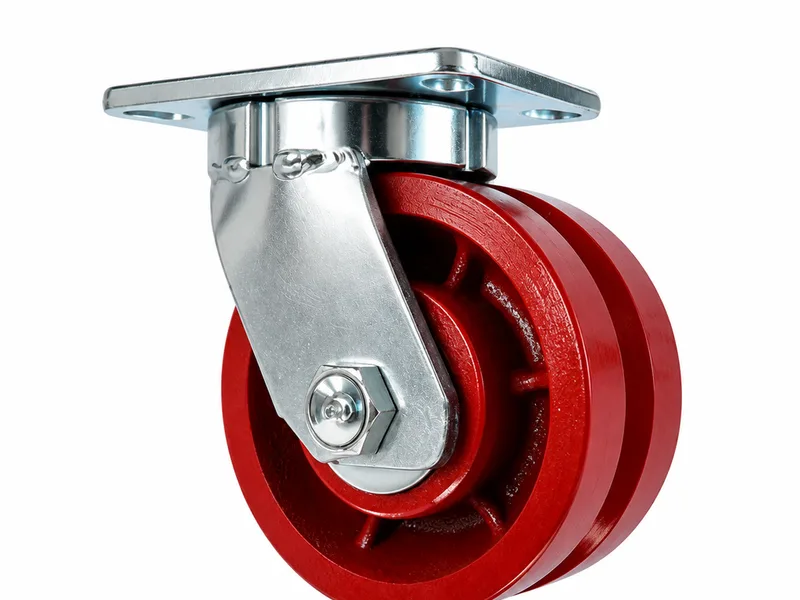
عجلات المسار ذات المجرى الخامسي تتدحرج على مسار الحديد الزاوي المقلوب بدل أرضية الورشة. ويحمل المطب مجرى خامسًا مشغولًا بدقة بزاوية 90 درجة مع مجرى تفريغ عند جذره، يوزّع الحمل على حدّي المسار ويبقي العجلة في المركز دون بكرات توجيه. والعجلة نفسها يمكن أن تعمل أيضًا على الأسطح المستوية، مما يجعلها خيارًا عمليًا للعربات التي تنتقل بين مقطع مسار ثابت وأرضية مكشوفة.
والاستخدامات النموذجية تشمل عربات المواد المركّبة على مسار، والبوابات المنزلقة، وعربات الأفران والمواقد، وعربات خطوط دفع النواقل، وأي تركيب يلزمه تكرار المسار نفسه آلاف المرات. ولأن المسار يحمل العجلة على سكة محددة، تتوقف حالة الأرضية عن كونها العامل المحدّد — فيصبح المحدّدات محاذاة المسار، ومادة العجلة، واختيار المحمل.
المواصفات
| مادة العجلة | مجرى خامسي على حديد زهر |
|---|---|
| مصفوفة أحجام المرجعية للموديلات (جدول القطاع) | VIR-0415-08: 4 × 1-1/2″, 700 lb, 1/2″ محور; VIR-0630-12: 6 × 3″, 3,500 lb, 3/4″ محور; VG 800–3,500 lb, VM 3,500–6,000 lb, VF 6,000–10,000 lb (Ø 4–10″), −40…+350 °F (VG/VM), −40…+800 °F (VF) — صفوف جداول منشورة، قيم مرجعية من الناشر لاختيار الحجم، وليست تصنيفات RollMaster؛ القيمة الملزمة تُعتمد لكل تهيئة في عرض السعر |
| هندسة المجرى | مجرى خامسي مشغول 90° مع مجرى تفريغ لتوزيع الحمل |
| مدى المقاسات | Ø 4–12″ (نطاق فئة المصنّع — بيانات كل مقاس تُثبَّت عند العرض) |
| مرجع أصناف المصنّع (لكل صنف، وليس لنا) | جدول عجلات خامسية لدى مصنّع يسرد أقطارًا من 4 إلى 12″ وعروضًا من 1.5 إلى 3″، ويصنّف عجلته 4″ × 1-1/2″ عند 700 lb وعجلاته 12″ × 3″ عند 6,000 lb (أرقام قطع سلسلة VIR) — قيم الجدول لكل صنف، ولا تكون أبدًا تصنيفات منّا |
| التشطيب السطحي | الجلفنة / طلاء الزنك |
| المسار | مسار حديد زاوي مقلوب؛ وتعمل أيضًا على الأسطح المستوية |
| علامة تجارية من طرف ثالث — تُوفر عبر شبكة التوريد لدينا | قد تستند مراجع المنتجات في هذه الصفحة إلى أكثر من مصدر خارجي. ولا يعني ذكر بائع أو كتالوج أنه الشركة المصنّعة. إذا لم تُحدَّد الشركة المصنّعة الأصلية أو رقم الطراز/القطعة بدقة، فهذه المعلومات غير مؤكدة في هذا الإدراج؛ لذا يُرجى تأكيدهما في عرض السعر المكتوب. وأي مهلة توريد أو حد أدنى للطلب أو ضمان يُعرض بوصفه عرضنا هو شرط عرض سعر من RollMaster، وليس شرطًا منشورًا من الشركة المصنّعة الخارجية. |
| علامة تجارية من طرف ثالث — تُوفر عبر شبكة التوريد لدينا | قد تستند مراجع المنتجات في هذه الصفحة إلى أكثر من مصدر خارجي. ولا يعني ذكر بائع أو كتالوج أنه الشركة المصنّعة. إذا لم تُحدَّد الشركة المصنّعة الأصلية أو رقم الطراز/القطعة بدقة، فهذه المعلومات غير مؤكدة في هذا الإدراج؛ لذا يُرجى تأكيدهما في عرض السعر المكتوب. وأي مهلة توريد أو حد أدنى للطلب أو ضمان يُعرض بوصفه عرضنا هو شرط عرض سعر من RollMaster، وليس شرطًا منشورًا من الشركة المصنّعة الخارجية. |
| علامة تجارية من طرف ثالث — تُوفر عبر شبكة التوريد لدينا | قد تستند مراجع المنتجات في هذه الصفحة إلى أكثر من مصدر خارجي. ولا يعني ذكر بائع أو كتالوج أنه الشركة المصنّعة. إذا لم تُحدَّد الشركة المصنّعة الأصلية أو رقم الطراز/القطعة بدقة، فهذه المعلومات غير مؤكدة في هذا الإدراج؛ لذا يُرجى تأكيدهما في عرض السعر المكتوب. وأي مهلة توريد أو حد أدنى للطلب أو ضمان يُعرض بوصفه عرضنا هو شرط عرض سعر من RollMaster، وليس شرطًا منشورًا من الشركة المصنّعة الخارجية. |
سعة الحمل في الكتالوجات المنشورة تُسعَّر لكل مقاس عجلة (عجلة خامسية حديد زهر 4 بوصة تُصنَّف شائعًا قرب 600 lb؛ والأقطار الأكبر تصنيفها أعلى). تعاملوا مع الأرقام المنشورة كقيم مرجعية لكل مقاس، لا كتصنيف للعائلة كلها — وتُثبَّت قيمة مقاسكم ومحملكم عند العرض.
التطبيقات والاختيار
حيث تكسب العجلات الخامسية مكانتها
المشكلة الهندسية التي تحلها العجلة الخامسية هي تكرار المسار. الكاستر الحر التدحرج على أرضية خشنة ينحرف، وكل انحراف يصححه المشغّل بدفع العربة جانبيًا. وعلى المسار، يشتبك المجرى الخامسي مع الحديد الزاوي فيثبت المسار: العربات تبقى في صفّها في ممرات معتمة، والبوابات تغلق في إطارها نفسه كل دورة، وعربات الأفران تدخل الحجرة دون خدش الجدران.
وحديد الزهر هو مادة النعل القياسية هنا لأن تدحرج المسار يركّز الحمل على حدّين ضيقين — النعل اللين (المطاط، البولي يوريثان) يتسطح ويتلوّى تحت ذلك التحميل الحدي، بينما يقوم حديد الزهر بمقاومته ويتسامح مع حرارة جوار الأفران والمواقد. وحيث يمر المسار عبر مقطع غسيل أو خارجي، تُبطئ الجلفنة تآكل السطح؛ وتبقى العجلة نفسها حديد زهر لأن طلاء نعلٍ يُشغل بعد الطلاء سيهزم الهندسة.
ومجرى التفريغ عند جذر الخامسية أهم مما يبدو. بدونه، يتكدس الحطام المنقول على المسار في قمة المجرى ويرفع العجلة عن مقعدها؛ والتفريغ يمنح ذلك الحطام مخرجًا ويحفظ تماس حدّي الخامسية معًا.
نقاط تحسمها قبل RFQ
مقطع المسار أولًا: اذكروا مقاس الحديد الزاوي وهل هو مركّب رأسه لأعلى. يجب أن يطابق مجرى العجلة زاوية المسار (90° هي القياسية)، وأن يتيح عرض العجلة لساق المسار أن يصعد نحو التفريغ لا أن يستقر في قمة المجرى.
الحمل ثانيًا: اقسموا الوزن الكلي المحمول على عدد العجلات المتقاسمة فعليًا — في عربة مسار رباعية ذلك عادةً ثلاثة، لأن المحاذاة لا تكتمل أبدًا. وسعة عجلات حديد الزهر تتناسب مع القطر وعرض النعل؛ ومنطق التحجيم هو ذاته وراء دليلنا لحساب سعة حمل الكاستر.
المحامل والبيئة أخيرًا: المحامل الأسطوانية المستقيمة تحمل أكثر ويسامح أشد الدفعات البطيئة الثقيلة؛ ومحامل الكريات تتدحرج أسهل للعربات المدفوعة يدويًا. ولجوار الأفران أو المواقد، افحصوا حد حرارة المحمل بقدر مادة العجلة — المحمل عادةً أول مكوّن يسقّف حرارة الخدمة.
Keep catalogue test conditions separate from the customer route. Elesa+Ganter describes an industrial dynamic test at 1.1 m/s (4 km/h), over 500 obstacles and 15,000 wheel revolutions, with 100 mm obstacle width and height set at 5% of wheel diameter for elastic treads up to 90 Shore A or 2.5% for harder treads, on a smooth, hard, horizontal floor. Those are the stated test conditions for the referenced standard, not a promise that a caster will cross a taller real threshold, a sharp edge, a gap, a ramp transition or an obstacle at an angle. Ask for the exact standard, wheel hardness category, test speed and complete caster configuration behind the quoted rating.
For powered towing, do not carry a 4 km/h dynamic rating into a faster application by assumption. Elesa+Ganter states that its cited dynamic rating normally refers to speeds up to 4 km/h and that higher towing speeds require a capacity correction because wheel-material performance changes with speed. The correction is wheel- and series-specific; obtain the selected manufacturer’s speed/load table or written rating for the actual speed, duty cycle, starts/stops and turning profile. A precision-bearing option or a larger wheel is not, by itself, proof of a higher-speed rating.
Validate the worst normal route with the equipment loaded to its maximum working condition. Include starting from rest at the obstacle, repeated crossings, turning immediately before or after the joint, braking, and the most adverse caster position. Record push/pull or drawbar force if ergonomics or tow effort is a requirement, then inspect tread damage, bearing play, fastener movement, bracket deformation and floor damage. A clean-floor rolling test cannot substitute for a representative route trial.
Comparing polyurethane wheel models: tread hardness, speed and the exact SKU
“Polyurethane” is not a complete wheel specification. Compare the named compound and hardness, wheel-centre material and reinforcement, exact diameter and tread width, bearing and hub dimensions, and the load rating at the intended speed. Blickle’s catalogue provides a useful like-for-like illustration: its ALST wheel uses 75 Shore A Softhane® polyurethane on a die-cast aluminium centre, while its ALB uses 92 Shore A Besthane® on an aluminium centre. Both are ball-bearing wheel families, but their ratings and operating envelopes are not interchangeable.
For example, Blickle ALST 150/20K and ALB 150/20K are both 150 mm diameter × 50 mm wide, with a 20 mm axle bore, 60 mm hub length and ball bearing. The ALST is listed at 500 kg at 4 km/h and 200 kg at 10 km/h; the ALB is listed at 650 kg at 4 km/h, 320 kg at 10 km/h and 240 kg at 16 km/h. This is a manufacturer-specific comparison, not proof that harder PU always carries more load: the compound, tread construction, test basis and exact wheel configuration belong to the named series.
A second useful check is the reinforced suffix. Blickle marks ALB 152/20K, ALB 162/20K and ALB 202/20K with an asterisk for a heavy-duty reinforced wheel centre. Do not collapse these into the base ALB model even where diameter is shared: for example, ALB 152/20K is 150 × 54 mm and listed at 900 kg at 4 km/h, while ALB 150/20K is 150 × 50 mm and listed at 650 kg. Width, hub/bore and reinforced centre are part of the SKU, not optional details to infer from diameter.
Use the matrix as a buyer comparison reference only. It does not establish a RollMaster equivalent, a complete caster rating, a static rating, a bracket capacity or a supplier stock commitment. For any separately identified RollMaster own-production core line, model cells are published only after the matching factory drawing, BOM and rating/test record are available; other manufacturers’ models remain identified by their original maker and part number.
Albion 16 Series pneumatic models: choosing tire width, load and mounting envelope
The Albion 16 Series catalogue gives a useful six-row model ladder for buyers who need a compact pneumatic caster rather than the larger 72 Series rig. Its nominal options span 6 × 2 in at 200 lb, 8 × 2 in at 210 lb, 8 × 2-1/2 in at 220 lb, 8 × 2-3/4 in at 295 lb, 10 × 4-1/8 in at 350 lb and 12 × 4-1/8 in at 445 lb. This makes the 8-inch nominal diameter a particularly important comparison point: changing tread width and tire construction changes the catalogue load class from 210 to 295 lb, while the mount height changes from 9-1/2 to 11 in. Do not attribute that increase to diameter alone.
The catalogue identifies the 16 Series plate as 4-1/2 × 4 in, with 3-5/8 × 2-5/8 in hole-centre spacing and 3/8 in attaching bolts. The table also gives nominal mount height and nominal swivel radius for each configuration. Treat these as the published Albion 16 Series mounting references; before drilling or replacing an installed caster, confirm the exact suffix, slot geometry, plate revision and full loaded swivel sweep against the current drawing. A shared series plate does not prove that every aftermarket plate or mounting hole is interchangeable.
The manufacturer table lists 50 PSI as maximum air pressure for these six tire configurations, not as the target pressure for every payload. The correct operating pressure must come from the exact tire instructions and load condition. It also states that load ratings are based on walking speed; a powered-tow application needs an engineering-confirmed rating for speed, duty cycle, starts/stops and turning. Do not convert a walking-speed capacity into a tow rating.
Bearing options are configuration-specific. Albion lists industrial ball bearings as standard and roller-bearing alternatives for the 8 × 2-1/2, 8 × 2-3/4 and 10 × 4-1/8 in rows; its catalogue instructs changing the bearing code 27 to 01 for the straight-roller variants. Do not assume every size has a roller-bearing option. The listed brake part numbers also differ: the 6 × 2 and 8 × 2 in rows use the SFBA brake suffix, while the wider 8, 10 and 12 in rows use the SF suffix. Verify the exact brake assembly and mounting clearance on the supplier drawing.
Albion catalogue dimensions are nominal tire sizes. Its individual product records market some exact models using larger measured wheel diameters—for example, 16SF08527S is shown as 9 × 2.8 in, 16SF10627S as 10.9 × 4.1 in and 16SF12727S as 13 × 4.1 in. Preserve the distinction between catalogue nominal size and individual product-page dimensions; never overwrite one convention with the other or assume the numbers describe a different model. All of these are Albion third-party reference configurations supplied through coordinated procurement, not RollMaster-manufactured products.
Compare same-size TPR wheel options before choosing
At 4 × 1-1/4 in, QMIR4G3-T is listed at 250 lb and Shore A 95 (±5), while QMIR4G3 is listed at 320 lb and Shore A 65 (±5); both use ball bearings and a 3/8 in accepted axle/bearing ID. The different hardness and capacity mean they should not be treated as interchangeable from diameter alone.
At 5 × 1-1/4 in, R5203A-TPR is 250 lb with 5/16 in ball bearings; R5283B is 300 lb with ball bearings and a flat tread; GCL50793A is 325 lb with a bushing and 5/8 in accepted axle/bearing ID; QMIR5G3 is 350 lb with ball bearings and a 3/8 in accepted axle/bearing ID. Check bearing fit, tread profile and mounting geometry before substitution.
For a wider tread, G5.00004.456.2 is 4 × 2 in / 400 lb and G5.00005.456.2 is 5 × 2 in / 500 lb; both are listed with a 1-3/16 in plain bore and bearing options that vary by selection. The 6 × 1-1/4 in 8009903 (bushing) and R6193B (ball bearing) are both listed at 300 lb but use different axle/bearing fits and hardness scales. These are wheel-item references, not complete caster ratings.
Selection points to settle before you RFQ
Track geometry first: provide the rail manufacturer\'s section drawing or a dimensioned cross-section, including included angle, leg lengths, thickness, apex/root radius, weld beads and any wear or coating build-up. Then match the wheel\'s included groove angle, opening width and depth to that profile. A nominal 90-degree groove alone is insufficient: manufacturers publish groove width/depth as separate dimensions and show different groove profiles for different angle-iron sizes. Check that the rail seats without bottoming at the apex or riding on an unintended edge, and verify clearance through the full travel.
Load and rail layout next: calculate the load at each wheel from the actual support geometry and worst credible load distribution; do not assume that every four-wheel rail cart always shares load across exactly three wheels. For a two-rail system, check rail spacing, parallelism, elevation and straightness over the full travel. RWM specifically warns that inverted angle rails must be parallel for smooth, constant tracking and notes that, in some layouts, one V-guided side with a flat-faced wheel running on flat bar on the other side may be advisable. That is a layout option to engineer, not a universal prescription.
Bearings and environment last: straight roller bearings carry the most and tolerate slow, heavy pushes; ball bearings roll easier for hand-pushed carts. For oven or kiln surroundings, check the bearing temperature limit as well as the wheel material — the bearing is usually the first component to limit service temperature.
الأسئلة الشائعة
هل العجلات الخامسية هي عجلات المسار ذات الحافة أم عجلات النواقل الخامسية؟
لا، والأسماء تختلط في البحث. عجلة المسار الخامسية لها مجرى 90 درجة مشغول في مطب أسطواني وتتدحرج على حديد زاوي مقلوب. وعجلة الحافة لها شفرة مرتفعة تجري على جانب السكة. و«عجلة الناقل الخامسية» غالبًا عجلة مكبوسة أخف بكثير لخطوط النواقل الجاذبة. وعند RFQ، اذكروا مقطع المسار الذي تعملون عليه — ذلك يفكك النوع أسرع من أي اسم.
ما مقاس العجلة الخامسية الذي أحتاجه لحملتي؟
احجموا من الحمل لكل عجلة وواجب التشغيل. التصنيفات المنشورة لكل مقاس عجلة (عجلة خامسية حديد زهر 4 بوصة تُدرج شائعًا قرب 600 lb؛ والتصنيفات ترتقي بالقطر). اقسموا الحمل الكلي على ثلاثة لعربة رباعية على مسار ناقص، ثم اختاروا القطر الأعلى التالي لمسار خشن أو متسخ ودورات متصلة. وتُثبَّت قيمة مقاسكم ومحملكم وسرعتكم عند العرض قبل تأكيد الطلب.
ماذا يجب أن يتضمن RFQ العجلات الخامسية؟
قطر العجلة وعرض النعل، وزاوية المجرى (90° قياسية)، ومقاس مقطع المسار واتجاهه، والحمل لكل عجلة، ونوع المحمل، والبيئة (حرارة، غسيل، حطام)، والكمية لكل مقاس. وصورة أو رسمة مقطع المسار تختصر التسعير أكثر من أي شيء، لأن ملاءمة المجرى للمسار هي التفصيل الأكثر خطأً في جولات RFQ الأولى.
الطلب والمستندات
المستندات
يُشحن كل طلب مع قائمة تغليف وفاتورة تجارية. وللمشتريات المشروعية نوفر رسومات أبعاد مقطع العجلة (زاوية المجرى، العرض، الصُّرّة والثقب) عند الطلب، ليُفحص صانع مساراتكم الملاءمة قبل الإنتاج. وبيانات المادة والتشطيب تُسعَّر لكل طلب.
عرض السعر
يحتاج العرض إلى: القطر، وعرض النعل، وزاوية المجرى، ونوع المحمل، والحمل لكل عجلة، والبيئة، والكمية المستهدفة. وتُثبَّت تصنيفات الحمل لكل مقاس وأي أبعاد مجرى خاصة في عرض السعر — أرقام الكتالوجات المنشورة قيم مرجعية للتحجيم، لا التزام الطلب.
العينات والتوريد
تُنتج مقاسات الكتالوج القياسية بالطلب بحد أدنى 200 قطعة؛ ويمكن في بعض المقاسات شحن كميات تجريبية أصغر من أصناف الكتالوج — اسألوا مع RFQ. ومدة التسليم 15–20 يومًا للتشكيلات القياسية و30–40 يومًا لأعمال المجرى أو الثقب المخصصة. وتُشحن العينات بأسعاف النقل على حساب المستلم وتُرد قيمتها مقابل طلب بالجملة.
التخزين والشحن
عجلات حديد الزهر متينة ميكانيكيًا لكن المجرى المشغول ومقاعد المحامل ينبغي حمايتهما: خزّنوا داخل المباني، وأبقوا المجرى خاليًا من الحصى قبل التركيب، ولا تكدّسوا العجلات مجرىً على مجرى دون فواصل. وفي التخزين الساحلي أو الرطب، أبقوا الأسطح المُجلفنة جافة داخل كراتينها؛ وتبقى المحامل بشحمها الأصلي حتى التركيب.