
Koła torowe z rowkiem V — koła żeliwne na torze z kątownika
Marka zewnętrzna — dostarczana za pośrednictwem naszej sieci zakupów
Informacje o produktach na tej stronie mogą pochodzić z kilku źródeł zewnętrznych. Sprzedawca lub katalog nie musi być producentem. Jeśli nie wskazano pierwotnego producenta lub dokładnego numeru modelu/części, informacja ta nie jest zweryfikowana w tym wpisie; należy potwierdzić oba elementy w pisemnej ofercie. Każdy termin dostawy, minimalna ilość zamówienia lub gwarancja przedstawione jako nasza oferta stanowią warunek oferty RollMaster, a nie opublikowany warunek producenta zewnętrznego.
Zaktualizowano 2026-11
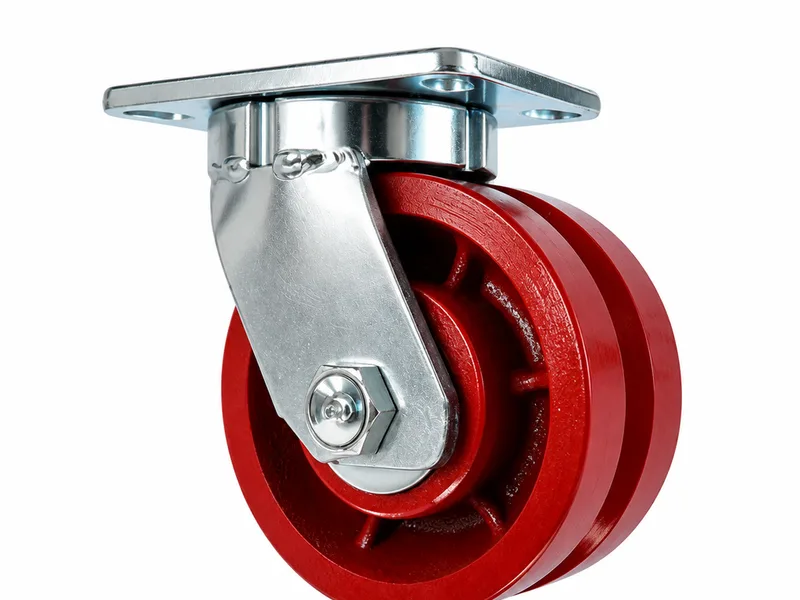
Koła torowe z rowkiem V toczą się po odwróconym torze z kątownika zamiast po hali. Bieżnik ma precyzyjnie obrobiony rowek V pod kątem 90 stopni z rowkiem ulgowym u jego podstawy, który wyrównuje obciążenie na obu krawędziach toru i utrzymuje koło wyśrodkowane bez rolek prowadzących. To samo koło może też jeździć po płaskich powierzchniach, co czyni je praktycznym wyborem dla wózków jeżdżących między stałym odcinkiem toru a otwartą halą.
Typowe zastosowania obejmują wózki materiałowe na torze, bramy przesuwne, wózki piecowe i komorowe, wózki linii pchanych przenośników oraz każdy osprzęt, który musi powtarzać tę samą trasę tysiące razy. Bo to tor niesie koło na zdefiniowanej szynie, stan podłogi przestaje być czynnikiem granicznym — czynnikami granicznymi stają się ustawienie toru, materiał koła i wybór łożyska.
Dane techniczne
| Materiał koła | Rowek V w żeliwie |
|---|---|
| Macierz referencyjna rozmiarów modeli (tabela branżowa) | VIR-0415-08: 4 × 1-1/2 in, 700 lb, 1/2 in oś; VIR-0630-12: 6 × 3 in, 3,500 lb, 3/4 in oś; VG 800–3,500 lb, VM 3,500–6,000 lb, VF 6,000–10,000 lb (Ø 4–10 in), −40…+350 °F (VG/VM), −40…+800 °F (VF) — opublikowane wiersze tabel, referencja wydawcy do doboru rozmiaru, nie wartości nominalne RollMaster; wartość wiążąca potwierdzana jest per konfiguracja w wycenie |
| Geometria rowka | Obrobiony rowek V 90° z rowkiem ulgowym do wyrównania obciążenia |
| Zakres rozmiarów | Ø 4–12 in (zakres kategorii producenta — dane per rozmiar potwierdzane w ofercie) |
| Referencja SKU producenta (per SKU, nie nasza) | Tabela kół producenta z rowkiem V podaje średnice kół od 4 do 12 in i szerokości od 1,5 do 3 in, klasyfikując koło 4 in × 1-1/2 in na 700 lb, a koła 12 in × 3 in na 6000 lb (numery katalogowe serii VIR) — wartości tabeli per SKU, nigdy nasze nośności |
| Wykończenie powierzchni | Cynkowanie |
| Tor | Odwrócony tor z kątownika; jeździ także po płaskich powierzchniach |
| Marka zewnętrzna — dostarczana za pośrednictwem naszej sieci zakupów | Informacje o produktach na tej stronie mogą pochodzić z kilku źródeł zewnętrznych. Sprzedawca lub katalog nie musi być producentem. Jeśli nie wskazano pierwotnego producenta lub dokładnego numeru modelu/części, informacja ta nie jest zweryfikowana w tym wpisie; należy potwierdzić oba elementy w pisemnej ofercie. Każdy termin dostawy, minimalna ilość zamówienia lub gwarancja przedstawione jako nasza oferta stanowią warunek oferty RollMaster, a nie opublikowany warunek producenta zewnętrznego. |
| Minimalne zamówienie | 200 sztuk (artykuły katalogowe standardowe wysyłane także w mniejszych ilościach) |
| Marka zewnętrzna — dostarczana za pośrednictwem naszej sieci zakupów | Informacje o produktach na tej stronie mogą pochodzić z kilku źródeł zewnętrznych. Sprzedawca lub katalog nie musi być producentem. Jeśli nie wskazano pierwotnego producenta lub dokładnego numeru modelu/części, informacja ta nie jest zweryfikowana w tym wpisie; należy potwierdzić oba elementy w pisemnej ofercie. Każdy termin dostawy, minimalna ilość zamówienia lub gwarancja przedstawione jako nasza oferta stanowią warunek oferty RollMaster, a nie opublikowany warunek producenta zewnętrznego. |
Nośność w opublikowanych katalogach jest podawana per rozmiar koła (żeliwne koło z rowkiem V o średnicy 4 cale jest powszechnie klasyfikowane około 600 lb; większe średnice klasyfikowane są wyżej). Traktujcie opublikowane liczby jako wartości referencyjne per rozmiar, nie nośność całej rodziny — nośność dla Państwa rozmiaru i łożyska jest potwierdzana w ofercie.
Zastosowania i dobór
Gdzie koła z rowkiem V się sprawdzają
Problemem inżynierskim, który rozwiązuje koło z rowkiem V, jest powtarzalność trasy. Wolno toczące się kółko na nierównej podłodze dryfuje, a każdy dryf jest korygowany przez operatora pchającego wózek bokiem. Na torze rowek V zaczepia o kątownik i trasa jest ustalona: wózki trzymają linię w ciemnych alejkach, bramy zamykają się w tę samą ramę przy każdym cyklu, a wózki piecowe wjeżdżają do komory bez szurania o ściany.
Żeliwo jest tutaj standardowym materiałem bieżnika, bo toczenie po torze koncentruje obciążenie na dwóch wąskich krawędziach — miękki bieżnik (guma, poliuretan) spłaszcza się i wykręca pod takim obciążeniem krawędziowym, a żeliwo mu się opiera i znosi ciepło otoczenia pieców i wypalarek. Tam, gdzie tor przechodzi przez sekcję mytą lub zewnętrzną, wykończenie cynkowane spowalnia korozję powierzchniową; samo koło pozostaje żeliwne, bo cynkowanie bieżnika obrobionego po cynkowaniu zniweczyłoby geometrię.
Rowek ulgowy u podstawy V znaczy więcej, niż wygląda. Bez niego gruz niesiony wzdłuż toru pakuje się w wierzchołek rowka i podnosi koło z jego gniazda; rowek ulgowy daje temu gruzu gdzieś uciec i utrzymuje kontakt obu krawędzi V.
Kwestie do rozstrzygnięcia przed zapytaniem ofertowym
Najpierw przekrój toru: podajcie rozmiar kątownika i to, czy jest zamontowany ostrzem do góry. Rowek koła musi pasować do kąta toru (90° to standard), a szerokość koła musi pozwolić ramieniu kątownika wjechać w rowek ulgowy, a nie oprzeć się o wierzchołek rowka.
Potem obciążenie: podzielcie niesioną masę przez liczbę kół faktycznie ją niosących — przy wózku torowym czterokołowym to zwykle trzy, bo ustawienie nigdy nie jest idealne. Nośność kół żeliwnych rośnie ze średnicą i szerokością bieżnika; logika wymiarowania to ta sama, która stoi za naszym przewodnikiem obliczania nośności kółek.
Łożyska i środowisko na końcu: łożyska wałeczkowe prośnie niosą najwięcej i znoszą wolne, ciężkie pchanie; łożyska kulkowe toczą się łatwiej dla wózków pchanych ręcznie. Dla otoczenia pieców lub wypalarek sprawdźcie granicę temperatury łożyska razem z materiałem koła — to zwykle łożysko jest pierwszym elementem ograniczającym temperaturę pracy.
Keep catalogue test conditions separate from the customer route. Elesa+Ganter describes an industrial dynamic test at 1.1 m/s (4 km/h), over 500 obstacles and 15,000 wheel revolutions, with 100 mm obstacle width and height set at 5% of wheel diameter for elastic treads up to 90 Shore A or 2.5% for harder treads, on a smooth, hard, horizontal floor. Those are the stated test conditions for the referenced standard, not a promise that a caster will cross a taller real threshold, a sharp edge, a gap, a ramp transition or an obstacle at an angle. Ask for the exact standard, wheel hardness category, test speed and complete caster configuration behind the quoted rating.
For powered towing, do not carry a 4 km/h dynamic rating into a faster application by assumption. Elesa+Ganter states that its cited dynamic rating normally refers to speeds up to 4 km/h and that higher towing speeds require a capacity correction because wheel-material performance changes with speed. The correction is wheel- and series-specific; obtain the selected manufacturer’s speed/load table or written rating for the actual speed, duty cycle, starts/stops and turning profile. A precision-bearing option or a larger wheel is not, by itself, proof of a higher-speed rating.
Validate the worst normal route with the equipment loaded to its maximum working condition. Include starting from rest at the obstacle, repeated crossings, turning immediately before or after the joint, braking, and the most adverse caster position. Record push/pull or drawbar force if ergonomics or tow effort is a requirement, then inspect tread damage, bearing play, fastener movement, bracket deformation and floor damage. A clean-floor rolling test cannot substitute for a representative route trial.
Comparing polyurethane wheel models: tread hardness, speed and the exact SKU
“Polyurethane” is not a complete wheel specification. Compare the named compound and hardness, wheel-centre material and reinforcement, exact diameter and tread width, bearing and hub dimensions, and the load rating at the intended speed. Blickle’s catalogue provides a useful like-for-like illustration: its ALST wheel uses 75 Shore A Softhane® polyurethane on a die-cast aluminium centre, while its ALB uses 92 Shore A Besthane® on an aluminium centre. Both are ball-bearing wheel families, but their ratings and operating envelopes are not interchangeable.
For example, Blickle ALST 150/20K and ALB 150/20K are both 150 mm diameter × 50 mm wide, with a 20 mm axle bore, 60 mm hub length and ball bearing. The ALST is listed at 500 kg at 4 km/h and 200 kg at 10 km/h; the ALB is listed at 650 kg at 4 km/h, 320 kg at 10 km/h and 240 kg at 16 km/h. This is a manufacturer-specific comparison, not proof that harder PU always carries more load: the compound, tread construction, test basis and exact wheel configuration belong to the named series.
A second useful check is the reinforced suffix. Blickle marks ALB 152/20K, ALB 162/20K and ALB 202/20K with an asterisk for a heavy-duty reinforced wheel centre. Do not collapse these into the base ALB model even where diameter is shared: for example, ALB 152/20K is 150 × 54 mm and listed at 900 kg at 4 km/h, while ALB 150/20K is 150 × 50 mm and listed at 650 kg. Width, hub/bore and reinforced centre are part of the SKU, not optional details to infer from diameter.
Use the matrix as a buyer comparison reference only. It does not establish a RollMaster equivalent, a complete caster rating, a static rating, a bracket capacity or a supplier stock commitment. For any separately identified RollMaster own-production core line, model cells are published only after the matching factory drawing, BOM and rating/test record are available; other manufacturers’ models remain identified by their original maker and part number.
Albion 16 Series pneumatic models: choosing tire width, load and mounting envelope
The Albion 16 Series catalogue gives a useful six-row model ladder for buyers who need a compact pneumatic caster rather than the larger 72 Series rig. Its nominal options span 6 × 2 in at 200 lb, 8 × 2 in at 210 lb, 8 × 2-1/2 in at 220 lb, 8 × 2-3/4 in at 295 lb, 10 × 4-1/8 in at 350 lb and 12 × 4-1/8 in at 445 lb. This makes the 8-inch nominal diameter a particularly important comparison point: changing tread width and tire construction changes the catalogue load class from 210 to 295 lb, while the mount height changes from 9-1/2 to 11 in. Do not attribute that increase to diameter alone.
The catalogue identifies the 16 Series plate as 4-1/2 × 4 in, with 3-5/8 × 2-5/8 in hole-centre spacing and 3/8 in attaching bolts. The table also gives nominal mount height and nominal swivel radius for each configuration. Treat these as the published Albion 16 Series mounting references; before drilling or replacing an installed caster, confirm the exact suffix, slot geometry, plate revision and full loaded swivel sweep against the current drawing. A shared series plate does not prove that every aftermarket plate or mounting hole is interchangeable.
The manufacturer table lists 50 PSI as maximum air pressure for these six tire configurations, not as the target pressure for every payload. The correct operating pressure must come from the exact tire instructions and load condition. It also states that load ratings are based on walking speed; a powered-tow application needs an engineering-confirmed rating for speed, duty cycle, starts/stops and turning. Do not convert a walking-speed capacity into a tow rating.
Bearing options are configuration-specific. Albion lists industrial ball bearings as standard and roller-bearing alternatives for the 8 × 2-1/2, 8 × 2-3/4 and 10 × 4-1/8 in rows; its catalogue instructs changing the bearing code 27 to 01 for the straight-roller variants. Do not assume every size has a roller-bearing option. The listed brake part numbers also differ: the 6 × 2 and 8 × 2 in rows use the SFBA brake suffix, while the wider 8, 10 and 12 in rows use the SF suffix. Verify the exact brake assembly and mounting clearance on the supplier drawing.
Albion catalogue dimensions are nominal tire sizes. Its individual product records market some exact models using larger measured wheel diameters—for example, 16SF08527S is shown as 9 × 2.8 in, 16SF10627S as 10.9 × 4.1 in and 16SF12727S as 13 × 4.1 in. Preserve the distinction between catalogue nominal size and individual product-page dimensions; never overwrite one convention with the other or assume the numbers describe a different model. All of these are Albion third-party reference configurations supplied through coordinated procurement, not RollMaster-manufactured products.
Compare same-size TPR wheel options before choosing
At 4 × 1-1/4 in, QMIR4G3-T is listed at 250 lb and Shore A 95 (±5), while QMIR4G3 is listed at 320 lb and Shore A 65 (±5); both use ball bearings and a 3/8 in accepted axle/bearing ID. The different hardness and capacity mean they should not be treated as interchangeable from diameter alone.
At 5 × 1-1/4 in, R5203A-TPR is 250 lb with 5/16 in ball bearings; R5283B is 300 lb with ball bearings and a flat tread; GCL50793A is 325 lb with a bushing and 5/8 in accepted axle/bearing ID; QMIR5G3 is 350 lb with ball bearings and a 3/8 in accepted axle/bearing ID. Check bearing fit, tread profile and mounting geometry before substitution.
For a wider tread, G5.00004.456.2 is 4 × 2 in / 400 lb and G5.00005.456.2 is 5 × 2 in / 500 lb; both are listed with a 1-3/16 in plain bore and bearing options that vary by selection. The 6 × 1-1/4 in 8009903 (bushing) and R6193B (ball bearing) are both listed at 300 lb but use different axle/bearing fits and hardness scales. These are wheel-item references, not complete caster ratings.
Selection points to settle before you RFQ
Track geometry first: provide the rail manufacturer\'s section drawing or a dimensioned cross-section, including included angle, leg lengths, thickness, apex/root radius, weld beads and any wear or coating build-up. Then match the wheel\'s included groove angle, opening width and depth to that profile. A nominal 90-degree groove alone is insufficient: manufacturers publish groove width/depth as separate dimensions and show different groove profiles for different angle-iron sizes. Check that the rail seats without bottoming at the apex or riding on an unintended edge, and verify clearance through the full travel.
Load and rail layout next: calculate the load at each wheel from the actual support geometry and worst credible load distribution; do not assume that every four-wheel rail cart always shares load across exactly three wheels. For a two-rail system, check rail spacing, parallelism, elevation and straightness over the full travel. RWM specifically warns that inverted angle rails must be parallel for smooth, constant tracking and notes that, in some layouts, one V-guided side with a flat-faced wheel running on flat bar on the other side may be advisable. That is a layout option to engineer, not a universal prescription.
Bearings and environment last: straight roller bearings carry the most and tolerate slow, heavy pushes; ball bearings roll easier for hand-pushed carts. For oven or kiln surroundings, check the bearing temperature limit as well as the wheel material — the bearing is usually the first component to limit service temperature.
Często zadawane pytania
Czy koła z rowkiem V to to samo co koła torowe z obrzeżem albo koła przenośnikowe z rowkiem V?
Nie, a nazwy mieszają się w wyszukiwarkach. Koło torowe z rowkiem V ma rowek 90-stopniowy obrobiony w walcowym bieżniku i toczy się po odwróconym kątowniku. Koło z obrzeżem ma podniesioną rant pracującą o bok szyny. "Koło przenośnikowe z rowkiem V" to często znacznie lżejsze koło tłoczone dla linii przenośników grawitacyjnych. Składając RFQ, podajcie przekrój toru, po którym jeździcie — to rozstrzyga typ szybciej niż jakakolwiek nazwa.
Jakiego rozmiaru koła z rowkiem V potrzebuję dla mojego obciążenia?
Wymiarujcie z obciążenia na koło i pracy. Opublikowane nośności są per rozmiar koła (żeliwne koło z rowkiem V o średnicy 4 cale jest powszechnie podawane około 600 lb; nośności rosną ze średnicą). Podzielcie masę całkowitą przez trzy dla wózka czterokołowego na niedoskonałym torze, potem wybierzcie następny rozmiar wyżej dla toru surowego lub brudnego i ciągłego cyklowania. Dokładna nośność dla Państwa rozmiaru, łożyska i prędkości jest potwierdzana w ofercie przed potwierdzeniem zamówienia.
Co powinna zawierać moja RFQ na koła z rowkiem V?
Średnicę koła i szerokość bieżnika, kąt rowka (90° standard), rozmiar i orientację przekroju toru, obciążenie na koło, typ łożyska, środowisko (temperatura, mycie, gruz) oraz ilość na rozmiar. Zdjęcie albo rysunek przekroju toru skraca wycenę najbardziej, bo dopasowanie rowka do toru to szczegół najczęściej podany źle w pierwszych rundach RFQ.
Zamówienia i dokumentacja
Dokumenty
Każde zamówienie jest wysyłane z listą pakową i fakturą handlową. Dla zakupów projektowych możemy na życzenie dostarczyć rysunki wymiarowe przekroju koła (kąt rowka, szerokość, piasta i otwór), aby Państwa wytwórca toru mógł sprawdzić dopasowanie przed produkcją. Deklaracje materiałowe i wykończeniowe są wyceniane per zamówienie.
Oferta
Do oferty potrzebne są: średnica, szerokość bieżnika, kąt rowka, typ łożyska, obciążenie na koło, środowisko i docelowa ilość. Nośności per rozmiar i ewentualne specjalne wymiary rowka są potwierdzane w ofercie — opublikowane liczby katalogowe to wartości referencyjne wymiarowania, nie zobowiązanie zamówienia.
Próbki i dostawy
Marka zewnętrzna — dostarczana za pośrednictwem naszej sieci zakupów. Informacje o produktach na tej stronie mogą pochodzić z kilku źródeł zewnętrznych. Sprzedawca lub katalog nie musi być producentem. Jeśli nie wskazano pierwotnego producenta lub dokładnego numeru modelu/części, informacja ta nie jest zweryfikowana w tym wpisie; należy potwierdzić oba elementy w pisemnej ofercie. Każdy termin dostawy, minimalna ilość zamówienia lub gwarancja przedstawione jako nasza oferta stanowią warunek oferty RollMaster, a nie opublikowany warunek producenta zewnętrznego.
Magazynowanie i wysyłka
Koła żeliwne są mechanicznie wytrzymałe, ale obrobiony rowek i gniazda łożysk powinny być chronione: przechowywać w pomieszczeniach, trzymać rowek wolny od grubu przed montażem i nie układać kół rowek-do-rowka bez przekładek. W magazynie nadmorskim lub wilgotnym trzymać powierzchnie cynkowane suche i w kartonach; łożyska powinny pozostać w fabrycznym smarze do montażu.