
V 形槽軌道輪 — 行走角鋼軌道的鑄鐵輪
第三方品牌——經由我們的採購網絡供貨
本頁產品參考資料可能來自多個第三方來源。賣方或目錄發布者不一定是製造商。若未標明原始製造商或確切型號/零件編號,本頁不視為已核實;請在書面報價中確認兩者。任何以我方報價條件列出的交期、最低訂購量或保固,均屬 RollMaster 的報價條件,而非第三方製造商公布的條件。
更新 2026-11
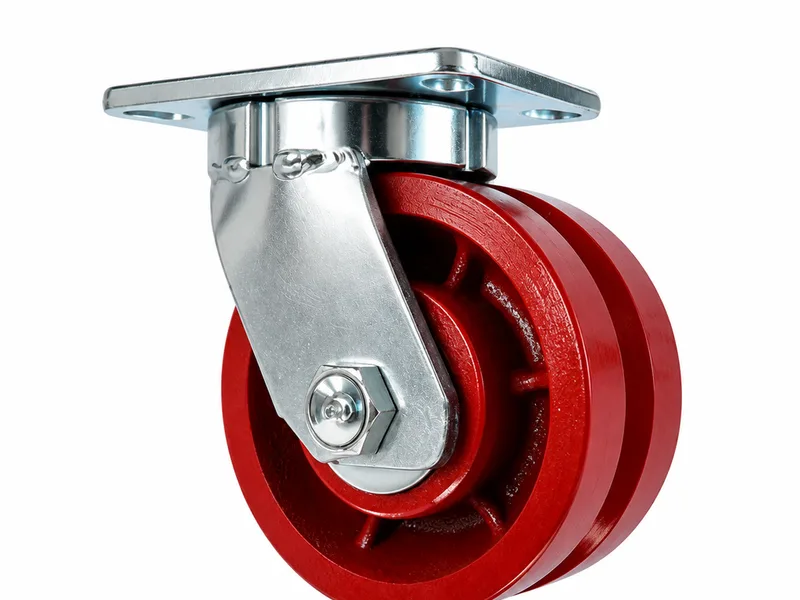
V 形槽軌道輪行走於倒置角鋼軌道,而非廠區地面。胎面上有一道精密加工的 90 度 V 形槽,槽底設有避位槽,使負載均勻分布在軌道兩側稜線上,且不需導向滾輪即可讓輪子保持在軌道中央。同一顆輪子也能在平面上行駛——這讓它成為在固定軌道段與開放地面之間移動的推車的實用選擇。
典型用途包括軌道式物料推車、滑動閘門、窯爐與烤箱台車、輸送推送線台車,以及任何必須數千次重複相同路徑的治具。因為軌道以明確的軌面承載輪子,地面狀況不再是限制因素——限制因素變成軌道對位、輪材與軸承選擇。
規格
| 輪材質 | 鑄鐵上的 V 形槽 |
|---|---|
| 型號尺寸參考矩陣(業界圖表) | VIR-0415-08: 4 × 1-1/2 in, 700 lb, 1/2 in 軸; VIR-0630-12: 6 × 3 in, 3,500 lb, 3/4 in 軸; VG 800–3,500 lb, VM 3,500–6,000 lb, VF 6,000–10,000 lb (Ø 4–10 in), −40…+350 °F (VG/VM), −40…+800 °F (VF) — 已發布圖表的行,為選型用的出版方參考值,並非 RollMaster 額定值;確定額定值依配置於報價時確認 |
| 槽幾何 | 精密加工 90° V 形槽,槽底設避位槽以均勻分布負載 |
| 尺寸範圍 | Ø 4–12 吋(製造商分類範圍——各尺寸數據於報價時確認) |
| 製造商 SKU 參考(單一 SKU,非本廠數據) | 某製造商 V 形槽輪選型表列出輪徑 4 至 12 吋、寬度 1.5 至 3 吋,其 4 吋 × 1-1/2 吋輪額定 700 lb、12 吋 × 3 吋輪額定 6,000 lb(VIR 系列料號)——表列數值按 SKU 分列,絕非供應商額定值 |
| 表面處理 | 鍍鋅 |
| 軌道 | 倒置角鋼軌道;亦可行駛於平面 |
| 第三方品牌——經由我們的採購網絡供貨 | 本頁產品參考資料可能來自多個第三方來源。賣方或目錄發布者不一定是製造商。若未標明原始製造商或確切型號/零件編號,本頁不視為已核實;請在書面報價中確認兩者。任何以我方報價條件列出的交期、最低訂購量或保固,均屬 RollMaster 的報價條件,而非第三方製造商公布的條件。 |
| 第三方品牌——經由我們的採購網絡供貨 | 本頁產品參考資料可能來自多個第三方來源。賣方或目錄發布者不一定是製造商。若未標明原始製造商或確切型號/零件編號,本頁不視為已核實;請在書面報價中確認兩者。任何以我方報價條件列出的交期、最低訂購量或保固,均屬 RollMaster 的報價條件,而非第三方製造商公布的條件。 |
| 第三方品牌——經由我們的採購網絡供貨 | 本頁產品參考資料可能來自多個第三方來源。賣方或目錄發布者不一定是製造商。若未標明原始製造商或確切型號/零件編號,本頁不視為已核實;請在書面報價中確認兩者。任何以我方報價條件列出的交期、最低訂購量或保固,均屬 RollMaster 的報價條件,而非第三方製造商公布的條件。 |
已發布型錄中的承載能力按輪徑報價(4 吋鑄鐵 V 形槽輪通常額定約 600 lb;直徑越大額定越高)。已公布數值應視為單一尺寸的參考值,而非整個家族的額定值——您尺寸與軸承對應的額定值於報價時確認。
應用
V 形槽輪物有所值之處
V 形槽輪解決的工程問題是路徑重複性。自由滾動的腳輪在粗糙地面上會偏移,而每一次偏移都得靠操作人員橫向推正。在軌道上,V 形槽咬住角鋼、路徑就此固定:推車在昏暗走道裡也保持成列,閘門每個循環都閉入同一個門框,窯車進入爐膛時不會刮擦爐壁。
鑄鐵是這裡的標準胎面材料,因為軌道滾動將負載集中在兩條窄稜上——軟質胎面(橡膠、聚氨酯)在這種稜線負載下會壓扁蠕動,鑄鐵則能抵抗並容忍烤箱與窯爐周邊的熱。當軌道穿越沖洗區或戶外段時,鍍鋅表面處理能減緩表面腐蝕;輪體本身維持鑄鐵,因為若胎面須在鍍後加工,鍍層便失去意義、幾何也遭破壞。
V 槽底部的避位槽比看起來更重要。沒有它,沿軌道帶入的碎屑會在槽尖堆積並將輪子頂離座面;避位槽讓碎屑有處可去,使 V 槽兩側稜線保持接觸。
送出 RFQ 前應確定的選型要點
先確定軌道斷面:說明角鋼尺寸以及是否尖角朝上安裝。輪槽必須匹配軌道角度(90° 為標準),且輪寬必須讓軌道翼緣得以爬入避位區,而非觸底於槽尖。
其次是負載:將總承重除以實際分攤的輪數——四輪軌道推車通常按三顆計,因為對位從不完美。鑄鐵輪承載隨直徑與胎面寬變化;選型邏輯與本廠腳輪承載計算指南背後的是同一套。
最後是軸承與環境:直柱滾子軸承承載最大、容忍低速重推;滾珠軸承滾動省力,適合手推推車。烤箱或窯爐周邊應用,除輪材外還須核對軸承溫度極限——通常率先限制使用溫度的是軸承。
Keep catalogue test conditions separate from the customer route. Elesa+Ganter describes an industrial dynamic test at 1.1 m/s (4 km/h), over 500 obstacles and 15,000 wheel revolutions, with 100 mm obstacle width and height set at 5% of wheel diameter for elastic treads up to 90 Shore A or 2.5% for harder treads, on a smooth, hard, horizontal floor. Those are the stated test conditions for the referenced standard, not a promise that a caster will cross a taller real threshold, a sharp edge, a gap, a ramp transition or an obstacle at an angle. Ask for the exact standard, wheel hardness category, test speed and complete caster configuration behind the quoted rating.
For powered towing, do not carry a 4 km/h dynamic rating into a faster application by assumption. Elesa+Ganter states that its cited dynamic rating normally refers to speeds up to 4 km/h and that higher towing speeds require a capacity correction because wheel-material performance changes with speed. The correction is wheel- and series-specific; obtain the selected manufacturer’s speed/load table or written rating for the actual speed, duty cycle, starts/stops and turning profile. A precision-bearing option or a larger wheel is not, by itself, proof of a higher-speed rating.
Validate the worst normal route with the equipment loaded to its maximum working condition. Include starting from rest at the obstacle, repeated crossings, turning immediately before or after the joint, braking, and the most adverse caster position. Record push/pull or drawbar force if ergonomics or tow effort is a requirement, then inspect tread damage, bearing play, fastener movement, bracket deformation and floor damage. A clean-floor rolling test cannot substitute for a representative route trial.
Comparing polyurethane wheel models: tread hardness, speed and the exact SKU
“Polyurethane” is not a complete wheel specification. Compare the named compound and hardness, wheel-centre material and reinforcement, exact diameter and tread width, bearing and hub dimensions, and the load rating at the intended speed. Blickle’s catalogue provides a useful like-for-like illustration: its ALST wheel uses 75 Shore A Softhane® polyurethane on a die-cast aluminium centre, while its ALB uses 92 Shore A Besthane® on an aluminium centre. Both are ball-bearing wheel families, but their ratings and operating envelopes are not interchangeable.
For example, Blickle ALST 150/20K and ALB 150/20K are both 150 mm diameter × 50 mm wide, with a 20 mm axle bore, 60 mm hub length and ball bearing. The ALST is listed at 500 kg at 4 km/h and 200 kg at 10 km/h; the ALB is listed at 650 kg at 4 km/h, 320 kg at 10 km/h and 240 kg at 16 km/h. This is a manufacturer-specific comparison, not proof that harder PU always carries more load: the compound, tread construction, test basis and exact wheel configuration belong to the named series.
A second useful check is the reinforced suffix. Blickle marks ALB 152/20K, ALB 162/20K and ALB 202/20K with an asterisk for a heavy-duty reinforced wheel centre. Do not collapse these into the base ALB model even where diameter is shared: for example, ALB 152/20K is 150 × 54 mm and listed at 900 kg at 4 km/h, while ALB 150/20K is 150 × 50 mm and listed at 650 kg. Width, hub/bore and reinforced centre are part of the SKU, not optional details to infer from diameter.
Use the matrix as a buyer comparison reference only. It does not establish a RollMaster equivalent, a complete caster rating, a static rating, a bracket capacity or a supplier stock commitment. For any separately identified RollMaster own-production core line, model cells are published only after the matching factory drawing, BOM and rating/test record are available; other manufacturers’ models remain identified by their original maker and part number.
Albion 16 Series pneumatic models: choosing tire width, load and mounting envelope
The Albion 16 Series catalogue gives a useful six-row model ladder for buyers who need a compact pneumatic caster rather than the larger 72 Series rig. Its nominal options span 6 × 2 in at 200 lb, 8 × 2 in at 210 lb, 8 × 2-1/2 in at 220 lb, 8 × 2-3/4 in at 295 lb, 10 × 4-1/8 in at 350 lb and 12 × 4-1/8 in at 445 lb. This makes the 8-inch nominal diameter a particularly important comparison point: changing tread width and tire construction changes the catalogue load class from 210 to 295 lb, while the mount height changes from 9-1/2 to 11 in. Do not attribute that increase to diameter alone.
The catalogue identifies the 16 Series plate as 4-1/2 × 4 in, with 3-5/8 × 2-5/8 in hole-centre spacing and 3/8 in attaching bolts. The table also gives nominal mount height and nominal swivel radius for each configuration. Treat these as the published Albion 16 Series mounting references; before drilling or replacing an installed caster, confirm the exact suffix, slot geometry, plate revision and full loaded swivel sweep against the current drawing. A shared series plate does not prove that every aftermarket plate or mounting hole is interchangeable.
The manufacturer table lists 50 PSI as maximum air pressure for these six tire configurations, not as the target pressure for every payload. The correct operating pressure must come from the exact tire instructions and load condition. It also states that load ratings are based on walking speed; a powered-tow application needs an engineering-confirmed rating for speed, duty cycle, starts/stops and turning. Do not convert a walking-speed capacity into a tow rating.
Bearing options are configuration-specific. Albion lists industrial ball bearings as standard and roller-bearing alternatives for the 8 × 2-1/2, 8 × 2-3/4 and 10 × 4-1/8 in rows; its catalogue instructs changing the bearing code 27 to 01 for the straight-roller variants. Do not assume every size has a roller-bearing option. The listed brake part numbers also differ: the 6 × 2 and 8 × 2 in rows use the SFBA brake suffix, while the wider 8, 10 and 12 in rows use the SF suffix. Verify the exact brake assembly and mounting clearance on the supplier drawing.
Albion catalogue dimensions are nominal tire sizes. Its individual product records market some exact models using larger measured wheel diameters—for example, 16SF08527S is shown as 9 × 2.8 in, 16SF10627S as 10.9 × 4.1 in and 16SF12727S as 13 × 4.1 in. Preserve the distinction between catalogue nominal size and individual product-page dimensions; never overwrite one convention with the other or assume the numbers describe a different model. All of these are Albion third-party reference configurations supplied through coordinated procurement, not RollMaster-manufactured products.
Compare same-size TPR wheel options before choosing
At 4 × 1-1/4 in, QMIR4G3-T is listed at 250 lb and Shore A 95 (±5), while QMIR4G3 is listed at 320 lb and Shore A 65 (±5); both use ball bearings and a 3/8 in accepted axle/bearing ID. The different hardness and capacity mean they should not be treated as interchangeable from diameter alone.
At 5 × 1-1/4 in, R5203A-TPR is 250 lb with 5/16 in ball bearings; R5283B is 300 lb with ball bearings and a flat tread; GCL50793A is 325 lb with a bushing and 5/8 in accepted axle/bearing ID; QMIR5G3 is 350 lb with ball bearings and a 3/8 in accepted axle/bearing ID. Check bearing fit, tread profile and mounting geometry before substitution.
For a wider tread, G5.00004.456.2 is 4 × 2 in / 400 lb and G5.00005.456.2 is 5 × 2 in / 500 lb; both are listed with a 1-3/16 in plain bore and bearing options that vary by selection. The 6 × 1-1/4 in 8009903 (bushing) and R6193B (ball bearing) are both listed at 300 lb but use different axle/bearing fits and hardness scales. These are wheel-item references, not complete caster ratings.
Selection points to settle before you RFQ
Track geometry first: provide the rail manufacturer\'s section drawing or a dimensioned cross-section, including included angle, leg lengths, thickness, apex/root radius, weld beads and any wear or coating build-up. Then match the wheel\'s included groove angle, opening width and depth to that profile. A nominal 90-degree groove alone is insufficient: manufacturers publish groove width/depth as separate dimensions and show different groove profiles for different angle-iron sizes. Check that the rail seats without bottoming at the apex or riding on an unintended edge, and verify clearance through the full travel.
Load and rail layout next: calculate the load at each wheel from the actual support geometry and worst credible load distribution; do not assume that every four-wheel rail cart always shares load across exactly three wheels. For a two-rail system, check rail spacing, parallelism, elevation and straightness over the full travel. RWM specifically warns that inverted angle rails must be parallel for smooth, constant tracking and notes that, in some layouts, one V-guided side with a flat-faced wheel running on flat bar on the other side may be advisable. That is a layout option to engineer, not a universal prescription.
Bearings and environment last: straight roller bearings carry the most and tolerate slow, heavy pushes; ball bearings roll easier for hand-pushed carts. For oven or kiln surroundings, check the bearing temperature limit as well as the wheel material — the bearing is usually the first component to limit service temperature.
常見問題
V 形槽輪與凸緣軌道輪或 V 形槽輸送輪是同一種東西嗎?
不是,但搜尋時這些名稱常被混用。V 形槽軌道輪在圓柱形胎面上加工出一道 90 度槽,行走於倒置角鋼。凸緣輪則是以凸起輪緣抵住軌道側面。「V 形槽輸送輪」通常指重力輸送線上輕得多的沖壓輪。RFQ 時請說明您行走的軌道斷面——這比任何名稱都更能釐清類型。
我的負載需要多大的 V 形槽輪?
從每輪負載與工況出發選尺寸。已發布的額定值按輪徑給出(4 吋鑄鐵 V 形槽輪通常標示約 600 lb;額定值隨直徑上升)。不平軌道上的四輪推車將總負載除以三,粗糙或髒污的軌道與連續循環作業則再取大一直徑。您尺寸、軸承與速度的確切額定值於訂單確認前在報價時確認。
V 形槽輪的 RFQ 應包含哪些內容?
輪徑與胎面寬、槽角度(90° 為標準)、軌道斷面尺寸與安裝方位、每輪負載、軸承類型、環境(溫度、沖洗、碎屑)以及各尺寸數量。附上一張軌道斷面的照片或圖面最能縮短報價時間——槽與軌道的配合正是第一輪 RFQ 中最常出錯的細節。
訂購
文件
每筆訂單隨附裝箱單與商業發票。專案採購可應要求提供輪子斷面的尺寸圖(槽角度、寬度、輪轂與孔徑),讓您的軌道製作商能在生產前核對配合。材料與表面處理聲明按訂單逐筆報價。
報價
報價需要:直徑、胎面寬、槽角度、軸承類型、每輪負載、環境與目標數量。各尺寸的負載額定與任何特殊槽尺寸於報價單上確認——已公布的型錄數字僅為選型參考值,不構成訂單承諾。
樣品與供貨
第三方品牌——經由我們的採購網絡供貨. 本頁產品參考資料可能來自多個第三方來源。賣方或目錄發布者不一定是製造商。若未標明原始製造商或確切型號/零件編號,本頁不視為已核實;請在書面報價中確認兩者。任何以我方報價條件列出的交期、最低訂購量或保固,均屬 RollMaster 的報價條件,而非第三方製造商公布的條件。
儲存與出貨
鑄鐵輪機械上堅固耐用,但加工過的槽與軸承座應受保護:存放於室內,組裝前保持槽內無砂礫,且不可無隔墊地槽對槽堆疊。沿海或潮濕倉儲環境中,鍍鋅表面應保持乾燥並維持裝箱;軸承在安裝前保留原廠油脂。