
V홈 트랙 휠 — 앵글 아이언 트랙용 주철 휠
제3자 브랜드 — 당사 조달 네트워크를 통해 공급
이 페이지의 제품 참고 정보는 여러 제3자 출처에서 가져왔을 수 있습니다. 판매업체나 카탈로그 운영자가 반드시 제조업체인 것은 아닙니다. 원 제조업체 또는 정확한 모델/부품 번호가 명시되지 않은 경우 이 페이지에서는 확인되지 않은 정보이므로 서면 견적서에서 두 항목을 모두 확인하십시오. 당사 제안으로 표시된 납기, 최소 주문 수량 또는 보증은 RollMaster의 견적 조건이며 제3자 제조업체가 공표한 조건이 아닙니다.
업데이트 2026-11
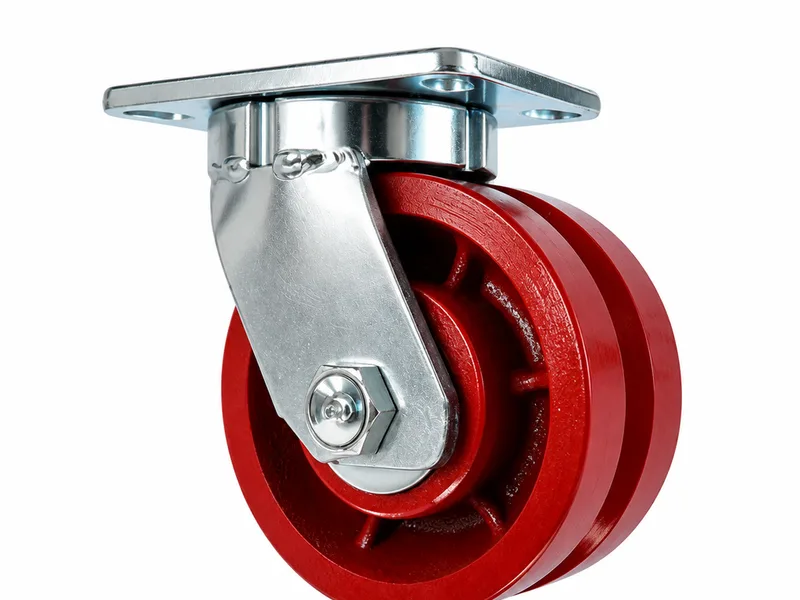
V홈 트랙 휠은 작업장 바닥 대신 역설 앵글 아이언 트랙 위를 굴러갑니다. 트레드(접지면)에는 뿌리에 여유 홈을 둔 정밀 가공 90도 V홈이 새겨져 있어 하중을 트랙 두 모서리에 균등히 배분하고 유도 롤러 없이도 휠을 중앙에 유지합니다. 같은 휠이 평면 위에서도 달릴 수 있어, 고정 트랙 구간과 열린 바닥 사이를 오가는 카트에 실용적인 선택이 됩니다.
전형적인 용도로는 트랙 장착 자재 카트, 미닫이 게이트, 소성로와 오븐 대차, 컨베이어 푸시라인 트롤리, 수천 번 같은 경로를 반복해야 하는 모든 지그가 있습니다. 트랙이 정의된 레일 위에 휠을 얹기 때문에 바닥 상태가 더 이상 제한 요인이 아니며 — 제한 요인은 트랙 정렬, 휠 소재, 베어링 선택이 됩니다.
제원
| 휠 소재 | 주철 V홈 |
|---|---|
| 모델별 사이즈 참조 매트릭스(업계 차트) | VIR-0415-08: 4 × 1-1/2 in, 700 lb, 1/2 in 축; VIR-0630-12: 6 × 3 in, 3,500 lb, 3/4 in 축; VG 800–3,500 lb, VM 3,500–6,000 lb, VF 6,000–10,000 lb (Ø 4–10 in), −40…+350 °F (VG/VM), −40…+800 °F (VF) — 공개 차트의 행, 사이즈 선정을 위한 출처 참조값이며 RollMaster 정격이 아닙니다. 확정 값은 견적 시 구성별로 확인됩니다 |
| 홈 지오메트리 | 하중 균등화를 위한 여유 홈을 갖춘 가공 90° V홈 |
| 사이즈 범위 | Ø 4–12 in(제조사 카테고리 범위 — 사이즈별 데이터는 견적 시 확인) |
| 제조사 SKU 참고(SKU별, 당사 것 아님) | 한 제조사의 V홈 휠 차트는 휠 직경 4–12 in, 폭 1.5–3 in를 안내하며 4 in × 1-1/2 in 휠을 700 lb, 12 in × 3 in 휠을 6,000 lb로 정격화(VIR 시리즈 품번) — 차트 값은 SKU별이며 당사 정격이 아님 |
| 표면 마감 | 아연 도금 |
| 트랙 | 역설 앵글 아이언 트랙; 평면 위에서도 주행 가능 |
| 제3자 브랜드 — 당사 조달 네트워크를 통해 공급 | 이 페이지의 제품 참고 정보는 여러 제3자 출처에서 가져왔을 수 있습니다. 판매업체나 카탈로그 운영자가 반드시 제조업체인 것은 아닙니다. 원 제조업체 또는 정확한 모델/부품 번호가 명시되지 않은 경우 이 페이지에서는 확인되지 않은 정보이므로 서면 견적서에서 두 항목을 모두 확인하십시오. 당사 제안으로 표시된 납기, 최소 주문 수량 또는 보증은 RollMaster의 견적 조건이며 제3자 제조업체가 공표한 조건이 아닙니다. |
| 최소 주문 수량(MOQ) | 200개(카탈로그 표준 품목은 소량 출하 가능) |
| 제3자 브랜드 — 당사 조달 네트워크를 통해 공급 | 이 페이지의 제품 참고 정보는 여러 제3자 출처에서 가져왔을 수 있습니다. 판매업체나 카탈로그 운영자가 반드시 제조업체인 것은 아닙니다. 원 제조업체 또는 정확한 모델/부품 번호가 명시되지 않은 경우 이 페이지에서는 확인되지 않은 정보이므로 서면 견적서에서 두 항목을 모두 확인하십시오. 당사 제안으로 표시된 납기, 최소 주문 수량 또는 보증은 RollMaster의 견적 조건이며 제3자 제조업체가 공표한 조건이 아닙니다. |
공개 카탈로그의 허용 하중은 휠 사이즈별로 표기됩니다(4인치 주철 V홈 휠은 보통 600 lb 부근, 더 큰 직경은 더 높게). 공개 수치는 사이즈별 참고값으로 취급하고 패밀리 전체 정격으로 취급하지 마십시오 — 사용하실 사이즈와 베어링의 정격은 견적 시 확인됩니다.
응용 및 선정
V홈 휠이 값을 증명하는 곳
V홈 휠이 푸는 공학적 문제는 경로 반복성입니다. 거친 바닥의 자유 구름 캐스터는 흘러가고, 그 흘러감을 작업자가 카트를 옆으로 밀어 바로잡습니다. 트랙 위에서는 V홈이 앵글 아이언에 물리고 경로가 고정됩니다. 어두운 통로에서도 카트는 라인을 유지하고, 게이트는 매 사이클 같은 프레임으로 닫히고, 소성로 카는 벽을 긁지 않고 챔버에 들어갑니다.
트랙 구름은 하중을 두 좁은 모서리에 집중시키기 때문에 주철이 여기서 표준 트레드(접지면) 소재입니다 — 연질 트레드(고무, 폴리우레탄)는 그 모서리 하중 아래 눌리고 비틀리는 반면, 주철은 이에 저항하고 오븐·소성로 주변의 열도 견딥니다. 트랙이 세척 환경(워시다운) 또는 실외 구간을 지나는 곳에서는 아연 도금 마감이 표면 부식을 늦춥니다. 휠 자체는 주철로 유지되는데, 도금 후 가공해야 하는 트레드를 도금하는 것은 지오메트리를 무너뜨리기 때문입니다.
V 뿌리의 여유 홈은 보기보다 중요합니다. 이것이 없으면 트랙을 따라 오는 이물이 홈 꼭짓점에 끼어 휠을 자리에서 들어 올립니다. 여유 홈은 그 이물이 갈 곳을 주어 V의 두 모서리가 모두 접촉을 유지하게 합니다.
견적 요청(RFQ) 전에 확정할 선정 포인트
먼저 트랙 단면입니다. 앵글 아이언 사이즈와 뾰족한 면이 위로 설치되었는지 명시하십시오. 휠 홈은 트랙 각도와 맞아야 하고(90°가 표준), 트랙 다리가 홈 꼭짓점에 바닥나는 것이 아니라 여유 홈으로 올라올 수 있도록 휠 폭이 충분해야 합니다.
다음은 하중입니다. 실린 총중량을 실제 분담하는 휠 수로 나누십시오 — 4륜 트랙 카트에서는 보통 셋입니다. 정렬이 완벽할 수 없기 때문입니다. 주철 휠 용량은 직경과 트레드 폭에 따라 달라지며, 사이징 로직은 당사 캐스터 허용 하중 계산 가이드 뒤에 있는 것과 같습니다.
마지막으로 베어링과 환경입니다. 스트레이트 롤러 베어링이 가장 많이 견디고 느리고 무거운 밀기에 강하며, 볼 베어링은 손으로 미는 카트에 더 쉽게 굴러갑니다. 오븐이나 소성로 주변에서는 휠 소재뿐 아니라 베어링 온도 한계도 확인하십시오 — 사용 온도를 먼저 제한하는 것은 보통 베어링입니다.
Keep catalogue test conditions separate from the customer route. Elesa+Ganter describes an industrial dynamic test at 1.1 m/s (4 km/h), over 500 obstacles and 15,000 wheel revolutions, with 100 mm obstacle width and height set at 5% of wheel diameter for elastic treads up to 90 Shore A or 2.5% for harder treads, on a smooth, hard, horizontal floor. Those are the stated test conditions for the referenced standard, not a promise that a caster will cross a taller real threshold, a sharp edge, a gap, a ramp transition or an obstacle at an angle. Ask for the exact standard, wheel hardness category, test speed and complete caster configuration behind the quoted rating.
For powered towing, do not carry a 4 km/h dynamic rating into a faster application by assumption. Elesa+Ganter states that its cited dynamic rating normally refers to speeds up to 4 km/h and that higher towing speeds require a capacity correction because wheel-material performance changes with speed. The correction is wheel- and series-specific; obtain the selected manufacturer’s speed/load table or written rating for the actual speed, duty cycle, starts/stops and turning profile. A precision-bearing option or a larger wheel is not, by itself, proof of a higher-speed rating.
Validate the worst normal route with the equipment loaded to its maximum working condition. Include starting from rest at the obstacle, repeated crossings, turning immediately before or after the joint, braking, and the most adverse caster position. Record push/pull or drawbar force if ergonomics or tow effort is a requirement, then inspect tread damage, bearing play, fastener movement, bracket deformation and floor damage. A clean-floor rolling test cannot substitute for a representative route trial.
Comparing polyurethane wheel models: tread hardness, speed and the exact SKU
“Polyurethane” is not a complete wheel specification. Compare the named compound and hardness, wheel-centre material and reinforcement, exact diameter and tread width, bearing and hub dimensions, and the load rating at the intended speed. Blickle’s catalogue provides a useful like-for-like illustration: its ALST wheel uses 75 Shore A Softhane® polyurethane on a die-cast aluminium centre, while its ALB uses 92 Shore A Besthane® on an aluminium centre. Both are ball-bearing wheel families, but their ratings and operating envelopes are not interchangeable.
For example, Blickle ALST 150/20K and ALB 150/20K are both 150 mm diameter × 50 mm wide, with a 20 mm axle bore, 60 mm hub length and ball bearing. The ALST is listed at 500 kg at 4 km/h and 200 kg at 10 km/h; the ALB is listed at 650 kg at 4 km/h, 320 kg at 10 km/h and 240 kg at 16 km/h. This is a manufacturer-specific comparison, not proof that harder PU always carries more load: the compound, tread construction, test basis and exact wheel configuration belong to the named series.
A second useful check is the reinforced suffix. Blickle marks ALB 152/20K, ALB 162/20K and ALB 202/20K with an asterisk for a heavy-duty reinforced wheel centre. Do not collapse these into the base ALB model even where diameter is shared: for example, ALB 152/20K is 150 × 54 mm and listed at 900 kg at 4 km/h, while ALB 150/20K is 150 × 50 mm and listed at 650 kg. Width, hub/bore and reinforced centre are part of the SKU, not optional details to infer from diameter.
Use the matrix as a buyer comparison reference only. It does not establish a RollMaster equivalent, a complete caster rating, a static rating, a bracket capacity or a 공급업체 stock commitment. For any separately identified RollMaster own-production core line, model cells are published only after the matching factory drawing, BOM and rating/test record are available; other manufacturers’ models remain identified by their original maker and part number.
Albion 16 Series pneumatic models: choosing tire width, load and mounting envelope
The Albion 16 Series catalogue gives a useful six-row model ladder for buyers who need a compact pneumatic caster rather than the larger 72 Series rig. Its nominal options span 6 × 2 in at 200 lb, 8 × 2 in at 210 lb, 8 × 2-1/2 in at 220 lb, 8 × 2-3/4 in at 295 lb, 10 × 4-1/8 in at 350 lb and 12 × 4-1/8 in at 445 lb. This makes the 8-inch nominal diameter a particularly important comparison point: changing tread width and tire construction changes the catalogue load class from 210 to 295 lb, while the mount height changes from 9-1/2 to 11 in. Do not attribute that increase to diameter alone.
The catalogue identifies the 16 Series plate as 4-1/2 × 4 in, with 3-5/8 × 2-5/8 in hole-centre spacing and 3/8 in attaching bolts. The table also gives nominal mount height and nominal swivel radius for each configuration. Treat these as the published Albion 16 Series mounting references; before drilling or replacing an installed caster, confirm the exact suffix, slot geometry, plate revision and full loaded swivel sweep against the current drawing. A shared series plate does not prove that every aftermarket plate or mounting hole is interchangeable.
The manufacturer table lists 50 PSI as maximum air pressure for these six tire configurations, not as the target pressure for every payload. The correct operating pressure must come from the exact tire instructions and load condition. It also states that load ratings are based on walking speed; a powered-tow application needs an engineering-confirmed rating for speed, duty cycle, starts/stops and turning. Do not convert a walking-speed capacity into a tow rating.
Bearing options are configuration-specific. Albion lists industrial ball bearings as standard and roller-bearing alternatives for the 8 × 2-1/2, 8 × 2-3/4 and 10 × 4-1/8 in rows; its catalogue instructs changing the bearing code 27 to 01 for the straight-roller variants. Do not assume every size has a roller-bearing option. The listed brake part numbers also differ: the 6 × 2 and 8 × 2 in rows use the SFBA brake suffix, while the wider 8, 10 and 12 in rows use the SF suffix. Verify the exact brake assembly and mounting clearance on the supplier drawing.
Albion catalogue dimensions are nominal tire sizes. Its individual product records market some exact models using larger measured wheel diameters—for example, 16SF08527S is shown as 9 × 2.8 in, 16SF10627S as 10.9 × 4.1 in and 16SF12727S as 13 × 4.1 in. Preserve the distinction between catalogue nominal size and individual product-page dimensions; never overwrite one convention with the other or assume the numbers describe a different model. All of these are Albion third-party reference configurations supplied through coordinated procurement, not RollMaster-manufactured products.
Compare same-size TPR wheel options before choosing
At 4 × 1-1/4 in, QMIR4G3-T is listed at 250 lb and Shore A 95 (±5), while QMIR4G3 is listed at 320 lb and Shore A 65 (±5); both use ball bearings and a 3/8 in accepted axle/bearing ID. The different hardness and capacity mean they should not be treated as interchangeable from diameter alone.
At 5 × 1-1/4 in, R5203A-TPR is 250 lb with 5/16 in ball bearings; R5283B is 300 lb with ball bearings and a flat tread; GCL50793A is 325 lb with a bushing and 5/8 in accepted axle/bearing ID; QMIR5G3 is 350 lb with ball bearings and a 3/8 in accepted axle/bearing ID. Check bearing fit, tread profile and mounting geometry before substitution.
For a wider tread, G5.00004.456.2 is 4 × 2 in / 400 lb and G5.00005.456.2 is 5 × 2 in / 500 lb; both are listed with a 1-3/16 in plain bore and bearing options that vary by selection. The 6 × 1-1/4 in 8009903 (bushing) and R6193B (ball bearing) are both listed at 300 lb but use different axle/bearing fits and hardness scales. These are wheel-item references, not complete caster ratings.
Selection points to settle before you RFQ
Track geometry first: provide the rail manufacturer\'s section drawing or a dimensioned cross-section, including included angle, leg lengths, thickness, apex/root radius, weld beads and any wear or coating build-up. Then match the wheel\'s included groove angle, opening width and depth to that profile. A nominal 90-degree groove alone is insufficient: manufacturers publish groove width/depth as separate dimensions and show different groove profiles for different angle-iron sizes. Check that the rail seats without bottoming at the apex or riding on an unintended edge, and verify clearance through the full travel.
Load and rail layout next: calculate the load at each wheel from the actual support geometry and worst credible load distribution; do not assume that every four-wheel rail cart always shares load across exactly three wheels. For a two-rail system, check rail spacing, parallelism, elevation and straightness over the full travel. RWM specifically warns that inverted angle rails must be parallel for smooth, constant tracking and notes that, in some layouts, one V-guided side with a flat-faced wheel running on flat bar on the other side may be advisable. That is a layout option to engineer, not a universal prescription.
Bearings and environment last: straight roller bearings carry the most and tolerate slow, heavy pushes; ball bearings roll easier for hand-pushed carts. For oven or kiln surroundings, check the bearing temperature limit as well as the wheel material — the bearing is usually the first component to limit service temperature.
자주 묻는 질문
V홈 휠은 플랜지 트랙 휠이나 V홈 컨베이어 휠과 같은 것입니까?
아니며, 검색에서 이름이 섞이는 경우가 많습니다. V홈 트랙 휠은 원통형 트레드에 가공된 90도 홈을 가지고 역설 앵글 아이언 위를 굴러갑니다. 플랜지 휠은 레일 측면에 닿는 돌출 림을 가집니다. "V홈 컨베이어 휠"은 흔히 그레비티 컨베이어 라인용 훨씬 가벼운 스탬핑 휠입니다. 견적 요청(RFQ) 때는 사용하는 트랙 단면을 명시하십시오 — 어떤 이름보다 빨리 유형을 확정해 줍니다.
내 하중에는 어떤 사이즈의 V홈 휠이 필요합니까?
휠당 하중과 용도로 사이징하십시오. 공개 정격은 휠 사이즈별입니다(4인치 주철 V홈 휠은 보통 600 lb 부근, 정격은 직경이 커질수록 올라갑니다). 불완전한 트랙의 4륜 카트는 총하중을 3으로 나누고, 거칠거나 더러운 트랙과 연속 사이클에는 직경을 한 단계 올리십시오. 사용하실 사이즈·베어링·속도의 정확한 정격은 발주 확정 전 견적 시 확인됩니다.
V홈 휠 견적 요청(RFQ)에는 무엇을 포함해야 합니까?
휠 직경과 트레드 폭, 홈 각도(90° 표준), 트랙 단면 사이즈와 방향, 휠당 하중, 베어링 종류, 환경(온도, 세척 환경(워시다운), 이물), 사이즈별 수량입니다. 트랙 단면 사진이나 도면 한 장이 견적을 가장 단축합니다. 첫 견적서에서 가장 자주 틀리는 세부가 홈과 트랙의 끼워 맞춤이기 때문입니다.
주문 및 서류
서류
모든 주문은 포장 명세서와 상업 송장과 함께 출하됩니다. 프로젝트 구매 시 요청하면 휠 단면(홈 각도, 폭, 허브와 보어)의 치수 도면을 제공하여 생산 전에 트랙 제작사가 끼워 맞춤을 확인할 수 있습니다. 소재와 마감 확인서는 주문별로 견적됩니다.
견적
견적에는 다음이 필요합니다. 직경, 트레드 폭, 홈 각도, 베어링 종류, 휠당 하중, 환경, 목표 수량. 사이즈별 하중 정격과 특수 홈 치수는 견적서에서 확인됩니다 — 공개 카탈로그 수치는 사이징의 참고값이며 발주 약속이 아닙니다.
샘플 및 공급
제3자 브랜드 — 당사 조달 네트워크를 통해 공급. 이 페이지의 제품 참고 정보는 여러 제3자 출처에서 가져왔을 수 있습니다. 판매업체나 카탈로그 운영자가 반드시 제조업체인 것은 아닙니다. 원 제조업체 또는 정확한 모델/부품 번호가 명시되지 않은 경우 이 페이지에서는 확인되지 않은 정보이므로 서면 견적서에서 두 항목을 모두 확인하십시오. 당사 제안으로 표시된 납기, 최소 주문 수량 또는 보증은 RollMaster의 견적 조건이며 제3자 제조업체가 공표한 조건이 아닙니다.
보관 및 출하
주철 휠은 기계적으로 튼튼하지만 가공된 홈과 베어링 시트는 보호해야 합니다. 실내에 보관하고, 조립 전 홈에 이물이 들어가지 않게 하며, 분리재 없이 홈끼리 맞대고 쌓지 마십시오. 해안 또는 습윙 보관 환경에서는 아연 도금 표면을 건조하게 카톤 보관하고, 베어링은 설치까지 원래 그리스 상태를 유지해야 합니다.