
Typical Applications
- ✓Medical carts and trolleys
- ✓Mobile diagnostic and laboratory equipment
- ✓Hospital beds and furniture
- ✓Sterilization and washdown equipment
- ✓Ambulance and patient transport equipment
- ✓Mobile IT and telemedicine workstations
- ✓Dental and examination chairs
- ✓Laboratory sample transport carts
Product Capabilities
- ✓Noise: Super-elastic non-marking treads
- ✓Brakes: Total lock standard
- ✓Loads: 40–300 kg per caster typical
Wheels for Casters for Medical Equipment OEMs
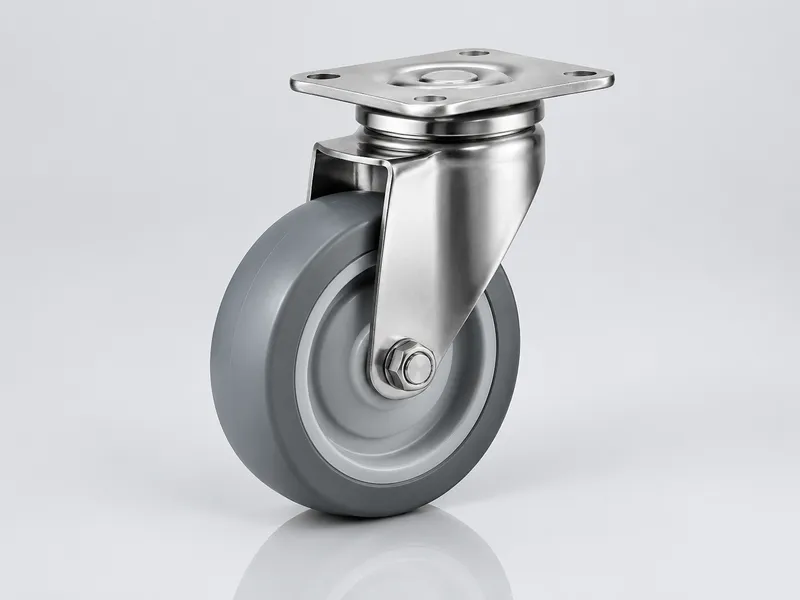
Super-elastic grey rubber and quiet PU on steel, PP or aluminium cores; stainless and chrome-cleanable brackets.
Material Selection Guide
Non-marking grey elastic rubber is the default for occupied environments; PU where loads rise.
| Wheel material | Typical hardness (grade-dependent) | Floor protection | Where it fits |
|---|---|---|---|
| Cast polyurethane (PU) | Shore A 92–95 | Very good: non-marking compounds | AGV/AMR, trolleys on painted or epoxy floors, heavy duty |
| Injected PU | Shore A 90–95 | Good | Cost-sensitive medium duty, light equipment |
| Cast nylon (PA6) | Shore D 70+ | Fair: hard tread | High load on suitable smooth floors; wet or cleaning use only after confirming the exact nylon grade, bearings, seals and cleaning-agent compatibility |
| Glass-filled nylon | Shore D 75+ | Fair | Application-specific; do not assume higher load or temperature than unfilled PA6 without exact grade and model data |
| Solid rubber | Shore A 65–75 | Good | Shock absorption, outdoor thresholds, economy |
| Super-elastic rubber | Shore A 55–65 | Excellent | Quiet running: medical, hotel, laboratory |
| Phenolic resin | — | Fair | Heat-resistant applications; confirm continuous and intermittent temperature limits for the exact wheel, bearing and complete caster |
| Forged steel | — | None: needs steel plate or heavy concrete | Extreme loads, heat, harsh floors |
| Stainless (wheel/bracket) | — | Good | Hygiene and corrosion-sensitive applications only after checking all wetted parts, bearings, seals, fasteners and cleaning chemistry |
| Assembly-level compatibility check | — | — | A wheel material or stainless bracket alone does not establish washdown, food-contact, chemical or temperature suitability; verify the complete caster configuration and exact cleaning process |
Industry-general tread comparison — wheel material behavior by floor and duty, not a rating for a specific size. Confirm the wheel material and rating for your application at quotation.
Sizing & Testing
Roundness and concentricity controlled for smooth, vibration-free running.
How to Order
OEM programs welcome: private labelling, matched sets and samples for approval are standard practice.
Quality & Documentation
Noise and roll-resistance comparison per compound batch; swivel torque tested per batch.
Casters by Wheel Material
Related Industries
Full Capabilities
See the complete range of products, materials and testing on our Heavy Duty Casters (150–2000 kg per caster) page.
Frequently Asked Questions
Can you supply under our brand?
Yes — OEM / ODM and private labelling are core business models, including your packaging and marking.
Are the wheels non-marking on hospital floors?
Grey super-elastic rubber and the PU compounds are non-marking on PVC, linoleum and resin floors; confirm the floor type and we match the tread to it.
What does an OEM validation program need from us?
Platform weight per wheel, floor types, duty cycle and your marking requirements. Samples for approval are standard, and the agreed configuration is frozen with its batch test records for repeat orders.
Do you offer stainless brackets for sterilization areas?
Yes - stainless steel brackets from the RM-Clean series fit the same wheel sizes, for autoclave-adjacent and wet sterilization environments where plated parts corrode.
What loads can a quiet wheel still carry?
Typical medical equipment range is 40-300 kg per caster. Above that, PU replaces grey rubber: it stays quieter than hard wheels while carrying the higher load.
Are total-lock brakes available on all medical wheel sizes?
Yes - the total lock (wheel plus swivel head) is offered across the medical load range, so one pedal standard can be kept across a whole equipment family.