
Product Catalog
Cast Iron Caster Wheels — High Load, Heat Tolerance and the Lowest Cost per Kilo
Third-party brand — supplied via our sourcing network
Product references on this page may come from more than one third-party source. A retailer or catalog is not necessarily the manufacturer. Where the original manufacturer or exact model/part number is not identified, it is not verified by this listing; confirm both in the written quotation. Any lead time, MOQ or warranty shown as our offer is a RollMaster quotation term, not a third-party manufacturer's published term.
Updated 2026-11
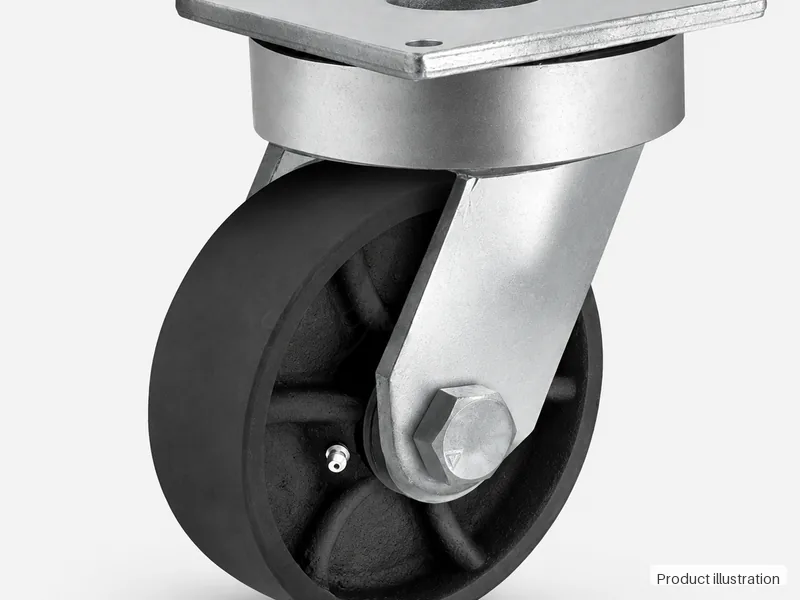
Cast iron wheels are the load-and-temperature workhorses of the wheel catalog: a hard, dimensionally stable metal tread that carries more weight per dollar than any polymer, shrugs off heat that would melt or delaminate every soft tread, and rolls with almost no resistance because nothing in the tread absorbs energy. The same hardness is also the limitation — cast iron transmits every bump and will mark, chip and eventually damage finished floors — so it belongs on rough concrete, steel decks, and in ovens and foundries, not on epoxy showroom floors.
Cast iron wheels in this catalog are supplied through coordinated procurement from the identified manufacturer, not presented as RollMaster own-production products. The published manufacturer chart is a selection reference only: confirm the exact manufacturer and wheel MPN, diameter, tread width, bore, hub length, bearing and rated load before quotation. Stock, MOQ, delivery schedule and any complete-caster configuration are confirmed for that exact sourced model. Typical applications are oven- and kiln-adjacent racks (with the bearing and grease temperature limits checked separately), heavy fixtures that move infrequently, and debris-strewn floors where a soft tread would wear quickly.
Specifications
| Wheel material | Cast iron (gray iron), machined tread; V-groove variants on the track-wheel page |
|---|---|
| Model-size reference matrix (industry chart) | CA: 300–6,000 lb, Ø 3–18 in; CW: 6,000–8,000 lb, Ø 8 in; by diameter: Ø 4 in 600–1,000 lb, Ø 5 in 1,000–1,500 lb, Ø 6 in 1,500–2,500 lb, Ø 8 in 2,500–4,000 lb, Ø 10 in 4,000–6,000 lb, −40…+800 °F — published chart rows, per-publisher reference for sizing, not supplier ratings; the binding rating is confirmed per configuration at quotation |
| Size range | No cast-iron-core category size range is confirmed; verify diameter, tread width, bore and hub length against the named manufacturer’s exact model. |
| Industry reference band | 1,000–3,000 lb per wheel at 5 in diameter (published comparison data, not a supplier rating); capacity rises with diameter and tread width |
| Temperature range | Industry reference: −40…500 °F for the wheel material — the bearing and grease usually limit first; high-temp grease quoted for oven duty |
| Tread hardness | Approx. Brinell 145 (manufacturer reference for gray iron V-groove-class wheels) |
| Albion CA cast-iron wheel manufacturer reference | Albion’s CA cast-iron wheel chart includes 3 in × 1-5/16 in at 300 lb (straight roller) and 3-1/4 in × 1-1/2 in at 400 lb, with approx. Brinell 145; the published line spans 300–6,000 lb across 3–18 in. These are Albion wheel-line chart values, not complete-caster or RollMaster ratings |
| Rolling resistance | Very low — the lowest of the common tread materials |
| Floor protection | Very poor on finished floors; intended for concrete, steel decks and track |
| Bearing options | Plain bore · straight roller · tapered roller (duty-dependent, quoted per configuration) |
| Third-party brand — supplied via our sourcing network | Product references on this page may come from more than one third-party source. A retailer or catalog is not necessarily the manufacturer. Where the original manufacturer or exact model/part number is not identified, it is not verified by this listing; confirm both in the written quotation. Any lead time, MOQ or warranty shown as our offer is a RollMaster quotation term, not a third-party manufacturer's published term. |
| Third-party brand — supplied via our sourcing network | Product references on this page may come from more than one third-party source. A retailer or catalog is not necessarily the manufacturer. Where the original manufacturer or exact model/part number is not identified, it is not verified by this listing; confirm both in the written quotation. Any lead time, MOQ or warranty shown as our offer is a RollMaster quotation term, not a third-party manufacturer's published term. |
| RollMaster commercial coverage | 18 months as RollMaster commercial coverage; exact coverage, exclusions and order terms are confirmed in the written quotation. Any manufacturer warranty is separate and must be confirmed for the named manufacturer and exact model. |
Load, temperature and hardness figures marked as industry or manufacturer references are published comparison data for sizing orientation — not supplier ratings and not family promises. Cast iron capacity is quoted per size, bore and bearing; the figure for your configuration is confirmed at quotation.
Applications & Selection
Where cast iron earns its keep
Three duty classes keep choosing cast iron. The first is raw load on forgiving floors: foundry carts, steel-mill and heat-treat fixtures, heavy tooling and dies, aerospace and shipyard dollies — anywhere the load per wheel climbs past what polymers carry and the floor is steel or rough concrete that a hard tread will not hurt. Published material comparisons put cast iron at 1,000–3,000 lb per wheel at 5 inches with a −40…500 °F band and the lowest cost index of the common materials, which is why it survives as the economy metal tread.
The second is heat. Polymer treads fail by softening or delamination at their continuous limits; cast iron does not care about oven-adjacent radiant heat, and the practical ceiling moves to the bearing and its grease. That is why oven racks, curing ovens, bakery and kiln cars run metal wheels with high-temperature grease — the wheel is rarely the first component to fail, and our bearing-temperature knowledge base covers how bearing type moves that ceiling.
The third is debris and abuse: scrap-handling, construction-site material trains, outdoor fixtures. A hard tread does not slice open on grit the way an elastomer does. The trade-offs are equally blunt: zero cushioning (fragile loads and operator comfort suffer), noise, floor damage, and brittleness — impact at the tread edge can chip cast iron where ductile iron or forged steel would dent. Where shock loads dominate, step up to forged steel; where the floor must survive, stay with polyurethane.
Selection points to settle before you RFQ
Size from load per wheel (total ÷ three for a four-wheel rig) and duty: cast iron ratings scale with diameter and tread width, so state the working load honestly and let the quotation fix the per-size rating rather than back-fitting from a catalog figure for a different size. If speeds exceed walking pace or duty is continuous, name it — metal wheels at speed on rough floor are a bearing and spall question.
Bearings decide more of the service life than the tread does. Plain bore is the cheap answer for slow, occasional moves; straight roller bearings carry more and tolerate slow heavy pushes; tapered rollers take combined loads on towed lines. For anything oven-adjacent, specify the ambient temperature so the grease is quoted to match — wheel material ratings mean nothing if the grease has already given up.
Fix the interface: bore and axle size, mounting (these wheels bolt into caster rigs or your own fabricated frames), and any groove requirement — a V-groove for angle-iron track is a different geometry and lives on our V-groove track wheel page. State the floor so the tread choice is on record; cast iron specified onto a finished floor is a complaint waiting to happen, and we would rather propose PU or a crowned metal tread at quotation than after delivery.
How do you verify a cast iron wheel against its specification?
Verify the hardware, not the labels. Measure bore, hub length and any mounting interface with calipers rather than reading the casting mark, and require the quotation to state tread hardness as a Brinell number with a test basis — metals are graded on the Brinell scale (BHN), where higher numbers mean harder material, so a line that says "hardness" without a number is not a checkable specification. The approx.-Brinell-145 figure on this page is a manufacturer chart-wide reference for its gray-iron wheel line, not a certificate for your lot. On receipt, inspect the tread edges and flanges for transit chips or visible cracks and reject any wheel that took a hard hit: cast iron is impact-brittle — published material guidance warns it chips on pallet-edge drops — so the impact behavior you chose it for has to start from an undamaged wheel. Three boundaries do not bend: do not dress, grind or paint over a chip or crack — cracks in cast iron only grow under load, and the failure that follows is never cosmetic; never run a wheel beyond its quoted rating on the theory that cast iron is "strong enough" — a drop or strike outside the tested envelope is how cast iron fractures; and do not treat one size\'s rating as interchangeable with another\'s — a 6-inch figure cannot be substituted for an 8-inch wheel unless the catalogue itself states it.
The load rating itself is verifiable only through named tests: industry practice establishes caster capacities under the ANSI ICWM standard, whose impact tests 6.10 (complete casters) and 6.11 (wheels only) drop a weight of 2 times the target capacity vertically onto the mounted unit. Ask which tests the quoted rating passed; a figure with no named test standard cannot be compared against one that can. What this page cannot verify: the actual hardness and graphite structure of the delivered heat — microstructure is a foundry-lot property no buyer-side check can confirm — and the per-size rating for your configuration, which is the quotation figure. For safety-relevant duty, ask for the material certificate for the casting lot; unless it states the hardness basis, the published class band stays an industry reference, not a verified property of your wheels.
Quality & Verification
The spec values for Cast Iron Caster Wheels draw on 8 field-level source records — 2 tenant confirmed, 1 manufacturer reference, 5 industry reference.
| Claim on this page | How a buyer verifies it |
|---|---|
| Load rating | Catalog ratings bind one configuration. State wheel, bearing, speed and duty. Require that exact rating on the quotation. |
| Sample or test report | Request test data or certificates per SKU. Agree acceptance in writing before the order. |
| Materials and tread | Confirm material by certificate, not description. Unresolved options are fixed at quotation. |
| Bearings | Name the bearing type in the RFQ. "Standard bearing" is not a specification. |
| Standards and compliance | Name the standard and certify against it. An unnamed equivalent is not a certification. |
What this page cannot verify
- No figure on this page is our own lab result.
- The binding rating is the quotation figure.
Sources for this page
- [1] cast iron capacity class (steel and cast iron carry substantially more weight than rubber or PU; load spreading across the wheel set governs) — industry reference (https://thecasterguy.com/2025/08/11/caster-wheel-materials/) — accessed 2026-10-28; independent second publisher for the capacity-class statement; figures stay bound to the ledgered casterhq/Albion entries
- [2] cast iron as standard wheel material, Ø 25–300 mm line size range — tenant confirmed (first-party) (owner://vertical.config.json (route A 2026-10-01)) — materials.standard_materials + dimensions; supply via own production + outsourcing per owner 2026-10-24
- [3] industry reference band (1,000–3,000 lb @ 5 in, −40…500 °F, very low rolling resistance, very poor floor protection, brittle, baseline cost; steel sub-type table) — industry reference (https://casterhq.com/pages/caster-wheel-materials-guide) — accessed 2026-10-26; rendered as industry reference, never as supplier ratings
- [4] model-size reference matrix (Albion CA 300–6,000 lb Ø 3–18 in; CW 6,000–8,000 lb Ø 8 in; per-size class bands Ø 4–10 in 600–6,000 lb, −40…+800 °F) — industry reference (https://albioncasters.com/caster-college/wheel-selection-chart/) — the two cited publisher pages, collected 2026-11-18 (albioncasters.com chart; casterhq.com size bands) — chart rows, never supplier ratings
- [5] tread hardness approx. Brinell 145, CA-series SKU figures (3–3.5 in, 300–700 lb, plain/straight-roller/tapered bearings) — manufacturer reference (https://albioncasters.com/wheels/ (raw capture scripts/content-research/raw/albion-wheels-index-20261026.html, 2026-10-26)) — Albion CA cast iron wheel line; per-SKU figures kept per-size, never merged into a family rating; SKU depth pass tier 3 (2026-10-28): chart rows ledger-ingested corpus-verbatim from albioncasters.com/wheels plus the Caster College CA row (300–6,000 lb, 3–18 in) — see model-evidence.json
- [6] verification practice (Brinell scale BHN grades metals; approx.-Brinell-145 kept as manufacturer chart reference; transit-chip/edge-crack receipt inspection) — industry reference (https://www.grainger.com/know-how/equipment/kh-types-casters-and-wheel-guide) — added 2026-11-16 C43 deepen; ledger also covers albioncasters.com/wheels CA chart (Brinell 145 chart-wide) and casterhq.com/pages/caster-wheel-materials-guide (cast iron impact-brittle, chips on pallet-edge drops); corpus-verbatim entries in packs/industrial-caster-wheels/model-evidence.json
- [7] rating test basis (ANSI ICWM dynamic endurance; impact tests 6.10 casters / 6.11 wheels at 2x target capacity vertical drop) — industry reference (https://www.nextdaycasters.com/blogs/next-level-blog/caster-capacity-calculation-a-comprehensive-guide-to-caster-wheel-and-cart-capacities) — added 2026-11-16 C43 deepen; corpus-verbatim ledger entry first recorded in the C41 batch; cited as the test regime a quoted rating should name, not supplier test data
- [8] lead_time/moq/warranty — tenant confirmed (first-party) — owner answers 2026-10-26 (Foundation runtime/owner-answers-20261026.json)
Frequently Asked Questions
Cast iron or forged steel wheels — which do I need?
Load class and impact. Cast iron carries 1,000–3,000 lb per wheel at 5 inches (industry reference) at the lowest cost, and is the right tread for heavy static loads, heat and debris on rough floors. Forged steel is the answer when loads run higher, duty is towed or impact-heavy, or a chipped cast iron tread is unacceptable — forged steel deforms instead of cracking, at several times the cost. If your loads sit under ~3,000 lb per wheel and the floor is rough concrete, cast iron is usually the economical choice.
Does the "Brinell 145" hardness figure on a cast iron wheel need verification?
Treat it as a reference, not a measurement. The approx. Brinell 145 on this page is a manufacturer chart-wide value for its gray-iron wheel line — a class figure, not a certificate for your lot. Metals are graded on the Brinell scale (BHN), where higher numbers mean harder material, so the verifiable form of the claim is a stated BHN with a test basis on the quotation. If your duty punishes treads — steel-deck tracks, scrap handling, dock plates — ask for the hardness on the lot certificate; if the duty is ordinary heavy rolling, the chart reference plus a transit-chip inspection is normally sufficient.
How should I inspect cast iron wheels on receipt?
Three checks, in order. First, dimensions: measure bore, hub and tread width against the drawing rather than trusting the casting label. Second, the tread surface: look for transit chips and edge cracks — cast iron is impact-brittle, and a pallet-edge drop in transit chips it exactly the way published material guidance warns, so a chipped tread will only get worse under load. Third, the bore: surface rust on the cast face is cosmetic, but rust or grit inside the bore will score the axle, so keep the bore clean and greased until assembly. Refuse damaged wheels on the spot — a chipped cast iron wheel cannot be dressed back to specification.
How hot is too hot for a cast iron wheel?
The wheel material tolerates oven-adjacent temperatures (published references give cast iron a −40…500 °F band), but the practical limit is almost always the bearing and its lubricant. Standard grease fails well below the wheel’s limit, so for oven, kiln or curing-oven duty specify the ambient temperature in your RFQ and the configuration is quoted with high-temperature grease — and check our knowledge base on cast iron housed bearing temperature limits for the bearing-type comparison.
What should my cast iron wheel RFQ include?
Load per wheel, wheel diameter and tread width (or bore and axle if you are fitting to your own frame), bearing type, ambient temperature if elevated, floor or track type, mounting arrangement, finish requirement, and quantity per size. A sketch of the mounting interface shortens quoting; for anything running on track, send the track section size instead.
Ordering & Documentation
Documents
Every order ships with a packing list and commercial invoice. On request we provide the dimension sheet for the quoted wheel (diameter, tread width, hub, bore) and the material statement for your configuration, so fabricated frames and maintenance records can be checked before production.
Quotation
A quotation needs: diameter, tread width, bore and axle, bearing type, ambient temperature, mounting, finish and quantity. Cast iron load ratings are per size and bearing — published bands are sizing references, and the order commitment is the figure on the confirmed quotation.
Sample & supply
Third-party brand — supplied via our sourcing network. Product references on this page may come from more than one third-party source. A retailer or catalog is not necessarily the manufacturer. Where the original manufacturer or exact model/part number is not identified, it is not verified by this listing; confirm both in the written quotation. Any lead time, MOQ or warranty shown as our offer is a RollMaster quotation term, not a third-party manufacturer's published term.
Storage & shipping
Cast iron wheels are mechanically robust; the care points are the machined surfaces and the bearings. Store indoors, keep treads and bores free of grit, keep bearings in their original grease until installation, and do not stack wheels tread-to-tread without separators. In coastal or humid storage, carton the wheels and keep them dry — the cast surface will surface-rust, which is cosmetic on the tread but must be kept out of the bore.