
Product Catalog
Kingpinless Casters — Impact-Resistant Swivel Casters Without a Kingpin
Third-party brand — supplied via our sourcing network
Product references on this page may come from more than one third-party source. A retailer or catalog is not necessarily the manufacturer. Where the original manufacturer or exact model/part number is not identified, it is not verified by this listing; confirm both in the written quotation. Any lead time, MOQ or warranty shown as our offer is a RollMaster quotation term, not a third-party manufacturer's published term.
Updated 2026-11
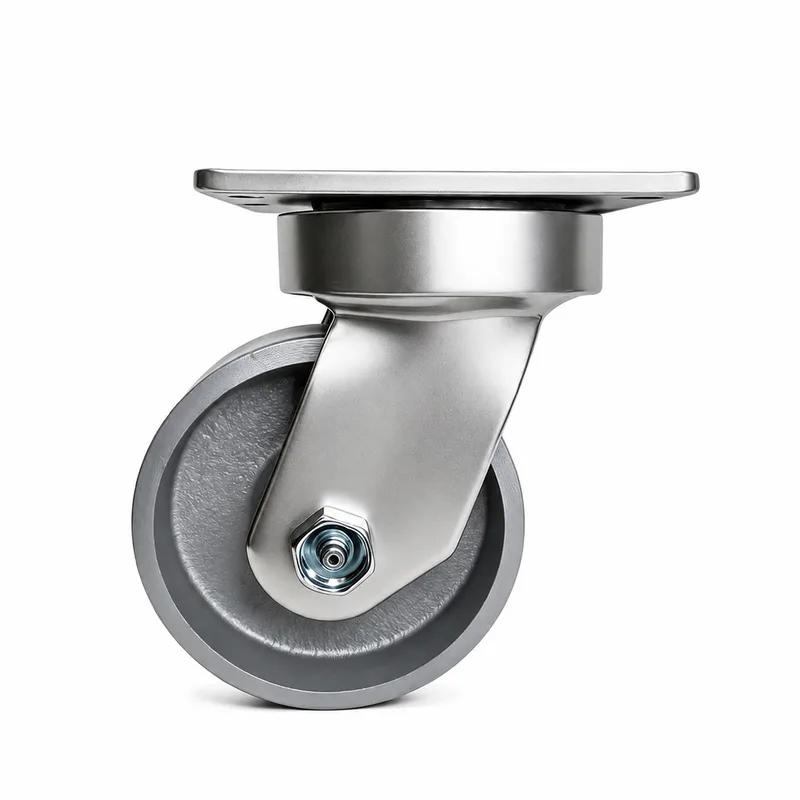
A conventional swivel caster holds its races together with a kingpin — a central bolt that is also the structurally weakest point of the swivel section. Under shock loads (towing, dock work, drop-offs over door thresholds, uneven floor edges) the kingpin and its raceway take the impact first, and kingpin damage or raceway deformation is one possible failure mode under severe shock or repeated impact; the actual failure mode depends on the caster design and duty. A kingpinless caster removes the pin entirely: the top plate and the swivel raceway are formed from one piece of steel, so impact loads pass through a continuous ring instead of a fastener.
The construction is often considered for high-impact, frequent-swiveling and towing applications such as tow lines, AGV tail casters, dock and ramp service. Suitability depends on the exact series, wheel, bearing, mounting and duty cycle; confirm the manufacturer’s rating and application limits for the quoted model.
Specifications
| Swivel construction | Kingpinless — integrally formed raceway, no kingpin fastener |
|---|---|
| Construction options | Stamped kingpinless (medium/impact duty); forged kingpinless (heavy/impact duty) |
| Construction materials | Stamped AISI 1045 steel; polished stainless steel (caster construction — the wheel material itself is confirmed at quotation) |
| Surface finishes | Zinc plating (frame finish) |
| Typical duty | High-impact, constant-swiveling, towed applications |
| Albion 110CA06201R manufacturer model reference (third-party SKU) | Albion manufacturer model 110CA06201R is identified on the Colson Group / Albion product page as a 110 Series Kingpinless rigid caster: 6 × 2 in CA cast-iron wheel, roller bearing, 1,400 lb listed capacity, 7.5 in mounting height and 4.5 × 4 in top-plate fastening size. The manufacturer page confirms the 110 Series identity; the Caster Specialists reseller page carries a conflicting “71 Series” label, which is not followed. Albion's linked 2016 110 Series catalogue labels its tabulated capacities as rated for manual operation, warns that application or equipment design may reduce capacity, and directs towing applications to factory consultation. It does not establish a dynamic, impact or towing rating for this exact model. The catalogue's 6-inch CA row shows 1 7/8 in tread, while the current exact-product page lists 2 in; retain this source discrepancy and confirm the current configuration with Albion. This is third-party Albion product data, never a RollMaster model or rating. |
| Published series variants (industry reference) | A spring-loaded kingpinless series lists capacities at 50% of wheel deflection (21/32 in; total possible deflection 1-5/16 in); a dual-wheel kingpinless version adds a third full leg for durability — variant selection confirmed at quotation |
| Exact third-party model reference (not a family rating) | The manufacturer-listed 1,400 lb capacity belongs only to Albion model 110CA06201R in its stated 6 × 2 in cast-iron / roller-bearing rigid configuration. It does not transfer to other models, wheel or bearing configurations, or series, and is not a RollMaster rating. The linked 2016 series chart supports a manual-operation capacity basis only; it is not a dynamic, impact or tow rating. Its 6-inch CA row lists 1 7/8 in tread, differing from the current exact page's 2 in. Confirm the exact current build and any towing or powered-duty rating with Albion. |
| Third-party brand — supplied via our sourcing network | Product references on this page may come from more than one third-party source. A retailer or catalog is not necessarily the manufacturer. Where the original manufacturer or exact model/part number is not identified, it is not verified by this listing; confirm both in the written quotation. Any lead time, MOQ or warranty shown as our offer is a RollMaster quotation term, not a third-party manufacturer's published term. |
| Third-party brand — supplied via our sourcing network | Product references on this page may come from more than one third-party source. A retailer or catalog is not necessarily the manufacturer. Where the original manufacturer or exact model/part number is not identified, it is not verified by this listing; confirm both in the written quotation. Any lead time, MOQ or warranty shown as our offer is a RollMaster quotation term, not a third-party manufacturer's published term. |
| RollMaster commercial coverage | 18 months as RollMaster commercial coverage; exact coverage, exclusions and order terms are confirmed in the written quotation. Any manufacturer warranty is separate and must be confirmed for the named manufacturer and exact model. |
Capacity is model- and series-specific. The cited 1,400 lb figure belongs only to the exact Albion 110CA06201R rigid model listing; it is not a RollMaster rating or a family ceiling. The linked 2016 chart marks capacity as manual-operation rated and requires factory consultation for towing; it also warns that application/equipment design may reduce capacity. Its 6-inch CA tread dimension differs from the current exact page (1 7/8 in versus 2 in). Confirm current configuration and duty-specific rating with Albion.
Applications & Selection
When the kingpin is the failure point, delete the kingpin
Kingpinless construction is often considered where repeated impact and frequent swiveling are important. Towed carts, dock equipment and AGVs can introduce transient loads at starts, stops, thresholds and uneven floor transitions. The way those loads travel through the swivel section depends on the exact pinned or kingpinless design; confirm the manufacturer’s application guidance rather than assuming that construction alone establishes a safe load rating.
The trade is repairability and price. A pinned caster can be disassembled — its races and swivel bearings are serviceable parts, which is why pinned construction still dominates maintenance-focused fleets (our kingpin, fork and bearing wear inspection guide covers that service path). A kingpinless caster is effectively a sealed structural unit: nothing to service, nothing to work loose, and when its (long) life ends it is replaced whole.
Selection points to settle before you RFQ
Compare stamped and forged construction against the exact manufacturer series, impact profile and duty cycle rather than treating either construction as a capacity rating. Ask for the series-specific dynamic rating, impact limitations, wheel and bearing configuration, and the test basis. Our forged vs stamped bracket comparison walks through the construction trade-offs.
Match the offset to the duty. Larger swivel offset reduces steering effort but increases the wobbling tendency at speed; towed applications typically want a moderate offset and a kingpinless raceway rated for the tow-line shock. If your build combines axial and radial loads at the swivel, bearing and fit selection at the raceway matters — see our clearance fit class guide for the fit-class logic.
State the environment. Where wash-down or corrosion drives the specification, identify the exact stainless or plated construction option and ask for its own model-specific rating, finish and maintenance guidance. Do not transfer a carbon-steel series rating to a stainless configuration without manufacturer confirmation.
Treat the mounting interface as a model-specific fit, not a generic “standard heavy-duty plate”. Compare plate outside length and width, both hole-centre distances, round-hole diameter or slot width/length, bolt size, plate thickness, overall installed height and swivel sweep as separate fields. Hamilton catalog examples show why: its Series EC 4-inch models list a 4 x 4½ in plate with 2⅝ x 3⅝ in holes slotted to 3 x 3 in and ⅜ in bolts; its Series EC 6-inch / 3-inch-face configuration uses a 4½ x 6¼ in plate and ½ in bolts; its Series EC 6-inch / 2-inch-face configuration returns to the smaller 4 x 4½ in plate. These are Hamilton model examples, not universal plate standards or RollMaster dimensions. A matching hole pattern alone does not establish frame strength, fastener adequacy or load capacity.
For replacement work, obtain the exact caster drawing before drilling or approving an adapter. Confirm whether the stated overall height is measured to the top or underside of the plate, and check full 360-degree swivel with the wheel, fork, brake pedal and nearby frame in the installed position. Slotted holes provide only the adjustment range shown on that model drawing; they do not justify forcing misaligned bolts or using fewer than the specified fasteners.
How do you verify a kingpinless swivel section before it enters service?
A kingpinless raceway cannot be verified from the outside of an assembled caster, so incoming checks concentrate on what the swivel does and on the specification behind it. Rock the rig and feel for swivel play — field inspection guidance treats excess wobble as the signal of kingpin or raceway wear, and on a new caster it should be essentially absent. Published precision-swivel references quantify the bands: standard industrial swivels tolerate initial axial play of 0.005–0.015 in, AGV-grade precision raceways are held to ≤0.002 in, and raceway hardness is published at Rockwell 55–58 HRC for standard grades versus 60–62 HRC for precision grades. Ask the quotation to state where the series sits relative to those bands; if it cannot, treat the raceway specification as unconfirmed rather than assuming precision. Do not accept "heat-treated raceway" as a verification by itself — heat treatment is a manufacturing step that prevents brinelling of the races, not a measurement you can check on receipt.
What this page cannot verify: the delivered raceway\'s actual hardness, the depth of any heat treatment, and the per-SKU axial play — those live in the manufacturer\'s process, so the only buyer-side evidence is a stated test basis. Industry rating practice names the tests: capacities established under ANSI ICWM include dynamic endurance running and impact tests 6.10 (complete casters) and 6.11 (wheels only), where the unit must survive a vertical drop of 2 times its target capacity. Shock is the regime kingpinless construction exists for, and published guidance puts shock loads at 3 to 5 times the static rating in heavy industrial use — standard ball bearings brinell under that shock while roller and tapered roller bearings take it without permanent deformation. Ask which tests the quoted series rating passed; a rating with no named standard is a catalog number, not a verified capacity.
Quality & Verification
The spec values for Kingpinless Casters draw on 8 field-level source records — 1 tenant confirmed, 1 manufacturer reference, 6 industry reference.
| Claim on this page | How a buyer verifies it |
|---|---|
| Load rating | Catalog ratings bind one configuration. State wheel, bearing, speed and duty. Require that exact rating on the quotation. |
| Sample or test report | Request test data or certificates per SKU. Agree acceptance in writing before the order. |
| Materials and tread | Confirm material by certificate, not description. Unresolved options are fixed at quotation. |
| Bearings | Name the bearing type in the RFQ. "Standard bearing" is not a specification. |
| Standards and compliance | Name the standard and certify against it. An unnamed equivalent is not a certification. |
What this page cannot verify
- No figure on this page is our own lab result.
- The binding rating is the quotation figure.
- materials — AISI 1045 vs stainless conflict annotated unresolved in gate-3 audit — rendered as construction options only, no metal-grade claim
- family load band — not rendered: catalog load_rating is a 15-value cross-series aggregation without per-value provenance and remains needs-owner in product-decisions/kingpinless-casters.decision.json; exact per-model examples may be shown only when the exact MPN and source row are present in model-evidence.json
Sources for this page
- [1] construction/duty (stamped vs forged kingpinless product-line structure) — industry reference (https://albioncasters.com) — Contender stamped / Shockmaster forged lines; no cross-series family capacity range rendered
- [2] surface_finishes — industry reference (https://casterspecialists.com)
- [3] per-SKU chart row (110-series 6x2 cast-iron wheel 1,400 lb, 7-1/2 in mounting height, series to 2,000 lb/ea) — industry reference (https://www.casterspecialists.com/products/albion-casters-110ca06201r-6x2-kingpinless-rigid-caster-with-heavy-duty-cast-iron-wheel) — added 2026-10-28 SKU depth pass tier 2; corpus-verbatim ledger entry in packs/industrial-caster-wheels/model-evidence.json; peer MPN and values never rendered as supplier ratings
- [4] spring-loaded kingpinless deflection rating basis (50% at 21/32 in, total 1-5/16 in) and 115 dual-wheel third-full-leg structure — manufacturer reference (https://albioncasters.com/series/s310-kingpinless-spring-loaded/) — added 2026-10-28 SKU depth pass tier 2; ledger entries also cover https://albioncasters.com/series/115-dual-wheel-kingpinless/; corpus-verbatim, never promoted to family ratings
- [5] swivel verification bands (initial axial play 0.005–0.015 in standard vs ≤0.002 in AGV precision; raceway hardness Rockwell 55–58 HRC standard vs 60–62 HRC precision; standard raceways develop axial play within 6–12 months) — industry reference (https://casterhq.com/blogs/application-guides/casters-for-agvs-autonomous-equipment) — added 2026-11-15 C41 deepen; corpus-verbatim ledger entry in packs/industrial-caster-wheels/model-evidence.json; published reference bands, not supplier tolerances
- [6] swivel/raceway failure vocabulary (wobble signals kingpin or raceway wear; brinelling dents from ball bearings raise swivel effort and can fail structurally; heat-treated raceways prevent brinelling; shock loads 3–5x static rating and bearing behavior under shock) — industry reference (https://atlantacaster.com/blog/reducing-downtime-how-the-right-casters-can-improve-production-efficiency/) — added 2026-11-15 C41 deepen; ledger entries also cover castercentral.com (brinelling), configurator.casterconcepts.com (heat-treated raceways), casterhq.com/pages/caster-load-rating-static-vs-dynamic (shock multiples); corpus-verbatim
- [7] rating test basis (ANSI ICWM dynamic endurance; impact tests 6.10 casters / 6.11 wheels at 2x target capacity drop) — industry reference (https://www.nextdaycasters.com/blogs/next-level-blog/caster-capacity-calculation-a-comprehensive-guide-to-caster-wheel-and-cart-capacities) — added 2026-11-15 C41 deepen; corpus-verbatim ledger entry; cited as the test regime a quoted rating should name, not as supplier test data
- [8] lead_time/moq/warranty — tenant confirmed (first-party) — owner answers 2026-10-26 (Foundation runtime/owner-answers-20261026.json)
Frequently Asked Questions
What is brinelling in a swivel raceway, and why does it matter for kingpinless casters?
Brinelling is denting of the hardened raceway surface under pressure from the ball bearings. Industry failure guides describe it as many small indentations that degrade the structural integrity of the swivel, raise swivel effort, and can progress to cracking and mechanical failure — the cart becomes noticeably harder to steer before it becomes unsafe. Heat-treated raceways are the industry\'s countermeasure, which is why heat treatment is worth asking about on impact-duty kingpinless casters. If a kingpinless caster develops rising swivel effort after impact events, brinelled races are a primary suspect; compare its swivel effort against a sister caster that has not seen the same shocks before replacing the whole unit.
Does kingpinless construction change how I should verify the load rating?
No — and that is the trap. Deleting the kingpin does not relax the rating discipline: capacities are per-series figures established under named test standards, and kingpinless or pinned makes no difference to how you check them. Ask the quotation to name its test basis (for example the ANSI ICWM dynamic and impact tests) and treat a rating quoted without one as unverified. The stakes are higher here precisely because kingpinless casters are chosen for shock duty: shock loads are published at 3 to 5 times the static rating, so the gap between a static catalog number and verified dynamic behavior matters more on a tow line than on a gentle-duty cart.
What does "kingpinless" actually mean — is it just a caster without a bolt?
It is a different swivel structure, not just a deleted fastener. In a kingpinless caster the top plate and the lower raceway are integrally formed from one piece of steel, so the swivel races are concentric grooves in continuous material. There is no pin to shear, no nut to loosen and no separate race to deform out of round. That continuous load path is what makes the construction resistant to impact failure.
How do I choose between stamped and forged kingpinless casters?
By the exact manufacturer series, impact profile and duty cycle. Do not infer a capacity from stamped or forged construction alone, and do not apply one universal load divisor or series step-up to every cart. Establish the effective number of load-bearing casters from the equipment geometry, floor conditions and load distribution; then account separately for the specified dynamic duty and verify the exact model rating and test basis with the manufacturer. Confirm the complete configuration at quotation.
Are heavy-duty caster top plates interchangeable if the bolt pattern looks similar?
No. Plate footprint, hole-centre spacing, round-hole or slot geometry, bolt size, plate thickness, overall height and swivel clearance must all match the exact caster and equipment interface. Manufacturer catalogs show different patterns even within one maker: Hamilton Series EC examples include 4 x 4½ in and 4½ x 6¼ in plates, with different bolt sizes and slot ranges depending on wheel-face configuration. Those are Hamilton examples, not universal standards. Send the old caster model and a dimensioned top-view/side-view drawing or measured photos; do not assume that a matching pair of hole spacings proves fit or capacity.
What should my kingpinless caster RFQ include?
Load per caster, towed or pushed (and tow speed if towed), top plate size and bolt pattern, wheel diameter and material, bearing type, swivel offset if it is fixed by your design, environment (corrosion, wash-down, temperature) and quantity. Say explicitly that you want kingpinless construction — quotes sometimes default to pinned equivalents at a lower price.
Ordering & Documentation
Documents
Orders ship with a packing list and commercial invoice. On request we provide top-plate and bolt-pattern dimension sheets for the quoted series, so your frame shop can drill before the casters arrive. Series specification statements (stamped or forged, plated or stainless) are quoted per order.
Quotation
A quotation needs: load per caster, duty (pushed/towed, cycles per shift), plate length × width, both hole-centre dimensions, hole diameter or slot dimensions, bolt size, plate thickness if specified, installed height, swivel radius/clearance, wheel and bearing selection, finish, and quantity. Attach the equipment mounting-face drawing and identify any adapter plate. The series and its load rating are confirmed on the quotation — that per-series figure, not a catalog headline number, is the commitment.
Sample & supply
Third-party brand — supplied via our sourcing network. Product references on this page may come from more than one third-party source. A retailer or catalog is not necessarily the manufacturer. Where the original manufacturer or exact model/part number is not identified, it is not verified by this listing; confirm both in the written quotation. Any lead time, MOQ or warranty shown as our offer is a RollMaster quotation term, not a third-party manufacturer's published term.
Storage & shipping
Kingpinless casters ship assembled. Store them plated-side dry and keep swivel sections free of concrete dust and welding spatter — grit packed into the raceway is the one storage-related failure this construction has. Do not lift a full cart by its casters; the raceway is designed for compression and steering loads, not hoist points.