
Product Catalog
Machine Skates — Low-Profile Roller Skates for Moving Heavy Equipment
Third-party brand — supplied via our sourcing network
Product references on this page may come from more than one third-party source. A retailer or catalog is not necessarily the manufacturer. Where the original manufacturer or exact model/part number is not identified, it is not verified by this listing; confirm both in the written quotation. Any lead time, MOQ or warranty shown as our offer is a RollMaster quotation term, not a third-party manufacturer's published term.
Updated 2026-11
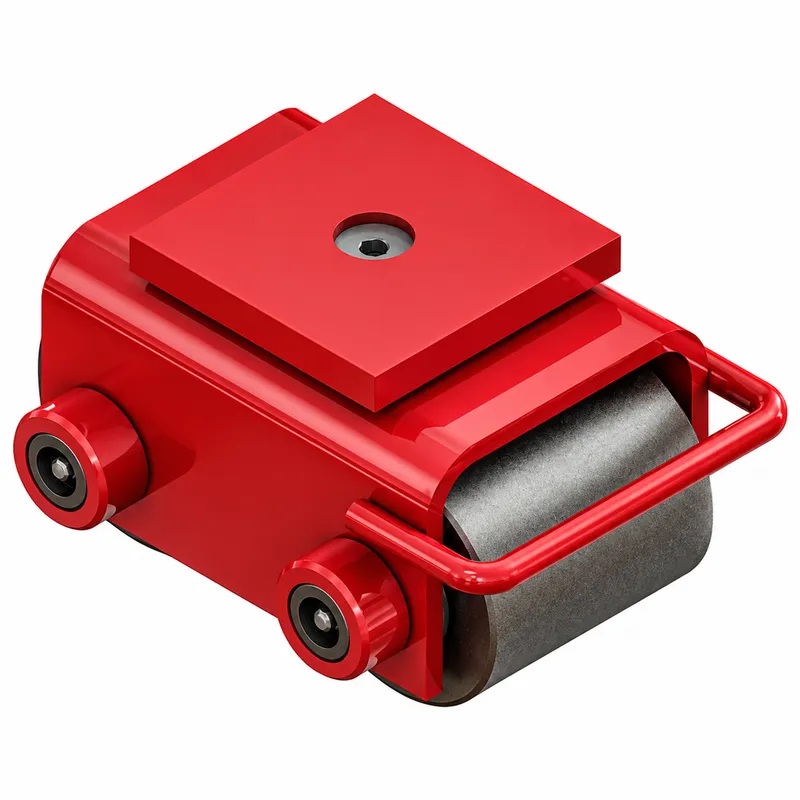
Machine skates — also called machinery skates, equipment skates or moving rollers — are low-profile platforms with roller decks that slide under a machine\'s lifting points or frame rails and turn a stationary piece of equipment into something a qualified rigging crew using suitable lifting and powered handling equipment can move across a shop floor. Unlike casters, skates are temporary: they go under the load for a move and come off when the machine reaches its pad.
Hevi-Haul publishes machine-skate capacities from 1.5 to 100 tons per skate across distinct Utility, Straight Line and Compact Swivel product families. This is one manufacturer's catalog range, not an industry-wide rating or a capacity shared by every construction; the exact family, model, roller type and configuration must be matched to the move. Because a skate sits under the load instead of hanging from it, its height — not its diameter — is the critical dimension: the skate must slide under the clearance your jacking method leaves. That is why every machine-moving RFQ starts with two numbers: how heavy, and how much clearance.
Specifications
| Type | Low-profile roller skate (machine-moving skate) |
|---|---|
| Model-size reference matrix (industry chart) | Hevi-Haul HD-15 (10 US tons per skate): 27-3/4 × 10-1/2 in footprint, 4 in height, 110 lb unit weight, steel rollers. Hevi-Haul's long straight-line steel-roller models range from HD-15 (10 tons) through SD-50 (25 tons), BB-100 (50 tons) and TDM-200 (100 tons); manufacturer model references, not RollMaster ratings |
| Capacity range | Hevi-Haul catalog range: 1.5–100 US tons per skate across distinct Utility, Straight Line and Compact Swivel families; not an industry-wide range or a RollMaster rating. Confirm the exact manufacturer's family, model, roller configuration and current rating before quotation |
| Frame | Welded steel frame |
| Rollers | Steel or PU-coated rollers |
| Operation | Temporary placement under lifting points; steered by handle or supplemental steering skate |
| Published per-SKU reference (manufacturer, straight-line class) | Hevi-Haul HD-15 manufacturer listing: 27-3/4 in long × 10-1/2 in wide × 4 in high, 110 lb, 10 US tons per skate with steel rollers. The cited current manufacturer listing does not specify roller count; do not infer a roller layout from this row |
| Roller ladder (manufacturer reference, per-model) | Hevi-Haul's long straight-line steel-roller ladder is HD-15 10 t, SD-50 25 t, BB-100 50 t and TDM-200 100 t per skate. Its current product pages list HD-15-P 10 t, SD-50-P 20 t, BB-100-P 20 t and TDM-200-P 55 t with polyurethane-coated rollers. An older Hevi-Haul PDF footnote gives BB-100-P 40 t only with all equal-sized 3-1/4 in polyurethane rollers; this conflicts with the current 20 t product-page listing. Treat BB-100-P capacity as configuration-dependent and unresolved until Hevi-Haul confirms the exact roller set in writing |
| Third-party brand — supplied via our sourcing network | Product references on this page may come from more than one third-party source. A retailer or catalog is not necessarily the manufacturer. Where the original manufacturer or exact model/part number is not identified, it is not verified by this listing; confirm both in the written quotation. Any lead time, MOQ or warranty shown as our offer is a RollMaster quotation term, not a third-party manufacturer's published term. |
| Third-party brand — supplied via our sourcing network | Product references on this page may come from more than one third-party source. A retailer or catalog is not necessarily the manufacturer. Where the original manufacturer or exact model/part number is not identified, it is not verified by this listing; confirm both in the written quotation. Any lead time, MOQ or warranty shown as our offer is a RollMaster quotation term, not a third-party manufacturer's published term. |
| RollMaster commercial coverage | 18 months as RollMaster commercial coverage; exact coverage, exclusions and order terms are confirmed in the written quotation. Any manufacturer warranty is separate and must be confirmed for the named manufacturer and exact model. |
Capacity is quoted per exact skate model and roller configuration. The 1.5–100 ton span is Hevi-Haul's published range across several distinct product families, not an industry-wide range and not a RollMaster rating. Never transfer a capacity between steel and polyurethane rollers or between models; confirm the exact model, roller set and current manufacturer rating in writing.
Applications & Selection
What a skate does that a caster cannot
A caster must carry its load all day, every day, through swivels and floor joints — so its capacity is limited by bearings and swivel structure that must also survive motion. A skate only has to survive one move: it is placed under a jacked load, rolls a bounded distance on a known floor, and comes off. Removing the swivel, the brake and the daily-duty requirement is what lets a palm-sized steel platform carry tens of tonnes.
The low profile is the second half of the trick. A machine cannot be lifted far — the gap under its frame after jacking is typically a few centimeters. A skate built to slide into that gap needs minimal height, which is why the roller deck (rollers rotating on axles in a welded frame) beats a wheel: rollers let the platform stay flat and thin while still rolling.
Moving a machine safely starts with a rigging plan, not a generic divisor. Determine the load's weight and centre of gravity, the geometry and strength of approved support points, the number and placement of skates, the lifting sequence, the route and floor capacity. Skate load sharing is not the caster-wheel divide-by-three method; use the skate manufacturer's placement guidance and a qualified machinery mover or rigger to calculate each unit's actual load.
Selection points to settle before you RFQ
Weight, centre of gravity and clearance first: state the machine's shipping weight, load distribution and the clearance achieved by the approved lifting method. Determine skate quantity and positions from load geometry, approved support points, floor condition and the manufacturer's instructions. Do not assume equal sharing or use a fixed three-skate divisor; size every unit for its calculated worst-case load. Roller surface second: steel rollers give the lowest rolling resistance on smooth concrete and carry the most; PU-coated rollers protect epoxy-sealed and painted floors from marking at some cost in rolling effort. State your floor — the floor type selection logic used for casters applies here too.
Steering last: straight-line moves need only a handle bar; turns need a steerable (swivel-top) skate placed as the lead unit, or skates repositioned in stages. For long or frequent moves, say so — the skate set and the moving plan are quoted together.
How a skate set goes wrong — the misuse modes to design out
A skate set can become overloaded when the centre of gravity is offset, support points are not designed for the load, the floor is uneven, or a unit unloads and the remaining units take more than their planned share. Do not assume four units each carry one quarter, that three units are always sufficient, or that a fixed number of jacks is safe. The number and position of support points, blocking, restraints and jacking sequence must follow the load geometry, manufacturer instructions and a qualified rigger's plan. Check floor capacity and each skate's exact model/roller rating before moving; never exceed any unit rating.
The second failure family is floor and roller mismatch. Steel rollers excel on rough or uneven floors and tolerate extended resting loads; polyurethane-coated rollers protect sealed and painted floors but are not suitable for extended resting loads or rough, debris-riddled surfaces, and the manufacturer ladder derates poly-roller models accordingly. Leaving a machine resting on poly rollers for weeks, or skating across grit that embeds in the coating, turns a floor-protecting choice into a marking one. Storage is part of this: keep rollers greased and deck faces clean, keep PU out of direct sunlight, and take the static load off the rollers once the move is done.
Skate, dolly, caster or roller skid — where the boundary sits
The boundary is duty cycle and height. A caster is a permanent attachment that carries its load every day through swivels and floor joints; a dolly is a taller wheeled platform meant for lighter, repeated moves; a skate is placed once for a bounded move under a jacked load and comes off. If the move happens once at installation, the skate wins on capacity-per-platform and on the few centimeters of clearance it needs; if the load moves daily, casters replace it; if the "machine" is a structural member — a beam, a press crown in sections — the same class extends into structural mover and beam-roller lines that the skate taxonomy shares.
The steering boundary is motion itself. A steerable (swivel-top) unit belongs at the front of the set and is only steered while the load is in motion; straight-line moves need nothing more than a handle bar, and turns that cannot be rolled are taken by repositioning the set in stages. Kits that pair one steer unit with straight units exist at every capacity tier in the class — stating the path (straight, one turn, many turns) in the RFQ decides the set composition before quotation, not after delivery.
Quality & Verification
The spec values for Machine Skates and Equipment Moving Casters draw on 8 field-level source records — 1 tenant confirmed, 2 manufacturer reference, 5 industry reference.
| Claim on this page | How a buyer verifies it |
|---|---|
| Load rating | Catalog ratings bind one configuration. State wheel, bearing, speed and duty. Require that exact rating on the quotation. |
| Sample or test report | Request test data or certificates per SKU. Agree acceptance in writing before the order. |
| Materials and tread | Confirm material by certificate, not description. Unresolved options are fixed at quotation. |
| Bearings | Name the bearing type in the RFQ. "Standard bearing" is not a specification. |
| Standards and compliance | Name the standard and certify against it. An unnamed equivalent is not a certification. |
What this page cannot verify
- No figure on this page is our own lab result.
- The binding rating is the quotation figure.
Sources for this page
- [1] Hevi-Haul HD-15 exact manufacturer model: 10 US tons per skate, steel rollers, 27-3/4 × 10-1/2 × 4 in, 110 lb; steel and PU roller ladders remain model/configuration-specific — manufacturer reference (https://www.hevihaul.com/machinery-skates/straight-line-skates/straight-line-skates-rigid-long/hd-15/) — manufacturer model page refreshed 2026-11-24; no roller count inferred; older Mappcaster lead is rejected as blocked/expired
- [2] swivel/dual-wheel skate design facts (dual-swivel spreads load; rigid vs swivel with integrated turntable; from 8,000 lb the load secures the system without clamps) — industry reference (https://www.casterconcepts.com/skates) — added 2026-11-17 machine-skates depth batch; design-practice description only
- [3] rigging practice context (machine skates in heavy load movement — rigger guidance) — industry reference (https://www.rbaker.com/press-room.php?id=3741&title=Rigger%27s+Guide+to+Machine+Skates+-+Role+in+Heavy+Load+Movement) — added 2026-10-28 provenance batch x21; corpus-located (knowledge.db parsed_segments)
- [4] operations guidance (load assessment, pinch-bar lift, toe-jack placement before skating) — industry reference (https://liftingequipmentstore.com/blogs/blog/machine-skates-an-efficient-way-of-moving-heavy-loads) — added 2026-10-28 provenance batch x21; corpus-located (knowledge.db parsed_segments); practice description only, no figures taken
- [5] channel taxonomy (machine skates & rollers category — DAYTON / GKS-Perfekt / Hilman Rollers brand lines) — industry reference (https://www.imperialsupplies.com/browse/material-handling/moving-and-distribution/dollies-and-movers/machine-skates-rollers) — added 2026-10-28 provenance batch x21; corpus-located (knowledge.db parsed_segments); existence-of-class evidence
- [6] machine-skate family ranges and frame/roller construction — manufacturer reference (https://www.hevihaul.com/machinery-skates/) — current primary manufacturer source refreshed 2026-11-24; independent second-publisher corroboration remains requisitioned (REQ-caster-machine-skates-second-source); not a RollMaster rating
- [7] lead_time/moq/warranty — tenant confirmed (first-party) — owner answers 2026-10-26 (Foundation runtime/owner-answers-20261026.json)
- [8] operations guidance (three-point rule, steering) — industry reference — derived from published rigging practice and gate-passed knowledge articles; no figures beyond the reference range
Frequently Asked Questions
Are machine skates the same as machinery moving rollers or equipment skates?
Yes — those are regional and vendor synonyms for the same product: a low-profile roller platform placed under a load to move it. The names that cause real confusion are "skate" versus "dolly" (a dolly is usually a wheeled platform, taller, meant for lighter repeated use) and versus "caster" (permanent attachment). RFQs that state the machine weight and under-frame clearance get quoted correctly regardless of the name used.
How many skates do I need and what capacity each?
There is no universal minimum count or safe divide-by-three rule for machine skates. The required number and placement depend on the machine's centre of gravity, approved support points, frame stiffness, skate design, floor condition and the lifting/moving plan. Have a qualified machinery mover or rigger calculate the load on each unit and confirm that every exact model and roller configuration stays within its manufacturer's rating. Include the route, floor capacity, slopes and thresholds in that review.
What should my machine skate RFQ include?
Machine weight (shipping weight, with the heaviest component stated separately if known), available clearance under the frame after jacking, floor type and condition, distance and path (straight or turning), roller surface preference, and how many moves the set must survive. Purpose-built moves — press bodies, CNC machining centers, injection molds — quote fastest when the machine footprint is included.
Ordering & Documentation
Documents
Orders ship with a packing list and commercial invoice. On request we provide the skate\'s dimension sheet (height, platform size, roller layout) so your rigging plan can be checked against the jacking clearance before the skates ship.
Quotation
A quotation needs: machine weight, clearance, floor type, move path, roller surface and set size. The quoted class and its per-unit rating are confirmed on the quotation against your stated load — the published industry range is for class selection, not the commitment.
Sample & supply
Third-party brand — supplied via our sourcing network. Product references on this page may come from more than one third-party source. A retailer or catalog is not necessarily the manufacturer. Where the original manufacturer or exact model/part number is not identified, it is not verified by this listing; confirm both in the written quotation. Any lead time, MOQ or warranty shown as our offer is a RollMaster quotation term, not a third-party manufacturer's published term.
Storage & shipping
Skates are heavy steel and ship bare or palletized. Between moves, keep the roller axles greased and the deck faces clean — a chip of welding slag or a hardened grit line across the rollers marks floors and raises rolling effort. Store indoors; PU-coated rollers should be kept out of direct sunlight, which ages the coating. Never store a skate under a load for weeks — take the static load off the rollers when the move is done.