
Product Catalog
Rubber Caster Wheels — Solid & Elastic Rubber for Quiet, Floor-Safe Rolling
Third-party brand — supplied via our sourcing network
Product references on this page may come from more than one third-party source. A retailer or catalog is not necessarily the manufacturer. Where the original manufacturer or exact model/part number is not identified, it is not verified by this listing; confirm both in the written quotation. Any lead time, MOQ or warranty shown as our offer is a RollMaster quotation term, not a third-party manufacturer's published term.
Updated 2026-11
Rubber caster wheels are the quietest, most floor-forgiving wheels in the catalog, and the reason is mechanical: a soft elastomer tread deforms under the load, so the contact patch grows, sharp debris and floor seams are cushioned instead of transmitted, and the energy of a bump is absorbed as a momentary squish rather than a rattle through the frame. That is why rubber is the default wheel for equipment carrying sensitive goods — medical carts, instrument trolleys, catering and hospitality equipment — and for carts that cross expansion joints, thresholds and dock plates all day.
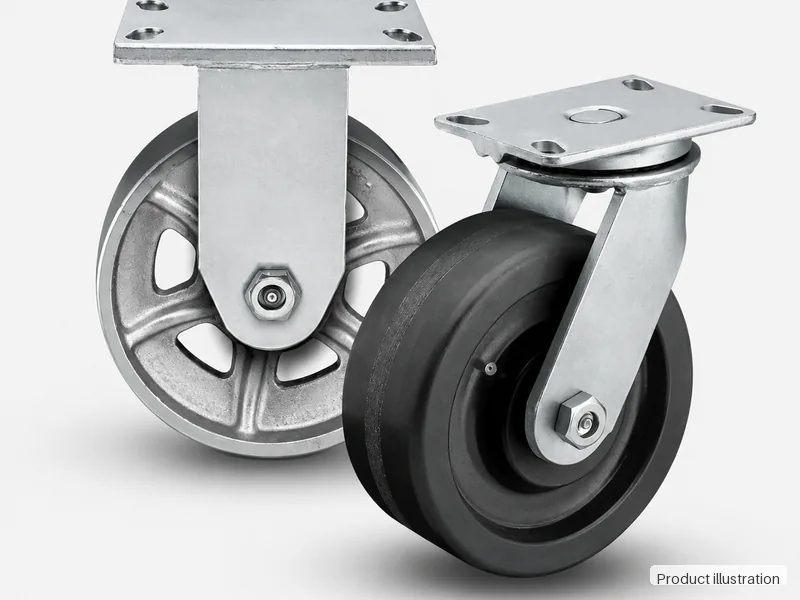
This sourced family covers two catalogued constructions: solid rubber on a steel core, and elastic (super-elastic grey) rubber on steel or polypropylene cores for quieter, lower-resistance rolling. These products are supplied through coordinated procurement and are not represented as RollMaster-manufactured. Compound availability, core, bracket finish and inspection scope vary by supplier and exact model; confirm them against the named manufacturer/model and written quotation. Do not assume batch hardness or tread-bond testing unless an applicable supplier inspection record is available.
Specifications
| Wheel materials | Solid rubber on steel core · Elastic (super-elastic grey) rubber on steel or PP core · oil-resistant and heat-resistant compound options |
|---|---|
| Model-size reference matrix (industry chart) | RR soft rubber: 125–360 lb, Ø 3–8 in, −40…+180 °F; OA press-on: 1,270–10,190 lb, Ø 8.5–22 in; solid rubber by diameter: Ø 4 in 200–300 lb, Ø 5 in 300–500 lb, Ø 6 in 400–700 lb — published chart rows, per-publisher reference for sizing, not supplier ratings; the binding rating is confirmed per configuration at quotation |
| Family load band | 30–400 kg per caster (declared line band; per-size rating confirmed at quotation) |
| Industry reference band | Solid rubber commonly 200–500 lb per wheel at 5 in diameter (industry comparison data, not a supplier rating) |
| Temperature range | Industry reference for solid rubber: −20…160 °F continuous; compound-specific limits confirmed at quotation |
| Floor protection | Excellent (industry comparison consensus); non-marking compounds available |
| Rolling resistance | Medium-high vs PU/nylon — the trade for quietness and cushioning |
| Brackets & finish | Steel brackets, zinc-plated |
| Quotation baseline | 200 pieces — RollMaster quotation-calculation baseline only; actual supplier MOQ is confirmed for the named manufacturer/model and configuration |
| Warranty | 18 months of RollMaster coverage; any manufacturer warranty is separate and confirmed for the actual supplier/model |
The 30–400 kg/caster figure is the RollMaster-declared catalog family band, not a rating for every sourced model. Industry comparison figures (the 5-inch 200–500 lb reference) are published comparison data for orientation between materials, not a product rating; the figure for the selected diameter, compound and bearing is confirmed against the exact manufacturer/model at quotation.
Applications & Selection
Where rubber earns its keep — and where it does not
Rubber is the right answer when the load is light-to-medium and the priority is what the wheel does to its surroundings: it protects the floor, the cargo and the ears. Hospital and lab carts, food-service equipment, hotel and janitorial trolleys, lightly loaded shelving units moved across finished floors, and any cart that crosses dock plates or door thresholds repeatedly all reward rubber’s cushioning. On rough concrete or jobsite debris, rubber on a cast-iron core keeps grip where harder treads skid — one reason scaffold and rental fleets still spec rubber despite the load penalty.
The honest limits: rolling resistance is the highest of the common tread materials, so a heavy cart on rubber takes noticeably more push effort than the same cart on polyurethane; load capacity per wheel is the lowest of the family (industry comparison data puts solid rubber at roughly half a polyurethane wheel of the same size); and rubber has real enemies — ozone (electric motors, welders), some oils and solvents, and prolonged outdoor sunlight. An oil-resistant compound may suit some chemical exposures, but compatibility must be confirmed for the actual formulation and exposure; it does not make a rubber wheel suitable for every 24/7 outdoor yard, where pneumatic or engineered-TPR constructions may be more appropriate.
Between the two constructions: solid rubber on a steel core is the durability choice where loads sit at the top of the band and the route is long; elastic grey rubber on a PP core is the comfort choice for lighter carts where quiet running and a low price matter most, with the plastic core removing corrosion from the wet-wipe-down equation entirely.
Selection points to settle before you RFQ
Load per wheel first, calculated the standard way: total load divided by three for a four-caster rig, then keep the working figure comfortably inside the band — rubber punishes running at its ceiling with flat-spotting and premature bond failure. If your number lands above roughly 400 kg per caster, move to polyurethane or nylon rather than asking rubber to stretch; the material families exist because the trade-offs are real.
Environment second: name the floor (finished, sealed concrete, rough outdoor), the temperature, and any chemical or washdown exposure. Ozone sources on the route (motor banks, welding bays) decide the compound as much as load does. For washdown and wet areas, say so — the PP-cored elastic wheel and stainless-fitted options exist for exactly that spec.
Bearings and speed last: rubber wheels are usually run at walking pace, so plain bore or ball bearings cover most cases; state expected daily distance and any towed use so the bearing and bond are quoted for the duty, not just the load. The same sizing arithmetic used across our catalog (total load ÷ sharing casters, then the duty margin) applies unchanged here.
Quality & Verification
The spec values for Rubber Caster Wheels draw on 6 field-level source records — 2 tenant confirmed, 0 manufacturer reference, 4 industry reference.
| Claim on this page | How a buyer verifies it |
|---|---|
| Load rating | Catalog ratings bind one configuration. State wheel, bearing, speed and duty. Require that exact rating on the quotation. |
| Sample or test report | Request test data or certificates per SKU. Agree acceptance in writing before the order. |
| Materials and tread | Confirm material by certificate, not description. Unresolved options are fixed at quotation. |
| Bearings | Name the bearing type in the RFQ. "Standard bearing" is not a specification. |
| Standards and compliance | Name the standard and certify against it. An unnamed equivalent is not a certification. |
What this page cannot verify
- No figure on this page is our own lab result.
- The binding rating is the quotation figure.
Sources for this page
- [1] durometer context (Shore A per ASTM D2240 - the hardness spec that predicts tread feel and failure mode; rubber occupies the lower Shore A range vs PU) — industry reference (https://casterhq.com/blogs/caster-university/polyurethane-vs-rubber-casters) — accessed 2026-10-28; second publisher for the materials comparison; class context only, no supplier figure
- [2] elastic rubber positioning (stronger shock absorption; equivalent wheel sizes support lower loads than PU/nylon) — industry reference (https://conveyorparts.eu/how-to-calculate-the-correct-load-capacity-for-industrial-castors/) — accessed 2026-10-28; independent publisher corroborating the solid-vs-elastic construction split and capacity trade-off
- [3] materials (solid rubber on steel core, elastic grey rubber on steel/PP core), compound options, 30–400 kg family band and zinc-plated bracket option — tenant confirmed (first-party) (owner://vertical.config.json + services.ts rubber-casters (owner copy)) — supplier-declared catalog options; per-batch hardness/bond inspection is not asserted without applicable supplier/model records
- [4] model-size reference matrix (RR 125–360 lb Ø 3–8 in; OA 1,270–10,190 lb Ø 8.5–22 in; solid rubber per-size 200–300/300–500/400–700 lb) — industry reference (https://albioncasters.com/caster-college/wheel-selection-chart/) — the two cited publisher pages, collected 2026-11-18 (albioncasters.com chart; casterhq.com size bands) — per-type/per-size chart rows, never supplier ratings
- [5] industry reference band (solid rubber 200–500 lb @ 5 in, −20…160 °F, medium-high rolling resistance, excellent floor protection, vulcanized-bonded tread on metal hub) — industry reference (https://casterhq.com/pages/caster-wheel-materials-guide) — accessed 2026-10-26; rendered as industry reference, never as supplier ratings
- [6] lead_time/moq/warranty — tenant confirmed (first-party) — owner answers 2026-10-26 (Foundation runtime/owner-answers-20261026.json)
Frequently Asked Questions
Rubber or polyurethane — which should I choose?
Rubber when cushioning, quietness and floor protection outrank effort and capacity; polyurethane when the cart is heavier, pushed all day, or the route is long. A useful shorthand from published comparisons: rubber wins on shock absorption and noise, PU wins on load capacity, rolling ease and abrasion life, and both protect floors well. If the load is under ~150 kg per caster, indoor, and noise-sensitive, start with rubber; above that or on long routes, start with PU.
How much load can a rubber caster wheel carry?
The RollMaster-declared catalog family band is 30–400 kg per caster; it is not a rating for every sourced model. The exact figure depends on wheel diameter, tread width, compound and bearing, and must be confirmed against the named manufacturer/model. Published industry comparisons put solid rubber around 200–500 lb per wheel at 5 in diameter — treat those as material-to-material reference points, not as a rating for a specific wheel.
What should my rubber wheel RFQ include?
Load per wheel, wheel diameter and tread width (or the old wheel’s measurements), solid-steel-core or elastic-PP-core construction preference, the environment (temperature, oil, ozone sources, washdown), floor type, bearing preference, mounting (top plate size or stem), brake requirement and quantity per size. If quiet operation is the reason you are choosing rubber, say so — compound and tread thickness are selected differently for a hospital corridor than for a loading dock.
Ordering & Documentation
Documents
Transaction documents are confirmed for the quoted supply route. A wheel dimension sheet, compound statement or inspection record is included only when the actual supplier/manufacturer can provide an applicable document for the named model; confirm document availability and issuer before order.
Quotation
A quotation needs: construction (solid steel-core or elastic PP-core), diameter and tread width, compound requirement (standard, oil-resistant, heat-resistant), bearing type, mounting, environment and quantity. The confirmed quotation states the load rating for your exact configuration — family bands and published industry figures are orientation data, and the order commitment is the figure on the quotation.
Sample & supply
Sourced models are supplied through coordinated procurement; they are not represented as RollMaster-manufactured items. The 200-piece figure is RollMaster’s quotation-calculation baseline only; it is not a universal supplier MOQ. Supplier MOQ, model availability, stock, sample terms and production/dispatch schedule are confirmed in writing for the named supplier, manufacturer where identified, exact model, configuration and quantity. The 18-month term is RollMaster coverage; any manufacturer warranty is separate and must be confirmed for the selected model. For critical duty, validate a sample on the actual route where one is available; sample availability and any test documentation must be confirmed before order. No fixed family-wide supplier lead time is promised.
Storage & shipping
Rubber ages in storage faster than any other tread in the catalog, so the storage rules matter: keep wheels indoors, out of direct sunlight, away from electric motors, welders and other ozone sources, and away from steam lines and heat. Do not store casters stacked under load — a tread held compressed for months takes a permanent set. Original packaging until fitting; bearings stay in their factory grease until installation.