
Product Catalog
Polyurethane Caster Wheels — Cast and Injected PU Treads on Iron or Steel Cores
Updated 2026-11
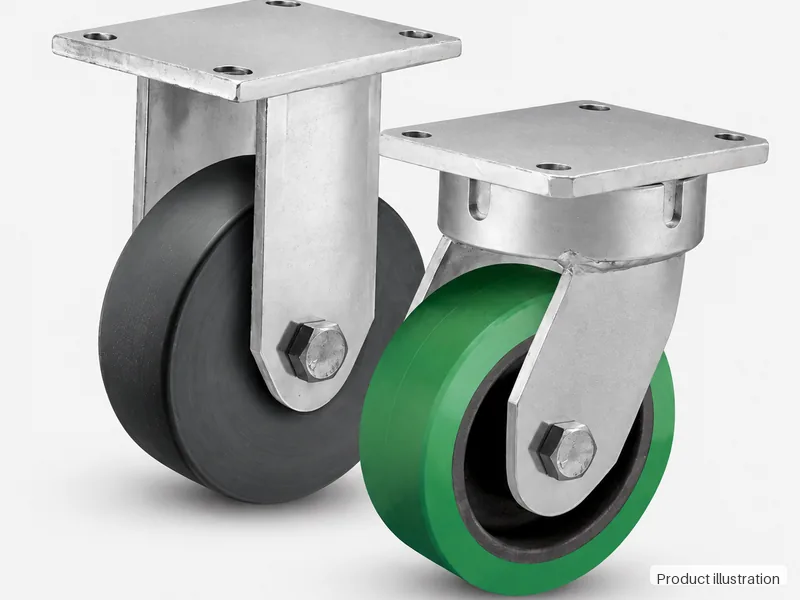
Polyurethane is widely used as an industrial caster tread because it combines load-bearing capability, low rolling resistance and resistance to many oils and greases while providing more floor protection than hard metal treads. Our polyurethane caster wheels use cast or injected PU treads bonded to grey-iron or steel cores. The exact wheel diameter, tread width, compound and core construction are confirmed for the selected model; the factory-wide 25–300 mm manufacturing envelope must not be read as a size range available in this PU family. A food-grade white PU option can be discussed for food-adjacent equipment, subject to the exact compound and applicable documentation.
The owner record declares 1,500 kg dynamic and 2,500 kg static as PU-family upper-bound figures, but does not identify the rated object (wheel, complete caster assembly or another test configuration), the test method, or the load distribution. These figures are therefore not usable design ratings for a wheel, caster or equipment load path. Do not compare the two figures as if their test basis were known; obtain the exact model rating and supporting test conditions before sizing or approving an application. Around 80 Shore A and 95 Shore A are common industrial PU reference grades, not confirmation that either grade is available on every model; the compound and hardness are confirmed in the quotation.
Specifications
| Wheel material | Polyurethane (PU) tread on grey iron or steel core |
|---|---|
| Core material | Grey iron or steel core — the PU tread is cast or injected onto and bonded to the core; aluminum-core and polypropylene-core PU wheels are separate wheel families |
| Bearing & bore | Ball or roller bearing, quoted per bore size and hub length — bearing choice is a quotation decision matched to load and speed, not a family default |
| Tread width | Quoted per size and core — industry PU wheel lines span roughly 1-3/8 to 6 in tread width across 3-18 in diameters (manufacturer line context for orientation, not a supplier family band) |
| Brake structure | Not applicable to the wheel family — braked units are configured on the caster families (see Swivel Casters with Brake) |
| Bracket material | Not applicable to the wheel family — brackets belong to the caster families (welded steel brackets on the RM series) |
| Load rating (PU family; unit and test basis to confirm) | 1,500 kg dynamic · 2,500 kg static (owner-declared PU-family upper bounds. The owner record does not specify whether these figures apply to an individual wheel, a complete caster assembly, or a defined test configuration. Do not use them as a per-wheel or per-assembly rating; confirm the exact model, load path and test basis in the quotation.) |
| Model-level parameter matrix | To be confirmed — model designations follow the RM-PU-<wheel-diameter> convention (RM-PU-100/125/150 class names in line planning are illustrative); the per-model cells (wheel diameter, tread width, PU hardness, core material, bore, bearing type, dynamic load, static load, speed, temperature, weight) land only from factory product records and test reports. No model-level cell is published until its record exists — the family figures on this page are the only numbers carried today |
| Durometer grades | ~80 Shore A and ~95 Shore A are the common industrial PU grades (industry reference for grade selection — your quoted grade is confirmed at quotation) |
| Published series structure (industry reference) | Manufacturer PU lines split cast-iron-core series (PY/PX/PH) from aluminum-core series (PA/PD/PM), with line capacities 300-10,900 lb across 3-18 in diameter and 1-3/8 to 6 in tread width at 80/95 Shore A — manufacturer line context for selection, never a supplier family rating |
| Solid elastomer line (industry reference) | A published solid-polyurethane line bands 900-2,500 lb across 3.25-10 in — the no-flat solid option where resilient-but-puncture-proof duty is wanted; per-line figure, not ours |
| Temperature range | −20…+80 °C (standard PU); −40…+120 °C (special PU) — owner-declared PU-family material bands, not complete-caster guarantees; confirm exact compound, bearing, grease and duty by model. |
| Speed rating | ≤ 4 km/h (8 km/h precision bearing series) |
| Size availability | The 25–300 mm figure is the factory-wide manufacturing envelope, not a confirmed size range for this PU family. Confirm the exact PU wheel diameter and tread width by model and quotation. |
| Food option | Food-grade white PU available |
| Lead time | 15–20 days (custom configurations 30–40 days) |
| MOQ | 200 pieces per model; trial orders negotiable |
| Warranty | 18 months |
The 1,500 kg dynamic / 2,500 kg static figures are owner-declared upper bounds for the PU family, not per-size ratings. The owner record does not identify the rated unit (individual wheel or complete caster assembly) or test configuration. Confirm the exact model, load path and test basis before using either figure for equipment sizing; the rating for the selected configuration is confirmed at quotation. Industry manufacturers list PU wheel capacities across far wider bands (one major manufacturer quotes 300–10,900 lb across its line); treat published figures as reference points, not commitments.
Applications & Selection
Where polyurethane is the right tread — and where it is not
Specify PU when the load is real but the floor still matters: factory floors, warehouse concrete, tiled or coated surfaces that steel would chew up. PU rolls easier than rubber at equal load, shrugs off the oils and solvents that swell rubber, and outlasts soft treads under abrasive debris. It is the tread behind most RM-Medium and RM-Heavy heavy-duty casters, and it is what an AGV wheel usually is once you add tight manufacturing tolerances.
Know the confirmed material and assembly limits before selection. The owner-declared standard and special PU temperature bands are family-level material declarations, not a complete-wheel guarantee; verify the tread compound, bearing, grease and other components for the exact model. The 2,500 kg static figure has no confirmed rated object or test basis and is not a parking-load or long-term static design rating. Obtain the selected model’s documented static-load limit and duration/creep conditions before approving equipment that remains loaded while parked.
Choose the durometer deliberately. Industry manufacturers build their PU lines around ~80 A and ~95 A grades for good reason: the softer grade rolls quieter, protects floors and conforms slightly to imperfect surfaces; the harder grade carries more and resists flat-spotting but transmits more vibration and noise. Load per wheel plus floor quality decides between them — the shore hardness guide and the PU load-capacity-by-durometer article walk the trade in numbers.
Selection points to settle before you RFQ
Calculate load per wheel with the three-of-four rule, then decide dynamic versus static honestly: equipment that rolls continuously, parks loaded, or sees shock loads needs the rating matched to that duty, not an average of them. If the duty is towing or impact-heavy, say so — PU on a steel core handles it, but the grade and core design change.
State the environment: temperature extremes (against the std/special PU bands), chemical exposure, washdown frequency, and floor condition. The food-grade white PU option exists for food-adjacent equipment — name the hygiene requirement in the RFQ so the correct compound and certification path is quoted.
Fix the hardware: bearing type (ball for easy rolling, roller for heavy slow duty), bore size, swivel/rigid/brake layout, and top plate. PU wheels are core-and-tread assemblies; if you need a replacement wheel only, state the existing bore and hub length so the new wheel mates with your fork.
How do you verify a polyurethane wheel before it enters service?
Durometer and dimensions are the checks a buyer can run on delivery. Spot-check tread hardness against the quoted grade — an 80 Shore A wheel that measures like 95 Shore A is not the wheel you specified, and the personality trade (quiet and floor-friendly versus hard and high-capacity) rides entirely on that number. Measure diameter, tread width and bore; a bonded wheel beyond diameter tolerance changes contact area and therefore capacity. Request the tread compound statement for the quoted configuration rather than accepting "polyurethane" as a complete specification — industry comparisons are explicit that shock absorption, noise and floor protection vary with the formulation and the core, so two PU wheels of the same size do not necessarily ride the same.
Function is verified by trial, not by certificate. Roll the wheel on your actual floor under actual load: low rolling resistance is a real PU property (industry ergonomics comparisons credit it for reduced operator effort, especially with precision ball bearings), but traction on smooth or wet surfaces is the known limit in lighter-duty applications — verify it where it matters rather than assuming it. On bonded wheels, inspect the bond line after the trial: a tread that has begun to lift or a wheel that has flat-spotted under your duty cycle disqualifies the configuration before it multiplies across a fleet. Unresolved duty assumptions are fixed at quotation; a trial result beyond the tested condition extends to nothing.
Quality & Verification
The spec values for Polyurethane Caster Wheels draw on 9 field-level source records — 2 tenant confirmed, 4 manufacturer reference, 3 industry reference.
| Claim on this page | How a buyer verifies it |
|---|---|
| Load rating | Catalog ratings bind one configuration. State wheel, bearing, speed and duty. Require that exact rating on the quotation. |
| Sample or test report | Request test data or certificates per SKU. Agree acceptance in writing before the order. |
| Materials and tread | Confirm material by certificate, not description. Unresolved options are fixed at quotation. |
| Bearings | Name the bearing type in the RFQ. "Standard bearing" is not a specification. |
| Standards and compliance | Name the standard and certify against it. An unnamed equivalent is not a certification. |
What this page cannot verify
- No figure on this page is our own lab result.
- The binding rating is the quotation figure.
Sources for this page
- [1] load_rating (1,500 kg dynamic / 2,500 kg static), temperature bands, size range, food-grade option — tenant confirmed (first-party) (owner://vertical.config.json (route A 2026-10-01)) — audit 2026-10-26: dynamic/static correctly split, temperature std/special split — no scale merging
- [2] durometer grades (80/95 Shore A) and industry capacity band (300–10,900 lb) — manufacturer reference (https://albioncasters.com/wheels/polyurethane/) — Albion manufacturer PU line page, accessed 2026-10-26 — rendered as industry reference for grade selection, never as supplier ratings
- [3] chemical/abrasion resistance context — industry reference (https://consolidatedcaster.com/polyurethane-vs-rubber-casters/) — corroboration context only
- [4] published series structure (cast-iron-core PY/PX/PH vs aluminum-core PA/PD/PM; line band 300-10,900 lb, 3-18 in dia, 1-3/8-6 in tread, 80/95 Shore A) — manufacturer reference (https://albioncasters.com/wheels/polyurethane) — added 2026-10-28 SKU depth pass tier 2; corpus-verbatim ledger entry in packs/industrial-caster-wheels/model-evidence.json; line context only, never merged with supplier family ratings
- [5] solid-polyurethane line band (900-2,500 lb, 3.25-10 in) — manufacturer reference (https://albioncasters.com/caster-college/wheel-selection-chart) — added 2026-10-28 SKU depth pass tier 2; corpus-verbatim ledger entry in packs/industrial-caster-wheels/model-evidence.json; per-line figure, never a supplier rating
- [6] rubber-vs-PU trade (rubber excels in shock absorption and traction; PU shock/noise/floor protection varies with formulation and core; PU higher initial cost; PU go-to for heavy-duty durability/load/abrasion; PU low rolling resistance ergonomics) — industry reference (https://www.casterspecialists.com/blogs/industry-company/a-comparative-analysis-of-rubber-and-polyurethane-casters-in-industrial-settings) — added 2026-11-14 blueprint production batch; corpus-verbatim ledger entry in packs/industrial-caster-wheels/model-evidence.json; material-class trade context, no figures rendered
- [7] nylon-vs-PU trade (nylon harder/more rigid, resists compression, lower rolling resistance on hard floors; PU compresses, absorbs shock, quieter, better floor protection) — industry reference (https://monroeengineering.com/blog/nylon-vs-polyurethane-casters-which-is-best/) — added 2026-11-14 blueprint production batch; corpus-verbatim ledger entry in packs/industrial-caster-wheels/model-evidence.json; material-class trade context, no figures rendered
- [8] lead_time/moq/warranty — tenant confirmed (first-party) — owner answers 2026-10-26 (Foundation runtime/owner-answers-20261026.json)
- [9] caster field model rows (core material; bearing & bore as quotation decision; tread width per size with manufacturer line band restated from the Albion series-structure provenance above; brake/bracket rows marked not applicable to the wheel family) — manufacturer reference (https://albioncasters.com/wheels/polyurethane) — remediation E 2026-11-17 — canonical caster field set applied; core/bearing/bracket applicability from existing supplier and industry-context statements, no new figures
Frequently Asked Questions
What is the difference between 80 Shore A and 95 Shore A polyurethane caster wheels?
Durometer — tread hardness — and it drives the whole personality of the wheel. 80 Shore A is the softer industrial grade: quieter, more floor-friendly, better on debris-strewn or uneven floors, slightly lower capacity. 95 Shore A is the hard grade: maximum load capacity, better flat-spot resistance, more vibration and noise transmitted to the cart. Both are standard industrial PU grades; the right one is decided by load per wheel, speed and floor, and our polyurethane shore hardness guide explains the trade with the underlying numbers.
Why are dynamic and static load ratings different for PU wheels?
Dynamic and static ratings describe different test conditions, but the owner record does not specify the rated object, test method, load distribution or duration for its 1,500/2,500 kg family-level figures. Do not use them as a wheel, caster or equipment design rating. Request the exact model’s documented dynamic and static limits with test conditions before sizing the application.
What should my polyurethane wheel RFQ include?
Diameter and tread width, load per wheel and duty (rolling, parked, shock, towed), floor type, temperature and chemical exposure, preferred durometer or the noise/floor-protection constraint, bearing type and bore, hub length if a replacement wheel, swivel/rigid/brake configuration and quantity. Food-adjacent or washdown equipment should be named — it changes the compound and the documentation quoted.
When does rubber outperform polyurethane despite PU\'s load advantage?
On shock absorption, traction and sometimes floor protection — the three places PU is weakest. Industry comparisons of the two materials state it directly: rubber excels in shock absorption and traction, and depending on the polyurethane formulation and core material, PU may not match a performance rubber wheel on shock absorption, noise reduction or floor protection, while also giving up traction on certain surfaces in lighter-duty applications. Rubber also usually wins on initial cost. The flip side is just as firm: PU carries more, resists abrasion, rolls easier and non-marking, and is the go-to tread for heavy-duty duty. If your floor is rough, your loads are light, and impact dominates, rubber deserves the first look.
Which wheel carries a steady heavy load better — nylon or polyurethane?
Nylon, if the load is the whole story. Nylon is the harder, more rigid material: it resists compression, deforms less under heavy standing loads, and generally gives lower rolling resistance on hard floors. PU compresses slightly under the same weight — which is exactly why it absorbs shock, rolls quieter and protects the floor better. Published comparisons settle it as a trade, not a winner: nylon for maximum load and rigidity where noise and floor scarring do not matter, polyurethane where cushion, quiet running and floor protection share the priority with load. On uneven or debris-strewn floors, check the resilient-tread option too — a hard wheel of either material rolls debris into its own tread.
Ordering & Documentation
Documents
Every order ships with a packing list and commercial invoice. On request we provide the wheel dimension sheet (diameter, width, bore, hub length, bearing) and the tread compound statement for the quoted configuration — including the food-grade declaration path where white PU is supplied.
Quotation
A quotation needs: size, durometer grade (or the duty constraints so we can propose one), bearing and bore, load and duty class, environment and quantity. The confirmed quotation states the rating for your exact wheel — family dynamic/static figures are declared bounds of the line, not per-size commitments.
Sample & supply
Standard sizes are produced to order with an MOQ of 200 pieces; trial-order quantities are negotiable; confirm availability and terms for the specified model in your RFQ. Lead time is 15–20 days for standard configurations and 30–40 days for custom durometer, core or bore work. Samples ship freight collect and are refundable against a bulk order.
Storage & shipping
PU wheels ship cartoned with tread protection. Store them indoors, out of direct sunlight, away from heaters, motors and welding bays — ozone and UV age polyurethane and cost it capacity and cushion. Do not store wheels stacked under load or on sharp-edge racks that dent the tread; keep bearing bores packaged until assembly.