
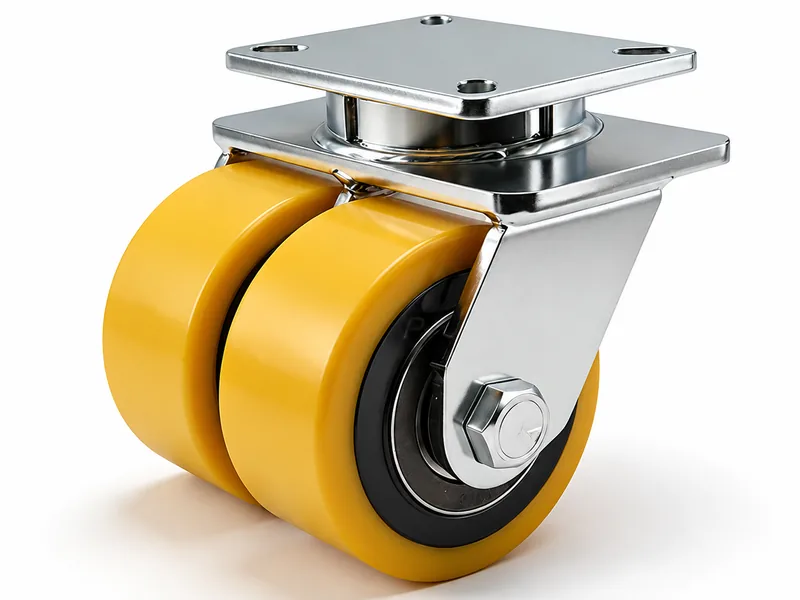
Send us the application, drawing or sample reference, load per caster, wheel and bracket requirements, mounting interface, operating environment and target quantity. We review the requirement against the RM core series and available products from identified manufacturers.
Core caster families are supplied through own-production arrangements. Complementary or non-standard items may be coordinated through sourcing, with the actual manufacturer and model identified. We do not make a blanket promise of OEM/ODM manufacturing, private labelling, custom tooling or drawing-based production; any such project is offered only after the actual cooperating factory, scope, samples, documentation and commercial terms have been confirmed.
Process Overview
A custom or OEM caster project replaces the catalogue decision - which bracket, which wheel - with a specification decision: your drawing, your compound, your brand on a production line that already makes casters at industrial volume.
The economic logic is tooling: existing bracket tooling with a compound or marking change is a fraction of the cost of a new bracket, which is why the first quotation question in any OEM project is how close the requirement sits to an existing platform.
Casters by Load Range
| Series | Load per caster | Typical wheel options | Best for |
|---|---|---|---|
| RM-Light | up to 150 kg | Nylon, rubber, elastic | Light trolleys, medical and display carts |
| RM-Medium | 150–500 kg | Polyurethane, nylon | Warehouse carts, racks, AGV/AMR platforms |
| RM-Heavy | 500–1500 kg | Polyurethane on steel, forged steel | Die carts, machinery moving, heavy trolleys |
| RM-Extreme | 1500 kg and up | Forged steel, double wheel | Steel mills, ovens, extreme-load skates |
Specifications
- Application and dimensional requirement review
- Cross-reference against existing RM series and identified manufacturer models
- Coordinated sourcing for complementary products, with manufacturer/model attribution
- Model-specific confirmation of materials, finishes, inspection documents and delivery scope
Typical materials
Material, compound and grade options are confirmed for the selected RM series or actual sourced manufacturer/model.
| Wheel material | Typical hardness (grade-dependent) | Floor protection | Where it fits |
|---|---|---|---|
| Cast polyurethane (PU) | Shore A 92–95 | Very good: non-marking compounds | AGV/AMR, trolleys on painted or epoxy floors, heavy duty |
| Injected PU | Shore A 90–95 | Good | Cost-sensitive medium duty, light equipment |
| Cast nylon (PA6) | Shore D 70+ | Fair: hard tread | High load on suitable smooth floors; wet or cleaning use only after confirming the exact nylon grade, bearings, seals and cleaning-agent compatibility |
| Glass-filled nylon | Shore D 75+ | Fair | Application-specific; do not assume higher load or temperature than unfilled PA6 without exact grade and model data |
| Solid rubber | Shore A 65–75 | Good | Shock absorption, outdoor thresholds, economy |
| Super-elastic rubber | Shore A 55–65 | Excellent | Quiet running: medical, hotel, laboratory |
| Phenolic resin | — | Fair | Heat-resistant applications; confirm continuous and intermittent temperature limits for the exact wheel, bearing and complete caster |
| Forged steel | — | None: needs steel plate or heavy concrete | Extreme loads, heat, harsh floors |
| Stainless (wheel/bracket) | — | Good | Hygiene and corrosion-sensitive applications only after checking all wetted parts, bearings, seals, fasteners and cleaning chemistry |
| Assembly-level compatibility check | — | — | A wheel material or stainless bracket alone does not establish washdown, food-contact, chemical or temperature suitability; verify the complete caster configuration and exact cleaning process |
Finishes
Finish availability is confirmed for the selected material, substrate, manufacturer and model.
| Bracket finish | What it does | Specify it when |
|---|---|---|
| Zinc plating (blue/white) | Baseline corrosion protection | Standard dry indoor use |
| Chrome plating | Hard, decorative, easy to clean | Visible / cleanroom-adjacent equipment |
| Powder coating | Custom color, good corrosion resistance | Brand colors, outdoor-adjacent use |
| Stainless steel 304 | No plating to fail | Corrosion-resistant option; washdown, food or medical use requires confirmation of grade, finish, welds, bearings, seals and cleaning process |
| Stainless steel 316 | Higher chloride resistance than 304 in many environments; not immune to pitting or crevice corrosion | Confirm chloride concentration, temperature, deposits, crevices and cleaning chemistry before specifying |
Testing
No blanket tolerance or inspection capability is claimed. Drawing control, tolerances and inspection records are confirmed only when available for the actual project.
| Selection factor | Rule of thumb | Effect on performance |
|---|---|---|
| Load sizing | Total load ÷ 3 (not ÷ 4) | On uneven floors only three wheels carry the cart |
| Wheel diameter | Bigger rolls easier | Larger wheels cut push force and bridge gaps |
| Tread hardness | Softer = quieter, harder = easier rolling | Pick the softest tread that carries the load |
| Bearing choice | Precision ball for manual pushing, roller for heavy loads | Bearings dominate rolling resistance at high load |
| Swivel vs rigid | 2 swivel + 2 rigid is the standard cart setup | All-swivel carts wander; all-rigid carts cannot steer |
| Floor condition | Rough floors need bigger wheels and softer treads | Small hard wheels on bad floors destroy both |
| Speed & duty | Match the wheel rating to travel speed and cycles | High travel speed and continuous cycling lower the effective capacity a wheel can carry |
Standard catalog vs custom OEM program
| Program | MOQ | Lead time | Samples |
|---|---|---|---|
| Standard catalog | Standard catalog items ship in small quantities | Standard lead time 15-30 days; samples faster | - |
| Custom / OEM program (this page) | 500–1000 (tooling fee separately quoted) | 30–45 days for standard catalog configurations (tooling adds 15–20 days) | Samples refundable on bulk order |
Ordering, Lead Times & MOQ
Standard catalog MOQ is 200 pieces per model; trial-order quantities are negotiable. Custom OEM/ODM MOQ and tooling are quoted against the drawing or sample.
Standard configurations: 15–20 days; custom configurations: 30–40 days; samples: 5–7 days. OEM project schedules are confirmed against tooling and sample-approval stages.
Business models: OEM manufacturing, ODM design, private labelling, standard catalog sales, replacement parts supply.
Frequently asked questions
Can you manufacture a caster from our drawing or sample?
We can review the drawing or sample and determine whether it matches an existing RM core-series configuration or requires a separate project route. We do not promise drawing-based or sample-based production in advance. Any manufacturing, tooling, prototype and inspection scope must first be confirmed with the actual cooperating factory and stated in the quotation.
Can you provide OEM, ODM or private-label production?
No blanket OEM/ODM or private-label capability is claimed. Share the marking, packaging and technical requirements; we will confirm whether an identified production partner can support them and state the responsible manufacturer and scope before accepting the order.
How are MOQ and lead time determined?
MOQ, tooling charges, sample terms, stock status and delivery schedule depend on the actual manufacturer, model and project. They are confirmed in the written quotation; industry examples or another supplier's terms are not treated as our commitment.
How do I calculate the required caster load capacity?
Total load = cart weight + payload. Divide by 3 (not 4) to stay safe on uneven floors. Add margin for speed, shock and rough floors.
What is the typical lead time?
Standard configurations: 15-20 days. Custom configurations: 30-40 days. Samples: 5-7 days; confirm the schedule for the quoted configuration.
What certifications do you hold?
ISO 9001 certified quality management. The applicable standard depends on intended use and speed: EN 12532 covers manually propelled or power-towed industrial applications up to 4 km/h; EN 12530 is for manually propelled institutional applications. Confirm the standard, edition and test conditions for the quoted configuration. In-house salt spray and dynamic load testing.
Can you manufacture under our brand?
OEM manufacturing, ODM design, private labelling. Custom brackets, compounds, colors and packaging. Samples then pilot then mass production.