
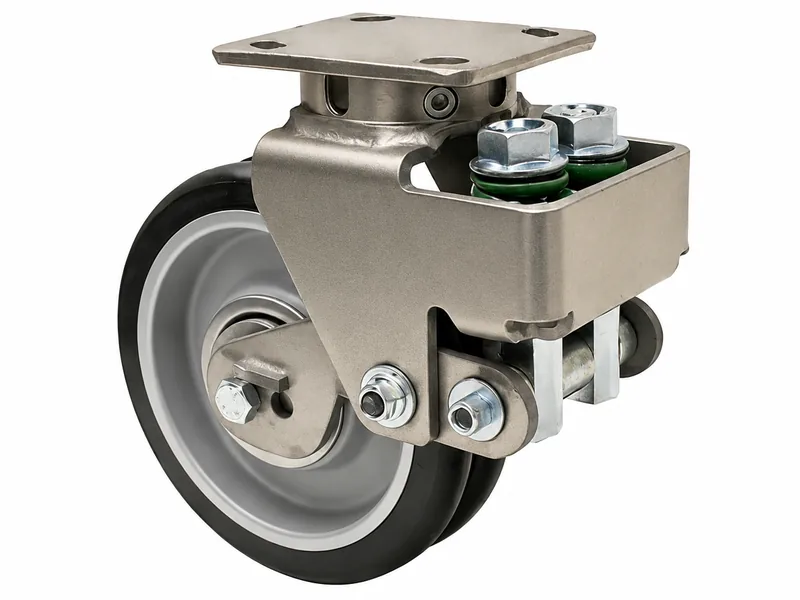
AGV/AMR wheel selection affects rolling effort, steering behaviour, positioning and service conditions. These outcomes depend on the actual tread compound, wheel geometry, load, speed, floor and vehicle design; no universal rolling-resistance or swivel-torque result is claimed.
Drive wheels, caster wheels and idlers can be reviewed as a coordinated requirement. Matched-set availability, hardness, dimensions and tolerances are confirmed against the actual manufacturer, model and written supply scope.
Casters by Load Range
| Series | Load per caster | Typical wheel options | Best for |
|---|---|---|---|
| RM-Light | up to 150 kg | Nylon, rubber, elastic | Light trolleys, medical and display carts |
| RM-Medium | 150–500 kg | Polyurethane, nylon | Warehouse carts, racks, AGV/AMR platforms |
| RM-Heavy | 500–1500 kg | Polyurethane on steel, forged steel | Die carts, machinery moving, heavy trolleys |
| RM-Extreme | 1500 kg and up | Forged steel, double wheel | Steel mills, ovens, extreme-load skates |
Specifications
- PU compound options for the specified load, floor and operating conditions; rolling resistance and starting force are confirmed only where model-specific data is available
- Swivel arrangement and steering behaviour reviewed against the vehicle layout; no numeric torque tolerance is claimed without model-specific evidence
- Drive-wheel tread profile and hub interface confirmed for the identified manufacturer and model
- Hardness, diameter, roundness and inspection documents are confirmed for the actual model and supplied lot; no blanket batch-documentation claim is made
Typical materials
AGV-grade PU on iron / aluminium core
| Wheel material | Typical hardness (grade-dependent) | Floor protection | Where it fits |
|---|---|---|---|
| Cast polyurethane (PU) | Shore A 92–95 | Very good: non-marking compounds | AGV/AMR, trolleys on painted or epoxy floors, heavy duty |
| Injected PU | Shore A 90–95 | Good | Cost-sensitive medium duty, light equipment |
| Cast nylon (PA6) | Shore D 70+ | Fair: hard tread | High load on suitable smooth floors; wet or cleaning use only after confirming the exact nylon grade, bearings, seals and cleaning-agent compatibility |
| Glass-filled nylon | Shore D 75+ | Fair | Application-specific; do not assume higher load or temperature than unfilled PA6 without exact grade and model data |
| Solid rubber | Shore A 65–75 | Good | Shock absorption, outdoor thresholds, economy |
| Super-elastic rubber | Shore A 55–65 | Excellent | Quiet running: medical, hotel, laboratory |
| Phenolic resin | — | Fair | Heat-resistant applications; confirm continuous and intermittent temperature limits for the exact wheel, bearing and complete caster |
| Forged steel | — | None: needs steel plate or heavy concrete | Extreme loads, heat, harsh floors |
| Stainless (wheel/bracket) | — | Good | Hygiene and corrosion-sensitive applications only after checking all wetted parts, bearings, seals, fasteners and cleaning chemistry |
| Assembly-level compatibility check | — | — | A wheel material or stainless bracket alone does not establish washdown, food-contact, chemical or temperature suitability; verify the complete caster configuration and exact cleaning process |
Finishes
Zinc-plated or stainless brackets
| Bracket finish | What it does | Specify it when |
|---|---|---|
| Zinc plating (blue/white) | Baseline corrosion protection | Standard dry indoor use |
| Chrome plating | Hard, decorative, easy to clean | Visible / cleanroom-adjacent equipment |
| Powder coating | Custom color, good corrosion resistance | Brand colors, outdoor-adjacent use |
| Stainless steel 304 | No plating to fail | Corrosion-resistant option; washdown, food or medical use requires confirmation of grade, finish, welds, bearings, seals and cleaning process |
| Stainless steel 316 | Higher chloride resistance than 304 in many environments; not immune to pitting or crevice corrosion | Confirm chloride concentration, temperature, deposits, crevices and cleaning chemistry before specifying |
Testing
Dimensional tolerances and available inspection records are confirmed for the actual manufacturer, model and configuration; no blanket per-batch measurement claim is made
| Selection factor | Rule of thumb | Effect on performance |
|---|---|---|
| Load sizing | Total load ÷ 3 (not ÷ 4) | On uneven floors only three wheels carry the cart |
| Wheel diameter | Bigger rolls easier | Larger wheels cut push force and bridge gaps |
| Tread hardness | Softer = quieter, harder = easier rolling | Pick the softest tread that carries the load |
| Bearing choice | Precision ball for manual pushing, roller for heavy loads | Bearings dominate rolling resistance at high load |
| Swivel vs rigid | 2 swivel + 2 rigid is the standard cart setup | All-swivel carts wander; all-rigid carts cannot steer |
| Floor condition | Rough floors need bigger wheels and softer treads | Small hard wheels on bad floors destroy both |
| Speed & duty | Match the wheel rating to travel speed and cycles | High travel speed and continuous cycling lower the effective capacity a wheel can carry |
Bonding, Thermal & Selection Limits
- Standard MDI/TDI polyurethane softens above roughly 70–80 °C internal temperature; the softening destroys the primer bond and leads directly to delamination in 24/7 duty.
- Bonding depends on core preparation: if the metal core is smooth (missing or light grit-blasting), PU-to-core bond strength drops by over 60% — an industry process figure worth auditing a supplier against.
- Primer must be applied within a strict window after blasting — often under 2 hours — because the blasted core begins oxidizing immediately.
- Full PU cross-linking requires oven post-cure at roughly 110–130 °C for up to 24 hours; shortcutting the cure leaves the material prone to heat-induced separation.
- Selection boundary: for 24/7 AGVs carrying >500 kg per wheel or running >1.5 m/s, move away from standard TDI/MDI and specify an NDI-based elastomer (Vulkollan or equivalent high-performance dynamic formulation).
Sizing & Runout Reference
- Size drive torque on the breakaway figure, not the steady-state figure: breakaway (start-up) force runs 1.5–3× the steady-state rolling force.
- Steady-state rolling resistance is expressed as a coefficient of 0.01–0.08 lb of push per lb of load — the spread is why per-platform sizing beats catalogue rules of thumb.
- AGV-class wheels are specified at 0.010 in tread TIR or tighter, against 0.030–0.060 in for commodity casters; runout is a positioning-accuracy budget line.
- A 0.008 in TIR poly-on-iron wheel that flat-spots over a weekend of static storage becomes a 0.040 in runout problem — storage condition belongs in the specification discussion.
Common Applications
- 24/7 high-cycle industrial fleets
- AGV
- AMR
- Automated Guided Vehicles
- Autonomous Mobile Robots
- continuous duty
- conveyor pallet transports
- Material Handling
- Robotics & Automation
- aerospace industry
- ground support
PU Chemistry Classes (industry reference)
| PU chemistry class | Hardness | Max temperature | Typical duty |
|---|---|---|---|
| TDI | 85A–95A | max ≈65 °C | light duty |
| MDI | 80A–95A | max ≈80 °C | standard AGVs |
| NDI (Vulkollan) | 92A–95A | max ≈100 °C | 24/7 heavy-payload operations |
Ordering, Lead Times & MOQ
Standard catalog MOQ is 200 pieces per model; trial-order quantities are negotiable. Custom-project MOQ is confirmed against the drawing or sample.
Standard configurations: 15–20 days; custom configurations: 30–40 days; samples: 5–7 days. Confirm the schedule at quotation.
Business models: OEM manufacturing, ODM design, private labelling, standard catalog sales, replacement parts supply.
Frequently asked questions
Why not standard PU on an AGV?
Standard PU varies in rolling resistance and flat-spotting. AGV-grade compounds keep resistance stable over thousands of kilometres, protecting battery budget and odometry.
How do I calculate the required caster load capacity?
Total load = cart weight + payload. Divide by 3 (not 4) to stay safe on uneven floors. Add margin for speed, shock and rough floors.
What is the typical lead time?
Standard configurations: 15-20 days. Custom configurations: 30-40 days. Samples: 5-7 days; confirm the schedule for the quoted configuration.
What is the minimum order quantity?
Standard catalog MOQ: 200 pieces per model. Trial-order quantities are negotiable. Custom-project MOQ is confirmed against the drawing or sample.
What certifications do you hold?
ISO 9001 certified quality management. The applicable standard depends on intended use and speed: EN 12532 covers manually propelled or power-towed industrial applications up to 4 km/h; EN 12530 is for manually propelled institutional applications. Confirm the standard, edition and test conditions for the quoted configuration. In-house salt spray and dynamic load testing.
Can you manufacture under our brand?
OEM manufacturing, ODM design, private labelling. Custom brackets, compounds, colors and packaging. Samples then pilot then mass production.
Sources · 4
- casterhq.comIndustry publication
- consolidatedcaster.comManufacturer technical documentation
- infordcaster.comManufacturer technical documentation
- configurator.casterconcepts.comManufacturer technical documentation
Technical references cited for verifiability — not supplier recommendations.Browse the research library.