
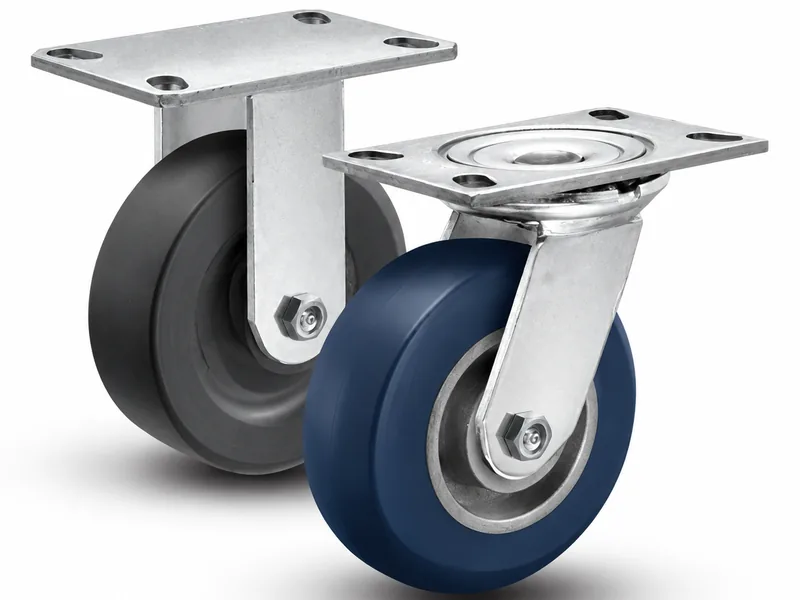
The RM-Extreme series is the top tier of the RollMaster heavy-duty line, rated from 1500 kg per caster — the line’s extra heavy duty band with forged steel cores, paired with welded heavy-gauge brackets. The heavy-duty family line is specified to 2000 kg per caster; requirements above that are engineered per application, so state the true load in the RFQ and we confirm the configuration at quotation.
This is the series behind machinery moving, die carts and heavy equipment that sees shock loads and continuous duty. The series uses welded steel brackets, with wheel diameters from 100 mm to 300 mm. Load-test methods and supporting records are confirmed for the exact model and configuration.
Process Overview
An extra heavy duty caster is defined by what survives shock: a forged steel wheel core, a welded heavy-gauge bracket and bearings sized for impact, not just for weight. The RM-Extreme series starts at 1500 kg per caster because below that band a lighter bracket line and a PU tread are usually the better economic choice.
The decision boundary is stated, not implied: the heavy-duty family line is specified to 2000 kg per caster, and requirements above that are engineered per application - wheel diameter, bearing type and bracket gauge are sized against the real load and duty cycle at quotation.
Casters by Load Range
| Series | Load per caster | Typical wheel options | Best for |
|---|---|---|---|
| RM-Light | up to 150 kg | Nylon, rubber, elastic | Light trolleys, medical and display carts |
| RM-Medium | 150–500 kg | Polyurethane, nylon | Warehouse carts, racks, AGV/AMR platforms |
| RM-Heavy | 500–1500 kg | Polyurethane on steel, forged steel | Die carts, machinery moving, heavy trolleys |
| RM-Extreme | 1500 kg and up | Forged steel, double wheel | Steel mills, ovens, extreme-load skates |
Specifications
- Load capacity from 1500 kg per caster (heavy-duty family line specified to 2000 kg; higher capacities engineered per application)
- Forged steel wheel cores; welded heavy-gauge steel brackets
- Zinc or powder-coated finish
- Precision ball or roller bearings, lubrication fittings as standard
- Speed rating ≤ 4 km/h; an 8 km/h precision-bearing option only where the exact configuration and load are confirmed in writing; not blanket approval for powered towing
- Load-test method and supporting records are confirmed for the exact model and configuration; no batch test claim is made without the applicable record.
- Finish requirements and any salt-spray test report are confirmed for the specified finish and model; certification is stated only where the applicable certificate is available.
Finishes
Zinc plating, chrome plating, powder coating
| Bracket finish | What it does | Specify it when |
|---|---|---|
| Zinc plating (blue/white) | Baseline corrosion protection | Standard dry indoor use |
| Chrome plating | Hard, decorative, easy to clean | Visible / cleanroom-adjacent equipment |
| Powder coating | Custom color, good corrosion resistance | Brand colors, outdoor-adjacent use |
| Stainless steel 304 | No plating to fail | Corrosion-resistant option; washdown, food or medical use requires confirmation of grade, finish, welds, bearings, seals and cleaning process |
| Stainless steel 316 | Higher chloride resistance than 304 in many environments; not immune to pitting or crevice corrosion | Confirm chloride concentration, temperature, deposits, crevices and cleaning chemistry before specifying |
Testing
Wheel concentricity, bracket alignment, rated load and applicable test basis are confirmed for the exact manufacturer/model and configuration; do not infer a certification or test result from the series band.
| Selection factor | Rule of thumb | Effect on performance |
|---|---|---|
| Load sizing | Total load ÷ 3 (not ÷ 4) | On uneven floors only three wheels carry the cart |
| Wheel diameter | Bigger rolls easier | Larger wheels cut push force and bridge gaps |
| Tread hardness | Softer = quieter, harder = easier rolling | Pick the softest tread that carries the load |
| Bearing choice | Precision ball for manual pushing, roller for heavy loads | Bearings dominate rolling resistance at high load |
| Swivel vs rigid | 2 swivel + 2 rigid is the standard cart setup | All-swivel carts wander; all-rigid carts cannot steer |
| Floor condition | Rough floors need bigger wheels and softer treads | Small hard wheels on bad floors destroy both |
| Speed & duty | Match the wheel rating to travel speed and cycles | High travel speed and continuous cycling lower the effective capacity a wheel can carry |
Common Applications
- Automated Guided Vehicles
- Construction Equipment
- Factory
- Furnace Carts & Heat Equipment
- Heavy Platforms
- Industrial Carts
- Industrial Machinery
- Large Equipment
- Mold Transfer
- Oversized Goods Transport
- Rough or Uneven Surface
- Scaffolding
- Steel Fabrication Rigs
- Storage Racks
- Transport Cart
- Transport Platforms for Oversized Loads
- Warehouse Carts
- die cart
- manufacturing facilities
- rough outdoor surfaces
- smooth indoor hard floors
RM series comparison
| Series | Load per caster | Typical wheel materials | Temperature range |
|---|---|---|---|
| RM-Light | Up to 150 kg/caster | Polypropylene (PP), Cast nylon (PA6), TPR, Solid rubber | - |
| RM-Medium | 150–500 kg/caster | Polyurethane (PU) on steel core, Cast nylon (PA6), Steel | −20…+80 °C (std PU); −40…+120 °C (special PU) |
| RM-Heavy | 500–1500 kg/caster | Polyurethane (PU) on steel core, Cast nylon (PA6), Forged steel / pressed steel | −20…+80 °C (std PU); −40…+120 °C (special PU) |
| RM-Extreme (this series) | 1500 kg+/caster (family line specified to 2000 kg) | Forged steel | −20…+80 °C (std PU); −40…+120 °C (special PU) |
| RM-Hot | - | High-temp nylon, Phenolic resin, Cast iron, Forged steel | +120…+280 °C (tread options) |
Ordering, Lead Times & MOQ
Standard catalog MOQ is 200 pieces per model; trial-order quantities are negotiable. Custom-project MOQ is confirmed against the drawing or sample.
Standard configurations: 15–20 days; custom configurations: 30–40 days; samples: 5–7 days. Confirm the schedule at quotation.
Business models: OEM manufacturing, ODM design, private labelling, standard catalog sales, replacement parts supply.
Frequently asked questions
How high does the RM-Extreme rating go?
The series is defined from 1500 kg per caster, and the heavy-duty family line is specified to 2000 kg per caster. Above 2000 kg the configuration is engineered per application — wheel diameter, bearing type and bracket gauge are sized against the real load and duty cycle, so send the equipment weight and usage pattern with the RFQ and we confirm at quotation.
Forged steel or PU — which wheel for an RM-Extreme caster?
Forged steel is the candidate when very high load, impact exposure or temperature rules out an elastomer tread, but its concentrated contact pressure can damage concrete toppings, coatings or other pressure-sensitive floors and it generally transmits more noise and vibration. PU on a steel core is worth evaluating when floor preservation and shock reduction matter, provided the exact compound, hardness, temperature and load are suitable. Do not treat “PU” as one universal grade: request the compound and hardness for the quoted wheel. As an industry comparison only, Blickle lists average floor-pressure reference values above 350 N/mm² for steel versus 3.5 N/mm² for its 75 Shore A PU and 8.0 N/mm² for its 92 Shore A PU. These values are not RollMaster measurements or permissible floor-pressure limits. Include floor construction, coating, wheel size, load, speed, impact and temperature in the RFQ; the complete wheel/bracket assembly still needs configuration-specific confirmation.
Which test basis should accompany an RM-Extreme load figure?
For an extra-heavy caster, ask whether the quoted figure is dynamic or static and request the test conditions with it. Dynamic rolling capacity and stationary static capacity are separate measures (ISO 22878 is the static-test reference). Blickle publishes an EN 12532 / ISO 22883 dynamic reference basis of 4 km/h, +15 °C to +28 °C, a hard horizontal surface, 15,000 revolutions and at least 500 obstacle crossings; the obstacle is 5% of wheel diameter for soft tread and 2.5% for hard tread. These are published industry reference conditions, not a substitute for the RM-Extreme configuration test report.
How should I size an RM-Extreme caster for shock or impact loading?
Do not size an impact application from the parked weight or a simple four-caster division alone. Shock loading can occur when a load is dropped onto a cart, when a wheel strikes a floor joint or dock plate, or when a ramp or uneven floor unloads one or more wheels and transfers load to the remaining supports. Hamilton notes that some impact events can make a wheel carry more than three times the nominal load, but this is an example of event severity—not a universal multiplier or a RollMaster rating. Start with the gross loaded mass and load-centre drawing; describe whether loading is gradual or sudden, the drop/impact event, maximum step and gap, approach speed and angle, ramp gradient, towing or manual movement, and event frequency. Ask for separate static and dynamic ratings and the exact test conditions for the quoted wheel, bearing, fork, swivel head, mounting plate and equipment frame. Do not stack a generic shock multiplier on top of an application factor without checking whether the same impact conditions are already represented; the required margin must be agreed against the actual duty and test basis.
How do I compare spring-loaded caster ratings and spring travel for an extra-heavy cart?
Read the spring curve and the capacity footnote together. A rated load may be stated at a defined fraction of spring travel rather than at the mechanical end stop; maximum travel is not a recommended normal operating point or an impact-energy rating. For example, Albion’s S410 kingpinless series lists capacity at 50% wheel deflection (21/32 in) and total possible deflection of 1-5/16 in. Its 2024 catalog lists S410PF10528S with a 10 × 3 in wheel, 2,000 lb per-caster capacity, 14 in overall height and 4-7/8 in swivel lead; the 12 × 3 in S410PF12528S is listed at 3,000 lb, 16 in overall height and 5-11/16 in lead. Those are Albion model data only. For any spring option, request the load-deflection curve, preload, rated point, maximum travel, end-stop construction, wheel/tread, bearing, overall height and mounting envelope for the exact model. Also check whether uneven floor loading causes one caster to bottom out before the others. We can source a suitable third-party configuration where available and state the manufacturer/model and procurement supply status; these Albion figures do not describe an RM-Extreme product.
Can an RM-Extreme caster be rated for 8 km/h at its full load?
Do not infer this from the 1500 kg+ series definition or the family ceiling. Higher-speed ratings use a separate test basis (EN 12533 / ISO 22884 in Blickle guidance), and ball-bearing wheels may have reduced capacity above 4 km/h. For powered movement, provide travel speed, duty cycle, floor condition and obstacle height; the allowable load must be confirmed for the exact wheel, bearing and bracket assembly.
What floor-obstacle information is needed for an RM-Extreme quotation?
For a loaded machine or die cart, provide the maximum step height, gap width, edge shape, route gradient, crossing frequency and travel speed—not just a general description such as uneven concrete. Include the wheel diameter and width envelope, mounting height limit, swivel clearance and whether the wheel approaches the obstacle straight-on or at an angle. Larger diameter generally improves rollover, but severe thresholds can still create impact loads in the tread, bearing, axle, fork and mounting structure. A compliant tread may reduce shock transfer but its exact compound and load deformation must be checked. Colson’s 2025 catalog (p. 6) identifies floor obstructions and rolling ease as selection factors. Request a configuration-specific review and validate the loaded equipment over the real route; a standard capacity-test obstacle does not certify kerbs, dock plates or floor joints.
What steering and swivel-head details matter on an RM-Extreme application?
For very heavy or powered equipment, steering effort is not determined by wheel diameter alone. Swivel resistance also depends on tread contact area, swivel-head construction and caster offset; side thrust during towing or tight turns can place demands on wheel and swivel bearings that differ from straight vertical loading. Hamilton’s selection guide identifies precision tapered roller bearings for severe combinations of downward and side forces, while precision ball bearings prioritize rollability when side thrust is not critical. These are general bearing-selection principles, not confirmation of a RollMaster bearing configuration. State whether the cart is hand-pushed, power-towed or repositioned by a tug, plus turning frequency, side loading, speed and floor condition; request confirmation of the actual swivel-head and bearing design.
What should an RM-Extreme RFQ include?
Load per caster, wheel diameter and width, wheel material, top-plate dimensions and bolt pattern, required brake function and braked-caster positions, maximum parking gradient, gross loaded mass and load centre, operating environment and floor condition, expected daily duty, and any shock or impact loading. For power-towed equipment, distinguish a stationary parking lock from a dynamic service/emergency brake. Drawings or the equipment weight breakdown speed up the quote.
What are the ordering terms?
Standard lead time is 15-20 days (custom configurations 30-40 days; engineered configurations are quoted individually). Standard catalog MOQ is 200 pieces per model; trial-order quantities are negotiable. Custom-project MOQ is confirmed against the drawing or sample. Packing is individual box, master carton or palletized; sample cost, freight and any credit against a later order are confirmed in the written quotation.
What is confirmed only at quotation on an RM-Extreme order?
Anything above the specified 2000 kg-per-caster line ceiling is engineered per application and confirmed at quotation, along with the rating of the exact wheel, bearing and bracket combination chosen. Material certificates, impact or duty-cycle test documentation and special forging requirements should be requested with the RFQ so they are part of the confirmed scope rather than assumed from the series band.
How do I calculate the required caster load capacity?
Total load = cart weight + payload. Divide by 3 (not 4) to stay safe on uneven floors. Add margin for speed, shock and rough floors.
What is the typical lead time?
Standard configurations: 15-20 days. Custom configurations: 30-40 days. Samples: 5-7 days; confirm the schedule for the quoted configuration.
What is the minimum order quantity?
Standard catalog MOQ: 200 pieces per model. Trial-order quantities are negotiable. Custom-project MOQ is confirmed against the drawing or sample.
What certifications do you hold?
ISO 9001 certified quality management. The applicable standard depends on intended use and speed: EN 12532 covers manually propelled or power-towed industrial applications up to 4 km/h; EN 12530 is for manually propelled institutional applications. Confirm the standard, edition and test conditions for the quoted configuration. In-house salt spray and dynamic load testing.
Can you manufacture under our brand?
OEM manufacturing, ODM design, private labelling. Custom brackets, compounds, colors and packaging. Samples then pilot then mass production.
Sources · 4
- promovecaster.comUnclassified source
- casterresource.comIndustry publication
- qualitycastersupply.comUnclassified source
- techincastor.comManufacturer technical documentation
Technical references cited for verifiability — not supplier recommendations.Browse the research library.