
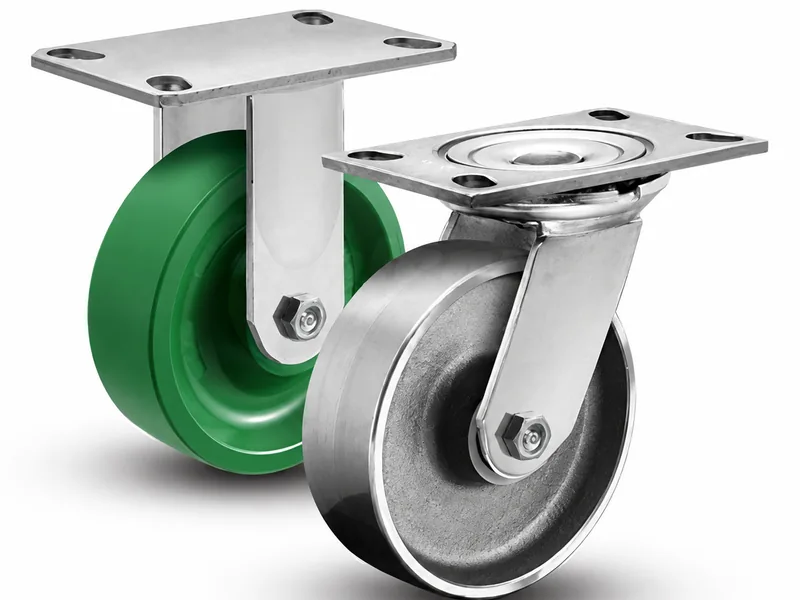
The RM-Heavy series is the middle tier of the RollMaster heavy-duty line, rated from 500 kg to 1500 kg per caster. It is the series for die carts, heavy trolleys, warehouse platforms and machinery-moving equipment — loads where a light bracket rivet line or an undersized wheel shows up as premature raceway wear.
Construction matches the rest of the line: welded brackets, precision ball or roller bearings with lubrication fittings, wheel diameters from 100 mm to 300 mm, ; any load-test method and supporting records are confirmed for the exact model and configuration. For loads above 1000 kg per caster we recommend 200 mm or larger wheels.
Process Overview
A heavy duty caster is the band where construction, not just the rating, changes character: welded steel brackets replace stamped housings, and the wheel and bearing choices decide whether the rating survives daily shock. The RM-Heavy series spans 500 kg to 1500 kg per caster - the middle tier of the RollMaster heavy-duty line.
Selection works from the cart, not the label: divide total weight plus payload by 3 to place the load, and once the per-caster figure passes 1500 kg the RM-Extreme series takes over rather than the top of this band.
Casters by Load Range
| Series | Load per caster | Typical wheel options | Best for |
|---|---|---|---|
| RM-Light | up to 150 kg | Nylon, rubber, elastic | Light trolleys, medical and display carts |
| RM-Medium | 150–500 kg | Polyurethane, nylon | Warehouse carts, racks, AGV/AMR platforms |
| RM-Heavy | 500–1500 kg | Polyurethane on steel, forged steel | Die carts, machinery moving, heavy trolleys |
| RM-Extreme | 1500 kg and up | Forged steel, double wheel | Steel mills, ovens, extreme-load skates |
Specifications
- Load capacity 500-1500 kg per caster; equipment sizing must account for actual load distribution, floor condition and caster contact. Do not assume exactly three of four casters always carry the load.
- Welded heavy-gauge steel brackets, zinc or powder-coated finish
- Wheel options in PU on steel core, cast nylon (PA6) and forged or pressed steel
- Precision ball or roller bearings, lubrication fittings as standard
- Speed rating ≤ 4 km/h; an 8 km/h precision-bearing option only where the exact configuration and load are confirmed in writing; not blanket approval for powered towing
- Load-test method and supporting records are confirmed for the exact model and configuration; no batch test claim is made without the applicable record.
- Finish requirements and any salt-spray test report are confirmed for the specified finish and model; certification is stated only where the applicable certificate is available.
Finishes
Zinc plating, chrome plating, powder coating
| Bracket finish | What it does | Specify it when |
|---|---|---|
| Zinc plating (blue/white) | Baseline corrosion protection | Standard dry indoor use |
| Chrome plating | Hard, decorative, easy to clean | Visible / cleanroom-adjacent equipment |
| Powder coating | Custom color, good corrosion resistance | Brand colors, outdoor-adjacent use |
| Stainless steel 304 | No plating to fail | Corrosion-resistant option; washdown, food or medical use requires confirmation of grade, finish, welds, bearings, seals and cleaning process |
| Stainless steel 316 | Higher chloride resistance than 304 in many environments; not immune to pitting or crevice corrosion | Confirm chloride concentration, temperature, deposits, crevices and cleaning chemistry before specifying |
Testing
Wheel concentricity, bracket alignment, rated load and applicable test basis are confirmed for the exact manufacturer/model and configuration; do not infer a certification or test result from the series band.
| Selection factor | Rule of thumb | Effect on performance |
|---|---|---|
| Load sizing | Total load ÷ 3 (not ÷ 4) | On uneven floors only three wheels carry the cart |
| Wheel diameter | Bigger rolls easier | Larger wheels cut push force and bridge gaps |
| Tread hardness | Softer = quieter, harder = easier rolling | Pick the softest tread that carries the load |
| Bearing choice | Precision ball for manual pushing, roller for heavy loads | Bearings dominate rolling resistance at high load |
| Swivel vs rigid | 2 swivel + 2 rigid is the standard cart setup | All-swivel carts wander; all-rigid carts cannot steer |
| Floor condition | Rough floors need bigger wheels and softer treads | Small hard wheels on bad floors destroy both |
| Speed & duty | Match the wheel rating to travel speed and cycles | High travel speed and continuous cycling lower the effective capacity a wheel can carry |
Common Applications
- Automated Guided Vehicles
- Construction Equipment
- Factory
- Furnace Carts & Heat Equipment
- Heavy Platforms
- Industrial Carts
- Industrial Machinery
- Large Equipment
- Mold Transfer
- Oversized Goods Transport
- Rough or Uneven Surface
- Scaffolding
- Steel Fabrication Rigs
- Storage Racks
- Transport Cart
- Transport Platforms for Oversized Loads
- Warehouse Carts
- die cart
- manufacturing facilities
- rough outdoor surfaces
- smooth indoor hard floors
RM series comparison
| Series | Load per caster | Typical wheel materials | Temperature range |
|---|---|---|---|
| RM-Light | Up to 150 kg/caster | Polypropylene (PP), Cast nylon (PA6), TPR, Solid rubber | - |
| RM-Medium | 150–500 kg/caster | Polyurethane (PU) on steel core, Cast nylon (PA6), Steel | −20…+80 °C (std PU); −40…+120 °C (special PU) |
| RM-Heavy (this series) | 500–1500 kg/caster | Polyurethane (PU) on steel core, Cast nylon (PA6), Forged steel / pressed steel | −20…+80 °C (std PU); −40…+120 °C (special PU) |
| RM-Extreme | 1500 kg+/caster (family line specified to 2000 kg) | Forged steel | −20…+80 °C (std PU); −40…+120 °C (special PU) |
| RM-Hot | - | High-temp nylon, Phenolic resin, Cast iron, Forged steel | +120…+280 °C (tread options) |
Ordering, Lead Times & MOQ
Standard catalog MOQ is 200 pieces per model; trial-order quantities are negotiable. Custom-project MOQ is confirmed against the drawing or sample.
Standard configurations: 15–20 days; custom configurations: 30–40 days; samples: 5–7 days. Confirm the schedule at quotation.
Business models: OEM manufacturing, ODM design, private labelling, standard catalog sales, replacement parts supply.
Frequently asked questions
When does a load need the RM-Heavy series instead of RM-Medium?
For a level floor with a rigid, evenly loaded cart and all four casters remaining in contact, total gross weight divided by four is the initial average load per caster. This average is not a design rating. Floor unevenness, frame stiffness, load offset, obstacles, shock, speed and duty can leave fewer casters carrying the load. If one caster may unload, using three load-sharing casters (gross weight divided by three) can be a conservative preliminary estimate, not a universal rule. Apply the appropriate application factor and compare the result with a rating established for the exact manufacturer, model and test conditions. Select the series only after comparing the resulting requirement with the exact caster’s rating and test conditions.
How should I specify the RM-Heavy wheel for floor joints or thresholds?
Measure the highest recurring step and the widest floor gap on the loaded route, and state how often the cart crosses them. Larger wheel diameter generally improves obstacle rollover and reduces rolling effort, but the available mounting height, swivel sweep, tread width and load rating still constrain the choice. A softer tread may reduce impact and noise but must be checked for load, deformation and wear; do not assume it makes a severe step safe. Colson’s 2025 catalog (p. 6) specifically says the wheel must be large enough for cracks, tracks, moldings and other obstructions, and that larger diameter improves rolling ease. Confirm the complete caster on the actual worst-case route; standardized test obstacles are not a substitute for testing your threshold or dock plate.
How should I choose PU, cast PA6 or steel for a 500-1500 kg cart?
Start with the floor and duty rather than assuming one material is best. PU is usually the first option to evaluate where floor preservation, lower noise and some shock cushioning matter; the selected compound, hardness and wheel geometry must still match the load and speed. Cast PA6 can provide high capacity and low rolling resistance on suitable hard floors, but its concentrated contact pressure can be unsuitable for pressure-sensitive coatings. Do not choose it simply because a floor is wet: confirm the exact PA6 grade, moisture exposure, chemicals and dimensional tolerances. Steel suits very high loads, impacts or temperature demands when the floor can accept very high contact pressure and greater noise. Blickle’s published average floor-pressure examples are 3.5 N/mm² for 75 Shore A PU, 8.0 N/mm² for 92 Shore A PU, 60 N/mm² for cast nylon and over 350 N/mm² for steel; these are comparative manufacturer reference values, not RollMaster ratings or floor design limits. Supply the floor finish, load, wheel dimensions, speed and moisture/chemical exposure for configuration review.
How should I compare dynamic and static capacity on an RM-Heavy caster?
They are different duty statements, not interchangeable numbers. Dynamic capacity applies while rolling and depends on speed, surface, obstacle crossings and temperature; static capacity applies while stationary and has its own test basis (ISO 22878). As a published reference, Blickle describes EN 12532 / ISO 22883 dynamic testing at 4 km/h, +15 °C to +28 °C, on a hard horizontal surface for 15,000 revolutions and at least 500 obstacle crossings. The reference obstacle height is 5% of wheel diameter for soft tread and 2.5% for hard tread. Request the RM test report for the exact wheel, bearing and bracket rather than treating the series band as a tested SKU value.
Does an 8 km/h option retain the 500-1500 kg series band?
The series band does not establish a full-load rating at every speed. Blickle treats higher-speed caster testing separately under EN 12533 / ISO 22884 and notes that ball-bearing wheels can exceed 4 km/h with reduced load capacity. Confirm the permitted load at 8 km/h for the selected RM-Heavy diameter, tread and bearing combination before specifying it for powered or continuous movement.
When is a spring-loaded caster a better choice than a rigid heavy-duty caster?
Consider a spring-loaded assembly when the transported load is sensitive to repeated shocks or vibration, or when a cart repeatedly crosses a known uneven route and the suspension can be matched to its real supported load. Do not choose by maximum caster capacity alone: confirm spring preload (the force before movement begins), spring force/rate, usable travel, rated load at the stated deflection, and whether the normal operating load places the spring in its intended working range. Blickle explains that a spring moves only after its initial tension is exceeded and that damping is impaired when the applied force is too high or too low; its selection table separates steel-spring and polyurethane-spring families. Albion’s S410 kingpinless series, by contrast, states capacity at 50% wheel deflection (21/32 in) and total possible deflection of 1-5/16 in. These are manufacturer-specific examples, not RollMaster specifications. If suspension is required, provide the actual load carried by each caster, load variation, shock event, travel speed, obstacle profile, mounting-height envelope and required residual clearance. We can review a sourced option and identify its actual manufacturer and model in the quotation; do not assume it is part of an RM own-production series.
How should caster offset and swivel radius be specified on a heavy cart?
Offset (also called lead or trail) is the horizontal distance between the swivel axis and wheel axle/contact centre; swivel radius is the swept clearance from the swivel axis to the outer edge of the wheel or any projecting brake. Offset influences self-alignment and steering effort, while the swivel radius determines whether the caster can rotate without striking the frame. Too little lead can increase steering effort; excessive lead can compromise capacity or promote wobble, so do not maximize it blindly. Supply the existing mounting-hole pattern, wheel diameter, offset, swivel radius, brake envelope and available frame clearance with the RFQ. Faultless’ catalog explains the steering trade-off on printed p. 12.
When should I use a fixed caster with swivel casters?
Caster count and arrangement affect manoeuvrability, control, cornering and stability. A fixed-plus-swivel layout can favour predictable straight travel, while all-swivel layouts can improve positioning in tight spaces but may require more deliberate steering control. The right arrangement depends on handle position, travel path, load centre, turning space, floor joints and whether the cart is pushed or towed. Share a plan-view drawing and describe straight runs, tight turns, ramps and docking manoeuvres; confirm the complete loaded cart rather than selecting from caster ratings alone.
What should an RM-Heavy RFQ include?
Load per caster, wheel diameter and width, wheel material, top-plate dimensions and bolt pattern, brake requirement, operating environment and floor condition, and expected daily duty. Drawings or the equipment weight breakdown speed up the quote.
What are the ordering terms?
Standard lead time is 15-20 days (custom configurations 30-40 days). Standard catalog MOQ is 200 pieces per model; trial-order quantities are negotiable. Custom-project MOQ is confirmed against the drawing or sample. Packing is individual box, master carton or palletized; sample cost, freight and any credit against a later order are confirmed in the written quotation.
How should I choose and maintain an RM-Heavy wheel bearing?
Start with the operating environment and service access, not the bearing label alone. Ask whether the hub needs protection from dry dust, fibres, water spray, frequent washdown, corrosive chemicals or temperature cycling; also state speed, load, side thrust and expected duty. A sealed, long-life-greased bearing may reduce routine relubrication, but seal construction and exposure limits must match the actual wash process. Greaseable designs require an accessible lubrication point and a compatible grease and interval specified for that exact assembly. Do not add grease to a factory-sealed 2RS bearing unless its manufacturer explicitly permits it: Blickle warns that relubricating its double-sealed ball bearings can damage them. Request bearing type, seal arrangement, corrosion-resistant materials, grease specification, lubrication point and maintenance instructions with the quotation.
What is confirmed only at quotation on an RM-Heavy order?
The 500-1500 kg band is the series definition, but the rating for a specific wheel diameter, material and bearing combination is confirmed at quotation, never assumed from the band. Material certificates, special compounds or finish test reports should be requested with the RFQ so they are part of the confirmed scope.
How do I calculate the required caster load capacity?
Total load = cart weight + payload. Divide by 3 (not 4) to stay safe on uneven floors. Add margin for speed, shock and rough floors.
What is the typical lead time?
Standard configurations: 15-20 days. Custom configurations: 30-40 days. Samples: 5-7 days; confirm the schedule for the quoted configuration.
What is the minimum order quantity?
Standard catalog MOQ: 200 pieces per model. Trial-order quantities are negotiable. Custom-project MOQ is confirmed against the drawing or sample.
What certifications do you hold?
ISO 9001 certified quality management. The applicable standard depends on intended use and speed: EN 12532 covers manually propelled or power-towed industrial applications up to 4 km/h; EN 12530 is for manually propelled institutional applications. Confirm the standard, edition and test conditions for the quoted configuration. In-house salt spray and dynamic load testing.
Can you manufacture under our brand?
OEM manufacturing, ODM design, private labelling. Custom brackets, compounds, colors and packaging. Samples then pilot then mass production.
Sources · 4
- promovecaster.comUnclassified source
- casterresource.comIndustry publication
- qualitycastersupply.comUnclassified source
- techincastor.comManufacturer technical documentation
Technical references cited for verifiability — not supplier recommendations.Browse the research library.