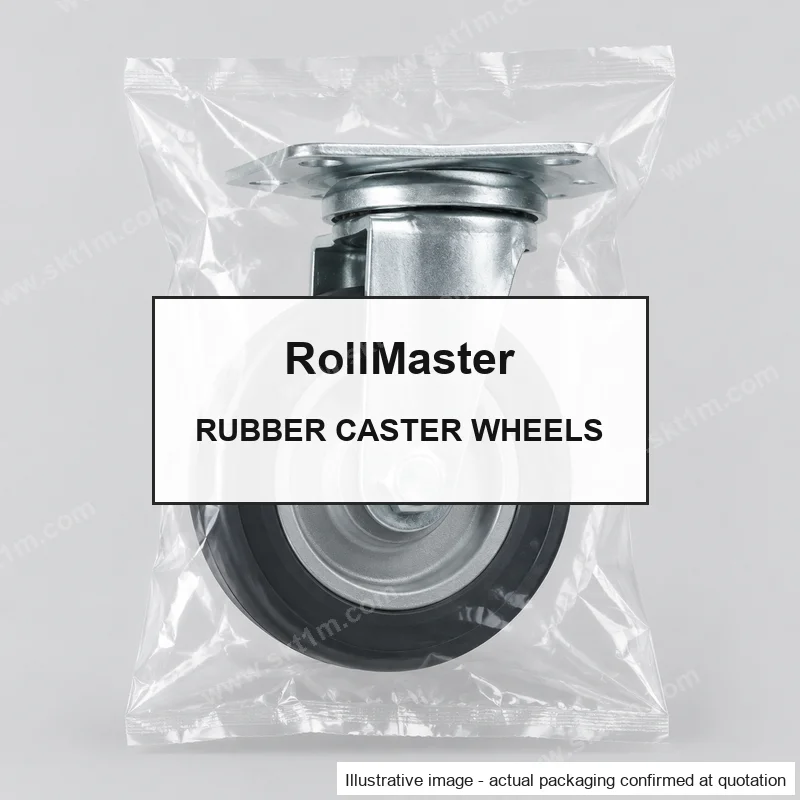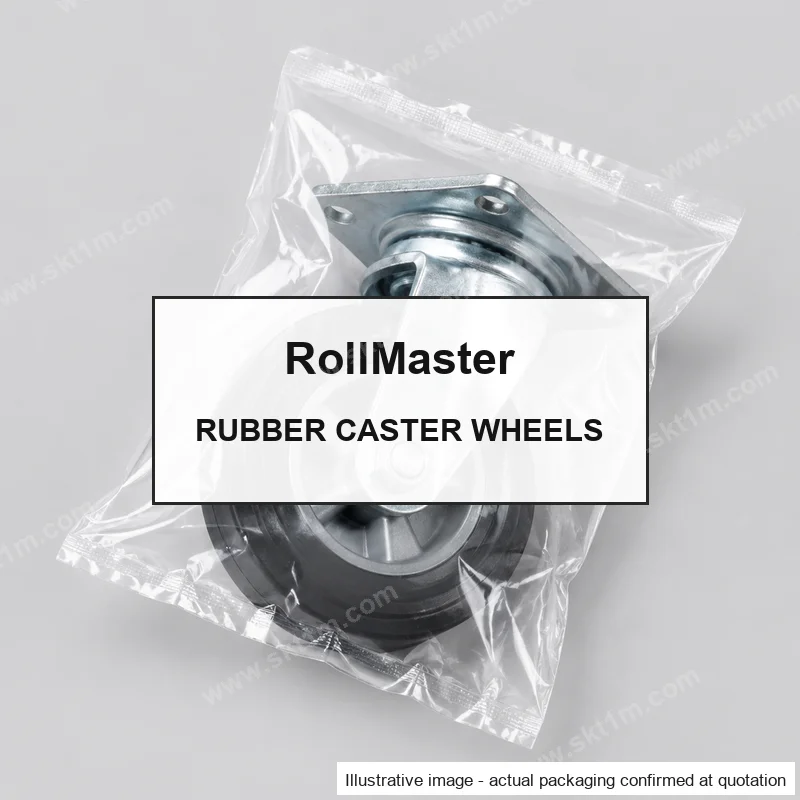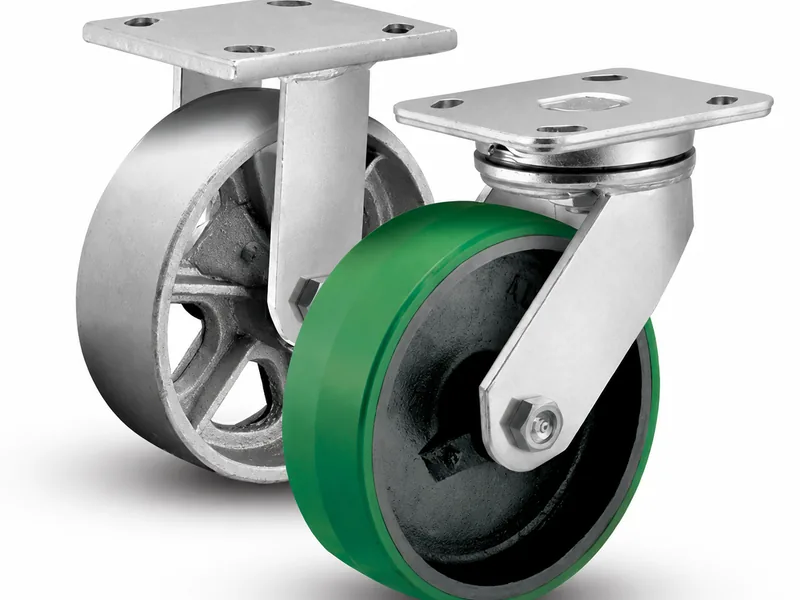
Solid and elastic rubber wheels absorb shocks, run quietly and protect both floors and cargo — the right wheel for equipment that carries sensitive goods or crosses expansion joints and thresholds.
Natural and synthetic rubber compounds are available. Oil- and heat-resistant options are compound-specific; confirm compatibility against the named medium, concentration, exposure time, temperature and operating conditions rather than assuming it from the word rubber.
Material Grades & Properties
Rubber Grades We Use
| Grade | Standard | Characteristics |
|---|---|---|
| Solid rubber | Shore A 65-75 | shock absorbing |
| Super-elastic grey | Shore A 55-65 | silent running |
Key Properties of Rubber
- ✓Best shock absorption
- ✓Quietest tread
- ✓Good floor protection
- ✓Higher rolling resistance than PU
Typical tolerances:Hardness and bond strength per batch
Applications for Rubber Casters
- medical carts
- laboratory equipment
- hotel trolleys
- outdoor thresholds
Engineering Notes for Rubber
Vulcanized bond to steel, PP or aluminium cores.
Finishes for Rubber Casters
- Zinc-plated bracket
- Stainless bracket
Specifications
- Solid rubber on steel or plastic cores
- Super-elastic grey rubber for quiet, low-resistance running
- Oil- and heat-resistant compound options; compatibility and temperature limits must be confirmed for the selected compound and exposure
- Typical loads 30–400 kg per caster
Typical materials
Solid rubber / elastic rubber on steel or PP core
| Wheel material | Typical hardness (grade-dependent) | Floor protection | Where it fits |
|---|---|---|---|
| Cast polyurethane (PU) | Shore A 92–95 | Very good: non-marking compounds | AGV/AMR, trolleys on painted or epoxy floors, heavy duty |
| Injected PU | Shore A 90–95 | Good | Cost-sensitive medium duty, light equipment |
| Cast nylon (PA6) | Shore D 70+ | Fair: hard tread | High load on suitable smooth floors; wet or cleaning use only after confirming the exact nylon grade, bearings, seals and cleaning-agent compatibility |
| Glass-filled nylon | Shore D 75+ | Fair | Application-specific; do not assume higher load or temperature than unfilled PA6 without exact grade and model data |
| Solid rubber | Shore A 65–75 | Good | Shock absorption, outdoor thresholds, economy |
| Super-elastic rubber | Shore A 55–65 | Excellent | Quiet running: medical, hotel, laboratory |
| Phenolic resin | — | Fair | Heat-resistant applications; confirm continuous and intermittent temperature limits for the exact wheel, bearing and complete caster |
| Forged steel | — | None: needs steel plate or heavy concrete | Extreme loads, heat, harsh floors |
| Stainless (wheel/bracket) | — | Good | Hygiene and corrosion-sensitive applications only after checking all wetted parts, bearings, seals, fasteners and cleaning chemistry |
| Assembly-level compatibility check | — | — | A wheel material or stainless bracket alone does not establish washdown, food-contact, chemical or temperature suitability; verify the complete caster configuration and exact cleaning process |
Finishes
Zinc-plated brackets
| Bracket finish | What it does | Specify it when |
|---|---|---|
| Zinc plating (blue/white) | Baseline corrosion protection | Standard dry indoor use |
| Chrome plating | Hard, decorative, easy to clean | Visible / cleanroom-adjacent equipment |
| Powder coating | Custom color, good corrosion resistance | Brand colors, outdoor-adjacent use |
| Stainless steel 304 | No plating to fail | Corrosion-resistant option; washdown, food or medical use requires confirmation of grade, finish, welds, bearings, seals and cleaning process |
| Stainless steel 316 | Higher chloride resistance than 304 in many environments; not immune to pitting or crevice corrosion | Confirm chloride concentration, temperature, deposits, crevices and cleaning chemistry before specifying |
Testing
Inspection scope and any test records are confirmed for the actual manufacturer, model and supply lot; no family-wide batch-test claim is made
| Selection factor | Rule of thumb | Effect on performance |
|---|---|---|
| Load sizing | Total load ÷ 3 (not ÷ 4) | On uneven floors only three wheels carry the cart |
| Wheel diameter | Bigger rolls easier | Larger wheels cut push force and bridge gaps |
| Tread hardness | Softer = quieter, harder = easier rolling | Pick the softest tread that carries the load |
| Bearing choice | Precision ball for manual pushing, roller for heavy loads | Bearings dominate rolling resistance at high load |
| Swivel vs rigid | 2 swivel + 2 rigid is the standard cart setup | All-swivel carts wander; all-rigid carts cannot steer |
| Floor condition | Rough floors need bigger wheels and softer treads | Small hard wheels on bad floors destroy both |
| Speed & duty | Match the wheel rating to travel speed and cycles | High travel speed and continuous cycling lower the effective capacity a wheel can carry |
Common Applications
- Finished concrete
- Institutional Equipment
- Laminate Floors
- Outdoor Use
- Rough concrete
- Rough or Uneven Surface
- Shock-Sensitive Equipment
- Tile Floor
- Transport Cart
- rough outdoor surfaces
- uneven ground
Surface Finish Reference
Frequently asked questions
Rubber or PU?
Rubber can provide more cushioning and noise reduction, while PU often provides a stronger balance of load and rolling effort. Actual performance depends on compound, hardness, core, wheel size, load, speed and floor; compare the specific configurations rather than relying on a material name.
Can I use the same rubber compound with oil, heat and ozone exposure?
Do not assume so. Oil, heat and ozone resistance vary by rubber formulation and the exposure conditions. Identify the chemical or environment, concentration, temperature and exposure pattern, then confirm the chosen compound and core bond against supplier data or a test record.
How do I calculate the required caster load capacity?
Total load = cart weight + payload. Divide by 3 (not 4) to stay safe on uneven floors. Add margin for speed, shock and rough floors.
What is the typical lead time?
Standard configurations: 15-20 days. Custom configurations: 30-40 days. Samples: 5-7 days; confirm the schedule for the quoted configuration.
What is the minimum order quantity?
Standard catalog MOQ: 200 pieces per model. Trial-order quantities are negotiable. Custom-project MOQ is confirmed against the drawing or sample.
What certifications do you hold?
ISO 9001 certified quality management. The applicable standard depends on intended use and speed: EN 12532 covers manually propelled or power-towed industrial applications up to 4 km/h; EN 12530 is for manually propelled institutional applications. Confirm the standard, edition and test conditions for the quoted configuration. In-house salt spray and dynamic load testing.
Can you manufacture under our brand?
OEM manufacturing, ODM design, private labelling. Custom brackets, compounds, colors and packaging. Samples then pilot then mass production.
Sources · 4
- bullcaster.comManufacturer technical documentation
- dersheng.com.twManufacturer technical documentation
- casterhq.comIndustry publication
- bulldogcastors.co.ukUnclassified source
Technical references cited for verifiability — not supplier recommendations.Browse the research library.