
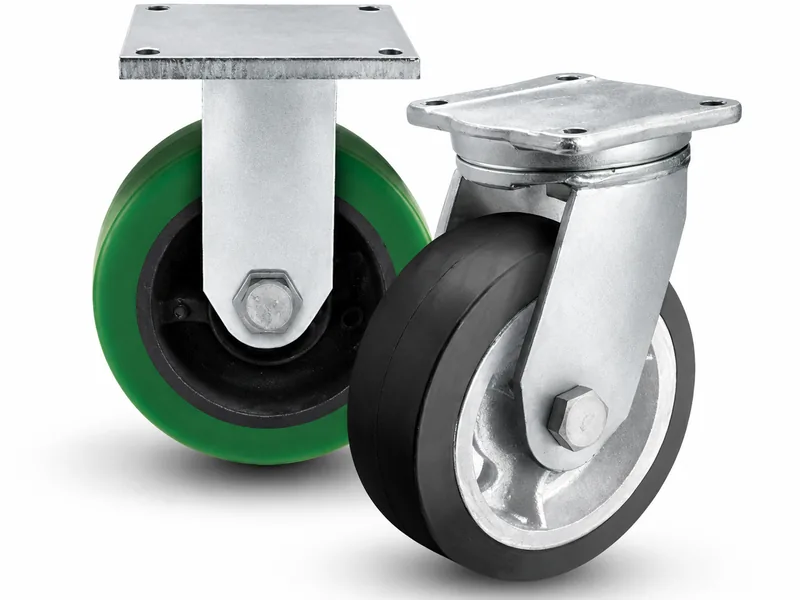
A total-lock caster brake blocks both wheel rotation and swivel-head movement at that caster. It is a parking-lock function, not a certified whole-cart restraint: slope holding depends on the complete equipment, load distribution, floor and tread, brake configuration and installation. Validate the loaded cart under the actual parking conditions.
Double-ball raceways are used on selected swivel-head models; exact construction and availability are confirmed by manufacturer and model. Directional-lock versions convert between full swivel and fixed travel.
Choose the lock by the motion that must be prevented. A wheel-only brake stops wheel rotation but leaves the swivel head free; a total lock blocks both at the caster; a directional lock blocks swivel movement for tracking while the wheel remains free to roll. None of these descriptions alone establishes a safe slope-holding capacity for the complete cart.
Keep parking locks separate from dynamic braking. A wheel brake or total lock is intended to hold a stationary caster; a directional lock controls tracking while the wheel continues to roll. Drum brakes and spring-applied dead-man brakes are different braking mechanisms and must be specified for the actual moving equipment. For powered towing, do not infer a towing load or speed rating from a walking-speed caster table.
Casters by Load Range
| Series | Load per caster | Typical wheel options | Best for |
|---|---|---|---|
| RM-Light | up to 150 kg | Nylon, rubber, elastic | Light trolleys, medical and display carts |
| RM-Medium | 150–500 kg | Polyurethane, nylon | Warehouse carts, racks, AGV/AMR platforms |
| RM-Heavy | 500–1500 kg | Polyurethane on steel, forged steel | Die carts, machinery moving, heavy trolleys |
| RM-Extreme | 1500 kg and up | Forged steel, double wheel | Steel mills, ovens, extreme-load skates |
Specifications
- Total lock (wheel + swivel), side brake and directional lock options
- Selected swivel-head models may use double-ball raceways; exact construction and availability are confirmed by manufacturer and model
- Load classes from 60 kg to 1500 kg per caster
- Plate, bolt-hole and stem mountings
Finishes
Zinc, chrome, powder coat, stainless
| Bracket finish | What it does | Specify it when |
|---|---|---|
| Zinc plating (blue/white) | Baseline corrosion protection | Standard dry indoor use |
| Chrome plating | Hard, decorative, easy to clean | Visible / cleanroom-adjacent equipment |
| Powder coating | Custom color, good corrosion resistance | Brand colors, outdoor-adjacent use |
| Stainless steel 304 | No plating to fail | Corrosion-resistant option; washdown, food or medical use requires confirmation of grade, finish, welds, bearings, seals and cleaning process |
| Stainless steel 316 | Higher chloride resistance than 304 in many environments; not immune to pitting or crevice corrosion | Confirm chloride concentration, temperature, deposits, crevices and cleaning chemistry before specifying |
Testing
Swivel torque and brake operation are confirmed only where model-specific test data is available; no blanket per-batch test claim is made
| Selection factor | Rule of thumb | Effect on performance |
|---|---|---|
| Load sizing | Total load ÷ 3 (not ÷ 4) | On uneven floors only three wheels carry the cart |
| Wheel diameter | Bigger rolls easier | Larger wheels cut push force and bridge gaps |
| Tread hardness | Softer = quieter, harder = easier rolling | Pick the softest tread that carries the load |
| Bearing choice | Precision ball for manual pushing, roller for heavy loads | Bearings dominate rolling resistance at high load |
| Swivel vs rigid | 2 swivel + 2 rigid is the standard cart setup | All-swivel carts wander; all-rigid carts cannot steer |
| Floor condition | Rough floors need bigger wheels and softer treads | Small hard wheels on bad floors destroy both |
| Speed & duty | Match the wheel rating to travel speed and cycles | High travel speed and continuous cycling lower the effective capacity a wheel can carry |
Common Applications
- Furniture
- heavy machinery
- stationary positioning
- workstation
- Medical Industry
Ordering, Lead Times & MOQ
Standard catalog MOQ is 200 pieces per model; trial-order quantities are negotiable. Custom-project MOQ is confirmed against the drawing or sample.
Standard configurations: 15–20 days; custom configurations: 30–40 days; samples: 5–7 days. Confirm the schedule at quotation.
Business models: OEM manufacturing, ODM design, private labelling, standard catalog sales, replacement parts supply.
Frequently asked questions
What is the difference between wheel-only, total-lock and directional-lock?
A wheel-only (tread/top/side) brake blocks wheel rotation but does not lock the swivel head. A total-lock brake blocks both wheel rotation and swivel movement. A directional lock blocks swivel movement in the aligned travel direction while the wheel can still roll; it is for straight tracking, not parking. Confirm the manufacturer’s exact mechanism because pedal appearance and naming vary by series.
Does a total-lock caster make a loaded cart safe on a slope?
Not by itself. Total lock describes the two motions blocked at each caster; it is not a whole-cart slope-holding rating or a substitute for a vehicle/equipment parking brake. Holding depends on the number and position of braked casters, actual wheel contact and tread, floor condition, slope, load centre, frame stiffness and installation. State the maximum measured gradient, gross loaded mass, load centre, floor surface and required hold duration; request a configuration-specific assessment and test the complete loaded cart. Use a separate engineered restraint where the risk assessment requires it.
How many casters should have brakes?
There is no universal “two diagonal” or “all four” rule. The right count and positions depend on the swivel/rigid layout, which wheels carry load in the parked state, access to each pedal, floor slope and the required restraint. A brake on an unloaded or poorly contacting wheel contributes little. Share a plan-view layout and have the loaded equipment checked in its parked condition.
What should a brake-system RFQ include?
Specify the required function (wheel-only, total lock, directional lock, central brake or a separate equipment-level parking brake), number and positions of braked casters, maximum floor gradient, gross loaded mass and load centre, floor material/condition, parking duration, operator access and pedal-clearance envelope. State whether the cart is hand-pushed or power-towed and whether the brake is for stationary locking or dynamic speed reduction. Confirm the exact mechanism, compatibility and holding test for the quoted configuration.
Can a soft PU or rubber tread reduce brake holding?
It can. Blickle notes that braking force is reduced with very soft tread compounds. The actual result also depends on the brake mechanism, wheel size, adjustment, floor and load. Do not transfer a competitor’s brake-force data to a RollMaster wheel; identify the exact tread compound and ask for configuration-specific holding evidence.
All four casters with brakes?
Not automatically. More brake pedals can improve access or provide additional locking points, but the count and positions must be assessed against load sharing, wheel contact, steering layout and operator access. Two diagonal brakes are not a universal rule either; confirm the complete loaded cart rather than choosing by a fixed convention.
Is a caster parking lock the same as a service or emergency brake?
No. A wheel brake or total lock is normally selected to restrain a stationary caster; a directional lock prevents swivel movement for straight tracking while the wheel remains free to roll. A drum brake or dead-man brake is a separate dynamic-braking mechanism. Blickle describes its cable-operated dead-man design as spring-applied before actuation and released by the cable or lever. Specify service braking, emergency stopping, dead-man behavior and parking restraint as separate functions, and verify the complete equipment-level system; a caster pedal lock is not an emergency-stop rating.
What does central brake operation change?
Central operation links two or more caster mechanisms to one pedal, lever or rod so the operator can apply them together. It changes actuation and access, not the underlying function: confirm whether the linked units are wheel brakes, total locks or directional locks, and check linkage travel, adjustment, installation clearance and whether every linked caster actually contacts the floor. Blickle documents ideal-stop lever connections and central-stop rod systems for selected series; availability is series-specific.
Can I use a walking-speed caster rating for a powered tow train?
Do not assume so. Albion’s 2024 catalogue says its towing recommendation is based on an average 3–5 mph and asks buyers to consult the factory for higher speeds; it also says product-table load ratings are based on walking speed and towing load ratings should be confirmed with engineering. Those are Albion catalogue conditions, not a RollMaster speed or load rating. For a powered application, submit maximum continuous and peak speed, gross train mass, dynamic load per caster, wheel and bearing, duty cycle, turns, floor condition and braking events, then obtain approval for the exact manufacturer/model and configuration.
Does wheel tread affect brake holding?
Yes. Blickle warns that braking force is reduced with very soft tread compounds/tyres. Do not convert that warning into a universal percentage: the result depends on the exact tread, brake mechanism, wheel size, adjustment, floor and load. Identify the wheel series and compound, and request holding evidence for the quoted configuration.
How should caster brakes be inspected, and when should parts be replaced?
Inspect every fitted brake separately with the equipment stationary and safely unloaded or supported. Check the wheel and tread as well as the brake mechanism: Caster Concepts’ 2023 care manual (p. 5) describes comparing equipment movement with each brake released and engaged; if a brake does not increase resistance or hold the equipment, replace the affected components or caster. Jarvis’ safety and maintenance instructions (p. 11) say that a brake slipping because of a worn or damaged wheel calls for wheel replacement; a malfunctioning brake mechanism should be repaired or replaced, then retested before the equipment returns to service. Blickle’s 2026 instructions for its named LSC/LSDC container castors (p. 20) additionally call for checking brake fasteners and confirming that the brake stays engaged under impact, operates without excessive force and keeps the wheel locked. These are manufacturer-specific procedures, not a universal inspection interval or wear limit. Do not adjust an unidentified brake or substitute a generic kit: record the complete manufacturer/model and suffix, obtain its current service instructions and confirm the exact compatible replacement part.
How do I calculate the required caster load capacity?
Total load = cart weight + payload. Divide by 3 (not 4) to stay safe on uneven floors. Add margin for speed, shock and rough floors.
What is the typical lead time?
Standard configurations: 15-20 days. Custom configurations: 30-40 days. Samples: 5-7 days; confirm the schedule for the quoted configuration.
What is the minimum order quantity?
Standard catalog MOQ: 200 pieces per model. Trial-order quantities are negotiable. Custom-project MOQ is confirmed against the drawing or sample.
What certifications do you hold?
ISO 9001 certified quality management. The applicable standard depends on intended use and speed: EN 12532 covers manually propelled or power-towed industrial applications up to 4 km/h; EN 12530 is for manually propelled institutional applications. Confirm the standard, edition and test conditions for the quoted configuration. In-house salt spray and dynamic load testing.
Can you manufacture under our brand?
OEM manufacturing, ODM design, private labelling. Custom brackets, compounds, colors and packaging. Samples then pilot then mass production.
Sources · 5
- garageage.comIndustry peer technical page
- colsongroup.comUnclassified source
- casterspecialists.comIndustry publication
- castertech.comUnclassified source
- resources.colsongroup.comAlbion 2025 manufacturer catalog — 110/610 swivel sections and brake options
Technical references cited for verifiability — not supplier recommendations.Browse the research library.