
Product Catalog
Dual-Wheel and Multi-Wheel Casters — Stability, Capacity and Application Fit
Third-party brand — supplied via our sourcing network
Product references on this page may come from more than one third-party source. A retailer or catalog is not necessarily the manufacturer. Where the original manufacturer or exact model/part number is not identified, it is not verified by this listing; confirm both in the written quotation. Any lead time, MOQ or warranty shown as our offer is a RollMaster quotation term, not a third-party manufacturer's published term.
Updated 2026-11
A dual-wheel caster commonly places two wheels side by side on a shared axle, but the term is a product-family label rather than a guarantee that every series has the same wheel count, axle motion or load-sharing behavior. Do not assume that two wheels automatically double capacity, split the load equally, reduce turning effort by a fixed amount or bridge every floor joint. The result depends on the actual wheel arrangement, tread and bearing construction, axle geometry, caster offset, floor profile and the load carried by the complete assembly. Manufacturer catalogs position dual-wheel designs around higher capacity in a lower overall height and a more stable footprint; those are design aims, not universal performance guarantees.
The important distinction is between the ordinary paired-wheel fork and specialist compensating assemblies. Albion’s 115/315/415/615 kingpinless dual series add a third full fork leg; its 298 aviation/GSE series instead specifies an oscillating, compensating wheel axle and cushion-suspension leveling. These are different structural solutions and the 298 features must not be attributed to every dual-wheel caster. We supply through factory production, available stock and coordinated sourcing; the quotation identifies the supply status and, for sourced models, the original manufacturer and model attribution.
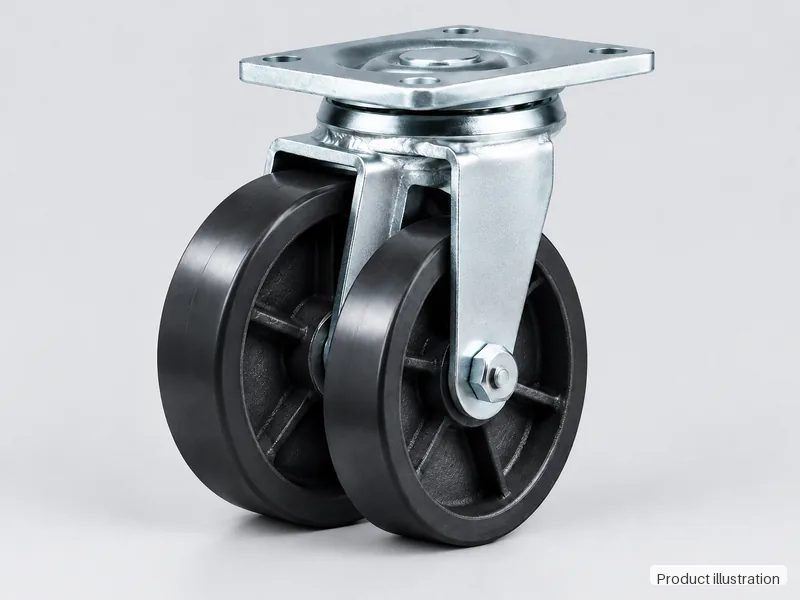
Specifications
| Type | Dual-wheel and selected multi-wheel swivel/rigid caster assemblies; verify wheel count and axle arrangement by exact model |
|---|---|
| Manufacturer series reference matrix (Albion 2024 Q1 catalog) | 115: Ø 4–8 in, 2 in tread, up to 2,000 lb (printed p.75); 315: Ø 6–12 in, 2–3 in tread, up to 4,100 lb (p.74); 415: Ø 6–12 in, 3 in tread, up to 5,400 lb (p.73); 615: Ø 6–12 in, 3–5 in tread, up to 9,500 lb (p.72); 850 forged kingpinless dual: Ø 6, 10, 12, 16, 18 in, 3–9 in tread, up to 30,000 lb (p.76); 298 aviation/GSE: Ø 12, 16-1/4, 18 in, 4-1/2, 6, 9 in tread, up to 20,000 lb (p.80). All are Albion series ceilings/reference data, not RollMaster ratings; exact SKU, wheel material and bearing row govern. |
| Model-size reference matrix (industry chart) | Shepherd 2 in TPR dual wheel: 2 × 13/16 in (wheel width), 180 lb; Hamilton DuraGlide dual-wheel AGV: 6 × 3 in and 8 × 3 in; publisher durometer figure for the cited AGV line: Hamilton DuraGlide-AGV tread hardness 95 Durometer (Shore A) — published chart rows, per-publisher reference for sizing, not supplier ratings; the binding rating is confirmed per configuration at quotation |
| Class positioning | Manufacturer-described advantages include higher load ratings at lower overall height and improved footprint stability; verify the actual series and application rather than assuming a universal single-wheel comparison |
| Capacity | No published family rating — confirmed per configuration at quotation |
| Specialist axle option (Albion 298 reference) | Oscillating, compensating wheel axle with cushion-suspension leveling; this is a 298 aviation/GSE series feature, not a generic dual-wheel feature |
| Kingpinless fork construction (Albion 115/315/415/615 reference) | A third full fork leg is added to the corresponding single-wheel series; exact plate, raceway, leg and axle dimensions vary by series |
| Typical duty | Heavy platform trucks, tow trains, dollies and dough troughs, tooling fixtures, scrap carriers, aviation ground support |
| Third-party brand — supplied via our sourcing network | Product references on this page may come from more than one third-party source. A retailer or catalog is not necessarily the manufacturer. Where the original manufacturer or exact model/part number is not identified, it is not verified by this listing; confirm both in the written quotation. Any lead time, MOQ or warranty shown as our offer is a RollMaster quotation term, not a third-party manufacturer's published term. |
| Third-party brand — supplied via our sourcing network | Product references on this page may come from more than one third-party source. A retailer or catalog is not necessarily the manufacturer. Where the original manufacturer or exact model/part number is not identified, it is not verified by this listing; confirm both in the written quotation. Any lead time, MOQ or warranty shown as our offer is a RollMaster quotation term, not a third-party manufacturer's published term. |
| RollMaster commercial coverage | 18 months as RollMaster commercial coverage; exact coverage, exclusions and order terms are confirmed in the written quotation. Any manufacturer warranty is separate and must be confirmed for the named manufacturer and exact model. |
Published capacity bands above are per-plate retail-class references for how the class is sold, not a family rating — the same footprint carries very different loads depending on wheel material, bearings and swivel construction. The rating for your configuration is confirmed at quotation.
Applications & Selection
Why two wheels beat one wide wheel
Do not compare a dual caster with a single wheel solely by adding tread widths. Compare the complete assemblies at the same mounting height, load, floor and steering geometry. Wheel spacing, independent wheel rotation, tread compound, caster offset/lead, swivel raceway and the direction of travel all affect turning behavior. A dual arrangement may be chosen to meet a capacity or package-height target, but it is not evidence by itself of a lower measured push/pull force or less floor scrub. For a tow train, request a like-for-like loaded steering or drawbar-force trial on the actual turning path.
Capacity and installation height must be read from the exact series table, not inferred from wheel count. Albion’s 2024 catalog separates 115, 315, 415 and 615 kingpinless dual series and publishes different diameter, tread-width and capacity ceilings; the forged 850 series is a separate higher-capacity family. A catalog maximum is a series ceiling, not the rating of every size/material/bearing combination. Check overall height, swivel lead, top-plate footprint and bolt spacing together: a dual caster that fits the capacity target may still foul the frame, deck, brake pedal or adjacent caster during a full swivel.
A wider wheel arrangement can change the support footprint, but it does not guarantee that both wheels remain equally loaded on an uneven floor or that the pair will bridge a particular joint. Albion’s 298 aviation/GSE series is a distinct example: the manufacturer specifies an oscillating, compensating axle and cushion-suspension leveling. That feature is series-specific; do not infer an oscillating axle, suspension or aviation qualification from the phrase “dual wheel”. For ordinary dual models, provide floor twist, joint width/height and contact conditions, then confirm the actual load sharing and obstacle behavior with the supplier.
Selection points to settle before you RFQ
Start with gross loaded mass, centre of gravity, caster count and exact mounting positions. State the load at each caster location for empty, normal and maximum payload; do not divide total mass evenly unless the frame geometry and support conditions justify it. Then match the top-plate dimensions and bolt pattern, overall height, swivel lead/radius and brake/toe-guard envelope to the existing frame. Use the Albion series table only to shortlist a model family; verify the exact SKU row and its wheel material, bearing and capacity.
Next specify wheel arrangement and axle: wheel count, spacing, whether each wheel rotates independently, axle diameter/support, bearing type and any oscillating/compensating movement. For continuous towing or high-cycle swiveling, compare the actual kingpin/raceway construction, fork-leg arrangement, axle and bearing options; “kingpinless” or “dual” alone does not state a tested duty rating. Give tow speed, acceleration/braking profile, train length, turning frequency and side-thrust exposure.
Finally specify the floor and environment rather than assuming dual wheels solve them: floor material/coating, joint and gap dimensions, debris type, slopes, wet/chemical exposure, washdown method and temperature. State whether the caster is manually pushed, towed or powered, and request the applicable static/dynamic rating basis. Choose polyurethane, metal, phenolic or other tread only against the actual floor, impact, noise, chemical and temperature requirements; do not infer washdown suitability from a stainless-looking bracket or a wheel count.
Quality & Verification
The spec values for Dual Wheel Casters draw on 9 field-level source records — 1 tenant confirmed, 6 manufacturer reference, 2 industry reference.
| Claim on this page | How a buyer verifies it |
|---|---|
| Load rating | Catalog ratings bind one configuration. State wheel, bearing, speed and duty. Require that exact rating on the quotation. |
| Sample or test report | Request test data or certificates per SKU. Agree acceptance in writing before the order. |
| Materials and tread | Confirm material by certificate, not description. Unresolved options are fixed at quotation. |
| Bearings | Name the bearing type in the RFQ. "Standard bearing" is not a specification. |
| Standards and compliance | Name the standard and certify against it. An unnamed equivalent is not a certification. |
What this page cannot verify
- No figure on this page is our own lab result.
- The binding rating is the quotation figure.
- supplier dual-wheel capacity/size ratings — no owner family data for this family yet — rendered as confirm-at-quotation; requisitioned, not speculatively filled
Sources for this page
- [1] Albion dual/kingpinless series ladder (115/315/415/615/850), wheel diameter, tread width and series capacity ceilings — manufacturer reference (https://resources.colsongroup.com/pdf/AlbionCatalog2024%20Q1_V2.pdf) — 2024 Q1 catalog printed pp.72–76; exact per-series dimensions and maxima are source-specific, not supplier ratings
- [2] dual-wheel kingpinless third-leg construction — manufacturer reference (https://albioncasters.com/series/115-dual-wheel-kingpinless/) — Albion 115 series structural reference; do not generalize to all dual-wheel models
- [3] Albion 298 aviation/GSE oscillating compensating axle, cushion suspension and series dimensions/capacity — manufacturer reference (https://resources.colsongroup.com/pdf/AlbionCatalog2024%20Q1_V2.pdf) — 2024 Q1 catalog printed p.80; specialist aviation/GSE design, not a generic dual-wheel feature
- [4] Hamilton AGV single/dual model availability and construction options — manufacturer reference (https://www.hamiltoncaster.com/Casters/AGV-Continuous-Duty-Casters/Heavy-Duty-AGV-Casters) — Hamilton describes dual variants as selected models for stability/higher capacity; its figures and components remain Hamilton-specific
- [5] aviation GSE dual-wheel variant (oscillating, compensating axle, cushion suspension leveling) — manufacturer reference (https://albioncasters.com/series/298-aviation-dual-wheel/) — same publisher as the 115 entry — not an independent source; application-context only
- [6] published per-class capacity bands (up to 2,500 lb on 4.5 × 6.25 in plate; up to 9,500 lb on 6.25 × 7.5 in) — industry reference (https://casterhq.com/pages/caster-floor-point-load-calculator) — second-publisher retail-class bands; kept per-band, never merged into a family rating
- [7] Albion SF wheel-level inflation, tire, bearing and hub references (component data only) — manufacturer reference (https://albioncasters.com/wheel/sf1062708/; https://albioncasters.com/wheel/sf1480116/; https://albioncasters.com/wheel/sf1680120/; https://albioncasters.com/wheel/sf1890120/) — current Albion wheel records; exact wheel MPNs only; not proof of caster suffix fitment, complete caster rating, pressure/load curve or universal inflation setting
- [8] model-size reference matrix (Never-Flat line: to 350 lb, Ø 8/10 in — manufacturer prose; no per-size chart in corpus, per-size cells registered as acquisition gap) — industry reference (https://albioncasters.com/casters/pneumatic/) — the cited publisher page, collected 2026-11-18 (albioncasters.com prose figures only) — never a supplier rating
- [9] lead_time/moq/warranty — tenant confirmed (first-party) — owner answers 2026-10-26 (Foundation runtime/owner-answers-20261026.json)
Frequently Asked Questions
Are dual wheel casters stronger than single wheel casters?
Not automatically. Manufacturer series tables show that some dual-wheel families offer higher series capacities at particular mounting footprints, but capacity is specific to the series, wheel size/material, bearing and caster structure. Two wheels do not guarantee a 2× rating or equal load split. Compare the exact model rows and the stated test/duty basis, then confirm the assembled caster rating for your load and operating conditions.
When should I choose dual wheels instead of one wide wheel?
Consider a dual or multi-wheel design when the required capacity and mounting-height envelope are difficult to meet with a single-wheel caster, when a manufacturer’s series is designed for the intended tow duty, or when a specialist compensating axle is required for uneven ground. Do not choose it solely on an assumed reduction in steering force or guaranteed joint-bridging. Compare a like-for-like single-wheel and dual-wheel assembly on the same route if ergonomics or floor marking is the deciding factor.
What should my dual wheel caster RFQ include?
Gross loaded mass, centre-of-gravity/load-centre drawing, load at each caster position, caster count and layout; wheel count/arrangement per caster, wheel spacing and independent/linked rotation; top-plate size, bolt pattern, overall height, swivel lead/radius and brake/toe-guard clearance; exact series/SKU and manufacturer attribution; wheel diameter, tread width/material, axle diameter/support and bearing type; manual/towed/powered duty, speed, starts/stops, turning frequency, train length and side thrust; floor material, joint/gap/obstacle geometry, slope, debris, temperature, washdown/chemicals and quantity. For a sourced model, retain the original manufacturer and model number in the RFQ and quotation.
Ordering & Documentation
Documents
Every order ships with a packing list and commercial invoice. Dimensional drawings (plate, bolt pattern, overall height, swivel radius, wheel face split) are available on request, and any special axle or raceway specification is stated on the quotation for the configuration quoted.
Quotation
A quotation needs: the load and mounting geometry at each caster position, exact wheel count/arrangement, plate and height envelope, wheel/axle/bearing configuration, material, duty cycle, route and environment, plus quantity. It should identify whether supply is self-produced, available stock or coordinated sourcing; sourced products retain their original manufacturer and model attribution. The confirmed quotation states the configuration-specific rating and supply status — published competitor catalog ceilings are references, not the order commitment.
Sample & supply
Third-party brand — supplied via our sourcing network. Product references on this page may come from more than one third-party source. A retailer or catalog is not necessarily the manufacturer. Where the original manufacturer or exact model/part number is not identified, it is not verified by this listing; confirm both in the written quotation. Any lead time, MOQ or warranty shown as our offer is a RollMaster quotation term, not a third-party manufacturer's published term.
Storage & shipping
Before installation, verify the delivered model and wheel arrangement against the quotation, check the mounting plate/bolt pattern and overall height, and inspect each wheel for free rotation, abnormal play, shipping damage and contamination. Follow the actual manufacturer’s axle-retention, lubrication and inspection instructions; do not apply a generic first-week retorque interval or assume that two wheels should rotate together unless the specific design documentation says so.