
Product Catalog
AGV / AMR Caster Wheels — Batch-Documented PU Wheels for Automated Vehicles
Updated 2026-11
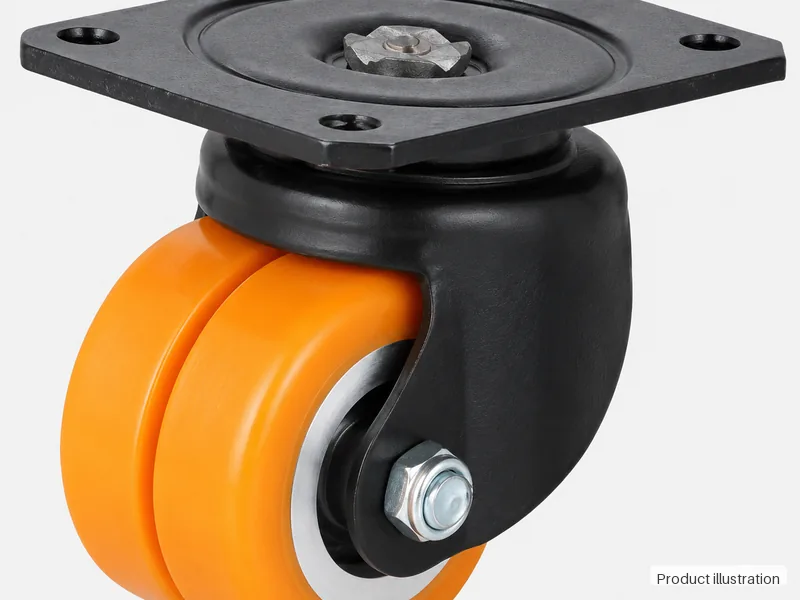
On a manually pushed cart, a mediocre caster is an annoyance; on an AGV or AMR it is a fault code. Automated vehicles navigate by dead reckoning, odometry and vision, so every inconsistency in the trailing casters — a soft spot in one tread, a diameter that differs from its setmates, a swivel that stutters — shows up as tracking error, missed docking or wheel-slip faults. That is why our AGV/AMR line is specified the way it is: AGV-grade PU wheels on iron or aluminium cores, rated to 8 km/h with precision bearings, and supplied as matched sets with hardness, diameter and roundness documented per batch.
The matched-set discipline is the product. A batch certificate says the wheels on one vehicle actually match each other — same measured diameter, same durometer, same roundness — so the vehicle\'s height stays level, its odometry stays honest, and no single caster carries a hidden share of the load. Maintenance teams then get a wear-check rhythm they can plan around instead of reactive fault-chasing; our AGV maintenance guide lays out the wear checks and intervals that keep uptime predictable.
Specifications
| Wheel material | AGV-grade PU on iron core · AGV-grade PU on aluminium core |
|---|---|
| Model-size reference matrix (industry chart) | Hamilton DuraGlide-AGV: durometer 95A polyurethane, Ø 4–16 in, tread width 1-1/4 / 2 / 3 in, 4,000–15,400 lb single-caster, sealed precision ball bearings; S-MDD-AGV-13GB95: Ø 10 × 3 in, 8,000 lb — published chart rows, per-publisher reference for sizing, not supplier ratings; the binding rating is confirmed per configuration at quotation |
| Quality documentation | Matched sets — hardness, diameter and roundness documented per batch (owner process statement) |
| Tolerances & torque metrics | To be test-confirmed — wheel diameter tolerance, roundness grade, hardness tolerance, start-up torque, rolling resistance and steering torque are measured per factory measurement record; matched-set documentation already covers hardness, diameter and roundness per batch, and no tolerance or torque figure is published as a family rating |
| Speed rating | ≤ 8 km/h (precision bearing series) |
| Size range | Ø 25–300 mm |
| Typical duty | AGV/AMR trailing casters, automated tuggers, mobile robot platforms |
| Published AGV classes (industry reference) | AGV ergonomic class up to 1,600 lb with ultra-low startup forces; engineered ergo line to 1,200 lb; a published 4 × 2 in twin-wheel AGV SKU rates 800 lb per unit — peer figures for context, never supplier ratings |
| Lead time | 15–20 days (custom configurations 30–40 days) |
| MOQ | 200 pieces per model; trial orders negotiable |
| Warranty | 18 months |
AGV caster capacity is specified per vehicle program — it depends on wheel size, floor, speed and how many casters share the load under the vehicle\'s own weight distribution — and is confirmed at quotation together with the batch documentation scope. Industry references place AGV caster duties anywhere up to the 1,600 lb ergonomic class and beyond in engineered configurations; published peer figures are context, not our ratings.
Applications & Selection
Why AGV casters are a different product
Three requirements separate an AGV caster from a lookalike catalog part. First, consistency: the vehicle leans on its casters being identical — a diameter mismatch of fractions of a millimeter across a set tilts the platform and shifts load onto the drive wheels, which is where traction and odometry live. This is why matched sets with per-batch documentation exist as a product category, and why "AGV-grade" means tolerances and certificates rather than a marketing adjective.
Second, rolling efficiency: every watt an AMR spends deforming a soft tread or dragging a misaligned swivel is battery runtime lost, and industry AGV-caster engineering is explicit that low rolling resistance and true tracking extend range and reduce faults. Hard, precise PU on a metal core, precision bearings and a consistently smooth swivel are the mechanical answer — the same tread family as our polyurethane wheels, manufactured and selected to tighter process control.
Third, wear behavior you can schedule around: a caster that fails suddenly takes a vehicle out of the fleet mid-shift, while one that wears predictably gets swapped at the planned maintenance window. That is the intent behind the batch documentation and the published wear-check intervals — maintenance reads the wear trend per position and replaces by plan. The maintenance guide linked below lays out the wear checks and the intervals behind that rhythm.
Selection points to settle before you RFQ
Start with the vehicle program, not the wheel: platform weight, caster positions and load distribution, drive-wheel layout (which decides how much load the trailing casters actually see), travel speed, floor material and joint condition, and duty cycles per shift. AGV capacity is a per-vehicle engineering number, and quoting it properly needs these inputs — per-wheel ratings copied from a catalog are how hidden overload happens.
State the documentation and consistency expectations explicitly: matched-set scope (per vehicle? per batch?), the measured properties you want on the certificate (diameter, durometer, roundness as our line documents them), and any fleet-wide interchangeability requirement so replacement sets drop in without re-leveling the platform.
Name the environment and interface: floor debris (a hard PU tread rides grit; a soft one embeds it), washdown or ESD requirements if any, mounting (top plate, stem or custom bracket), swivel/rigid mix and whether the vehicle needs a specific offset or trail for tracking. Where the AGV tows loads or runs fast duty cycles, derating is part of the quote, not an afterthought.
Balance beam or spring-loaded suspension: how the arrangement is chosen
Trailing casters decide whether the platform sits level; the drive wheels decide whether it moves where it is told. An AGV component maker, HONPINE, sets out the choice between two ways of holding the drive wheels to the floor. A spring-loaded steering drive unit lets its wheel move vertically within the available travel, so it follows a low spot in the floor instead of losing contact. HONPINE points to correct spring preload and suspension adjustment as what keeps traction without overloading the wheel. For a light or medium-duty AGV on reasonably even indoor floors, this is the arrangement to evaluate first.
A balance beam, also called an equalizing or rocker beam, is a pivoting linkage like a seesaw between two wheels: as one wheel rises over an obstacle, the other is pressed down, so both stay on the floor and share the load. This suits heavy-duty vehicles and large differences between the unloaded and loaded platform. HONPINE names vehicles above 2 metric tons as heavy-duty projects worth comparing on a balance beam, while calling that a starting point for evaluation rather than an automatic rule.
A patent from Dematic shows the same problem solved on the drive wheels themselves. US10434924B2 mounts spring-biased drive wheels between casters at the corners of the frame, giving them vertical travel that reaches below the casters, enough to stay in contact over uneven ground such as about a 5% grade change or a 3° slope. The downward force on each drive wheel is set by how many springs are fitted and their rating.
The choice stays at the configuration level. HONPINE warns that the load split across a beam depends on its geometry and wheel arrangement, and that keeping the wheels in contact does not by itself give either traction or equal loading. Its selection points are the vehicle\'s empty and loaded weight, the load on each wheel, the variation in floor height, speed and installation space. Our RFQ list mirrors those points, plus maintenance access to the springs and guides, which HONPINE also names. Send them with your RFQ. These sources are peer manufacturers, so their descriptions and figures are context for the design question, not our ratings.
Quality & Verification
The spec values for AGV / AMR Caster Wheels draw on 8 field-level source records — 3 tenant confirmed, 0 manufacturer reference, 5 industry reference.
| Claim on this page | How a buyer verifies it |
|---|---|
| Load rating | Catalog ratings bind one configuration. State wheel, bearing, speed and duty. Require that exact rating on the quotation. |
| Sample or test report | Request test data or certificates per SKU. Agree acceptance in writing before the order. |
| Materials and tread | Confirm material by certificate, not description. Unresolved options are fixed at quotation. |
| Bearings | Name the bearing type in the RFQ. "Standard bearing" is not a specification. |
| Standards and compliance | Name the standard and certify against it. An unnamed equivalent is not a certification. |
What this page cannot verify
- No figure on this page is our own lab result.
- The binding rating is the quotation figure.
Sources for this page
- [1] materials, speed, size range — tenant confirmed (first-party) (owner://vertical.config.json (route A 2026-10-01)) — audit 2026-10-26 verdict pass_tenant_confirmed
- [2] matched sets documented per batch (hardness, diameter, roundness) — tenant confirmed (first-party) (owner://process-statement) — owner process statement, audit 2026-10-26
- [3] industry duty context (ergonomic class to 1,600 lb; tracking/battery rationale) — industry reference (https://www.accesscasters.com/agv-casters.aspx) — context only; casterconcepts corroboration via Wayback snapshot 20251015 (DNS-unreachable live) — raw text scripts/content-research/raw/casterconcepts-agv-wayback-20261026.txt; peer figures never rendered as supplier ratings
- [4] published AGV class rows and per-SKU chart row (1,600 lb / 1,200 lb class bands; S-EHS-AGV-4SWC95 4x2 twin wheel 800 lb) — industry reference (https://www.accesscasters.com/agv-casters.aspx) — added 2026-10-28 SKU depth pass; corpus-verbatim ledger entries in packs/industrial-caster-wheels/model-evidence.json; peer MPN and values never rendered as supplier ratings
- [5] lead_time/moq/warranty — tenant confirmed (first-party) — owner answers 2026-10-26 (Foundation runtime/owner-answers-20261026.json)
- [6] suspension arrangement choice (spring-loaded steering drive unit vs balance/equalizing beam; the beam pivots like a seesaw so both wheels stay on the floor; >2 t as a starting point, not a rule) — industry reference (https://www.honpine.com/news/Product-News/AGV-Suspension-Should-You-Choose-a-Balance-Beam-or-a-Spring-Loaded-Steering-Drive-Unit.html) — corpus manual-acquisition-20261110, s-balance-honpine: "An AGV balance beam, also called an equalizing beam or rocker beam, is a pivoting mechanical linkage that works like a seesaw." / "For heavy-duty projects, including AGVs carrying more than 2 metric tons, a balance-beam layout is worth including in the initial design comparison." / "Treat this as a starting point for evaluation rather than an automatic selection rule." — peer manufacturer; rendered as design context, never supplier capability
- [7] RFQ inputs named for the suspension choice (empty and loaded weight, load on each wheel, floor-height variation, speed, installation space) — industry reference (https://www.honpine.com/news/Product-News/AGV-Suspension-Should-You-Choose-a-Balance-Beam-or-a-Spring-Loaded-Steering-Drive-Unit.html) — added 2026-11-11 bridge, paraphrased: HONPINE\'s selection points for the suspension choice — empty and loaded vehicle weight, load on each wheel, floor-height variation, speed and installation space — s-balance-honpine: "For a practical selection review, request calculations and specifications covering the complete vehicle: empty weight, maximum payload, individual wheel loads, floor-height variations, travel speed, installation space, and maintenance access." — corpus manual-acquisition-20261110 (peer manufacturer page AGV-Suspension-Should-You-Choose-a-Balance-Beam-or-a-Spring-Loaded-Steering-Drive-Unit); rendered on agv-amr-casters as the RFQ list at the end of the balance-beam section; peer manufacturer, never supplier capability
- [8] drive-wheel vertical travel for slope (about 5% grade / 3° change) — industry reference (https://patents.google.com/patent/US10434924B2/en) — corpus manual-acquisition-20261110, s-balance-dematic-us10434924 (patent, Dematic): "the spring components are configured to provide a vertical travel for the pair of drive wheels 32 that extends below the casters a distance that maintains the pair of drive wheels in contact with the ground surface when the ground surface that the AGV is traveling over is uneven, such as to accommodate at least about a 5% change in incline or otherwise a change in slope of about 3 degrees." — one design example
Frequently Asked Questions
What makes an AGV caster wheel different from a standard polyurethane caster?
Process control and documentation, more than material. An AGV-grade wheel is the same PU-on-metal-core family, but manufactured to tighter diameter and roundness consistency, supplied in matched sets whose hardness, diameter and roundness are measured and documented per batch, and rated for the 8 km/h precision-bearing speed class automated vehicles actually run. The point is fleet behavior: level platforms, honest odometry, predictable wear — things a generic catalog caster cannot promise because nobody measured it that way.
How do I size AGV/AMR casters for my vehicle?
From the vehicle, not the catalog. Distribute the platform\'s loaded weight across its caster positions per the actual geometry (trailing casters rarely share load equally, especially around the drive wheel), apply the duty margin for speed, floor joints and cycle count, and size the wheel for floor-friendly contact at that load. The rating for your program — including the matched-set documentation scope — is confirmed at quotation; industry references show AGV caster duties ranging up to and beyond the 1,600 lb ergonomic class, which is why per-program sizing matters.
What should my AGV caster RFQ include?
Vehicle platform weight and geometry, caster positions and load distribution, speed, floor type and condition, duty cycles, matched-set and batch-certificate expectations (which measured properties, per vehicle or per batch), environment (debris, moisture, ESD), mounting interface, swivel/rigid layout, and quantity per program. A drawing of the platform\'s underside shortens quoting the most.
Ordering & Documentation
Documents
Every order ships with a packing list and commercial invoice. AGV orders additionally quote with the batch documentation scope: the measured properties (hardness, diameter, roundness) recorded for the supplied matched sets. On request we provide wheel dimension sheets and mounting drawings so your vehicle integration can be checked before production.
Quotation
A quotation needs: the vehicle program data (weight, geometry, speed, floor, cycles), matched-set and documentation expectations, mounting and configuration, and quantity. The confirmed quotation states the capacity and documentation scope for your program — AGV capacity is a per-vehicle engineering figure, not a catalog number.
Sample & supply
Standard sizes are produced to order with an MOQ of 200 pieces; trial-order quantities are negotiable; confirm availability and terms for the specified model in your RFQ. Lead time is 15–20 days for standard configurations and 30–40 days for custom cores, mounting or documentation work. Samples ship freight collect and are refundable against a bulk order.
Storage & shipping
AGV wheels ship in set-preserving packaging: matched sets are kept together and identified, and treads are protected from denting and ozone (UV, sunlight, motor rooms) in storage. Store flat at stable indoor temperature; a wheel that takes a set in storage is exactly the inconsistency the batch documentation exists to prevent. Keep bearing bores packaged until installation.