
Product Catalog
RM-Light Series Casters — Own-Production Range up to 150 kg per Caster
Updated 2026-11
This page describes the RollMaster RM-Light series, a core product family supplied through own-production arrangements with the cooperating factory. The owner-declared series band is up to 150 kg per caster. That figure defines the upper boundary of the series-selection band; it is not a measured rating for every wheel, bracket, mounting plate or complete caster assembly. The applicable rating for the exact model, including its dynamic or static basis where relevant, must be confirmed in the written quotation.
Owner records list polypropylene (PP), cast nylon (PA6), thermoplastic rubber (TPR) and solid rubber as RM-Light family wheel options, with stamped-steel housings recorded at family level. These are not interchangeable grades and do not mean every material, housing, finish or mounting interface is available in every size. The exact compound, dimensions, construction and suitability must be checked against the selected model and its evidence.
The words light duty are used differently across industry guides and distributor catalogs. Their class limits, wheel-size examples and load bands are not RM-Light specifications. This page therefore uses the owner-confirmed RM-Light series band as the only supplier load-range statement and does not convert third-party light-duty taxonomies into RollMaster ratings. Configurations outside the confirmed own-production scope may be coordinated through sourcing; any such offer must identify the actual manufacturer and model and must not be represented as RollMaster-manufactured.
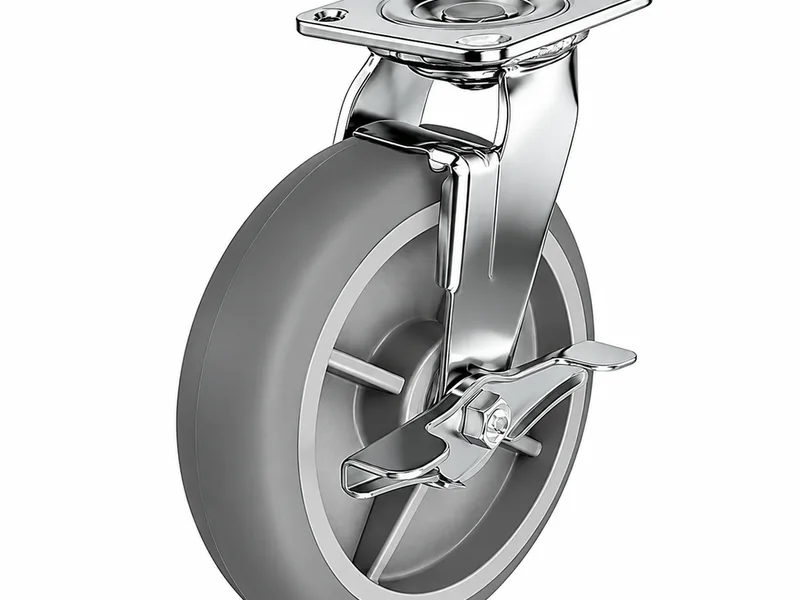
Specifications
| Series identity | RollMaster RM-Light — own-production core series |
|---|---|
| Owner-declared series band | Up to 150 kg per caster; this is a series boundary, not a per-SKU or complete-assembly rating |
| Recorded family wheel options | Polypropylene (PP), cast nylon (PA6), thermoplastic rubber (TPR) and solid rubber; exact compound and model availability confirmed by configuration |
| Housing scope | Stamped-steel housing recorded at family level; confirm the actual housing design and mounting interface by model |
| Wheel dimensions and mounting | Wheel diameter, width, overall height, plate or stem dimensions, bolt pattern and swivel radius are confirmed for the selected model |
| Performance and operating limits | Per-model dynamic/static rating, speed, temperature, brake function and duty limits are not inferred from the series name; confirm against the selected configuration |
| Finish options | Zinc plating, chrome plating and powder coating are line-wide options; substrate and availability are confirmed for the selected housing |
| Quotation-planning schedule | RollMaster planning baseline: 15–20 days for standard catalog configurations and 30–40 days for special configurations; actual schedule confirmed in the written quotation |
| Quotation-planning quantity | 200 pieces is a RollMaster planning baseline, not a factory or manufacturer MOQ; standard catalog configurations may be supplied in smaller quantities |
| Commercial coverage | 18-month RollMaster commercial coverage; scope and exclusions confirmed in the written quotation |
Do not treat the 150 kg/caster series boundary as the rating of a selected SKU or complete assembly. Ask for the exact model, load basis, mounting structure and applicable test conditions. Industry class charts and distributor ranges are not substituted for model-specific evidence.
Applications & Selection
Match the complete caster to the equipment
RM-Light is intended for the lighter end of industrial caster applications, including furniture programs, retail displays, bins, light racks and manually moved utility carts where the selected configuration suits the floor and duty. These are application examples, not blanket approvals for every RM-Light model. A cart that crosses thresholds, carries an off-centre payload or runs continuously may need a different wheel, bracket or series even when its nominal load appears to fit the family band.
Start with the equipment dead weight plus maximum payload. Record the load centre, caster count and mounting positions, then describe the actual floor, joints, thresholds, debris and turning conditions. Dividing total weight evenly by four assumes all four wheels remain in contact and share load equally. Where floors are uneven, the load is offset or a wheel may unload, a three-support calculation can be a conservative preliminary screen; it is not a universal safety formula. Verify the selected caster rating and the complete equipment mounting structure before release.
Choose wheel material from the real duty, not a generic ranking
PP, PA6, TPR and solid rubber are recorded family options, but the material name alone does not establish noise, floor marking, rolling resistance, chemical resistance or service life. Those outcomes depend on the exact compound or resin, hardness, wheel geometry, load, floor finish, speed, temperature and exposure. State the actual cleaning agents or chemicals, concentration, contact time and ambient conditions when these affect selection; request model-specific compatibility information rather than relying on a generic material comparison.
For a furniture or display program, describe the floor surface and any non-marking, appearance or noise requirement. For a utility cart, include obstacle height, route frequency and whether the cart is pushed or towed. The factory-confirmed wheel compound and complete assembly should be selected against those conditions; do not assume that all four recorded materials are offered in every configuration.
Confirm mounting, swivel and brake interfaces
A wheel that fits the load but not the equipment interface is not a usable replacement. Include a drawing or dimensions for the stem diameter and length, grip-ring or threaded connection, top plate and bolt-hole spacing, overall height and available swivel clearance. Identify whether the application needs swivel, rigid, total-lock or directional-lock behavior. Brake terminology and the actual locking action must be confirmed for the selected model rather than inferred from a product photograph.
If replacing an installed caster, provide the original manufacturer and model marking where available, photographs from multiple angles, and measurements of the mounting interface. A visual resemblance is not proof of interchangeability. Confirm the replacement against the original drawing or a measured sample before ordering a production quantity.
Quality & Verification
The spec values for RM-Light Series Casters draw on 4 field-level source records — 4 tenant confirmed, 0 manufacturer reference, 0 industry reference.
| Claim on this page | How a buyer verifies it |
|---|---|
| Load rating | Catalog ratings bind one configuration. State wheel, bearing, speed and duty. Require that exact rating on the quotation. |
| Sample or test report | Request test data or certificates per SKU. Agree acceptance in writing before the order. |
| Materials and tread | Confirm material by certificate, not description. Unresolved options are fixed at quotation. |
| Bearings | Name the bearing type in the RFQ. "Standard bearing" is not a specification. |
| Standards and compliance | Name the standard and certify against it. An unnamed equivalent is not a certification. |
What this page cannot verify
- No figure on this page is our own lab result.
- The binding rating is the quotation figure.
- exact SKU dimensions, mounting, dynamic/static rating, speed, temperature and test basis — not declared as universal RM-Light values; confirm for the selected model and complete assembly
Sources for this page
- [1] RM-Light own-production series identity and up-to-150 kg/caster series band — tenant confirmed (first-party) — vertical.config.json product_series and services.ts rm-light-casters owner-confirmed copy
- [2] PP, PA6, TPR and solid-rubber wheel options; stamped-steel housing at family level — tenant confirmed (first-party) — services.ts rm-light-casters and RM-Light product-catalog entry; not a per-SKU combination matrix
- [3] line-wide finish options — tenant confirmed (first-party) — vertical.config.json surface-treatment options; confirm substrate and model availability
- [4] RollMaster planning schedule, quantity baseline and commercial coverage — tenant confirmed (first-party) — RM-Light product-catalog owner_specs; planning/commercial terms, not supplier guarantees
Frequently Asked Questions
Does the RM-Light series support 150 kg on every caster?
No. Up to 150 kg per caster is the owner-declared upper boundary of the RM-Light series band. It is not a universal rating for every SKU, wheel, bracket or complete assembly. The exact model rating, dynamic or static basis and applicable test conditions must be confirmed for the quoted configuration.
Is RM-Light the same as every supplier’s light-duty caster class?
No. Industry guides and distributors use different light-duty class boundaries and may publish unrelated wheel sizes or load ranges. Those references do not define RM-Light. Use the owner-declared RM-Light series band for series positioning and the selected model documentation or written quotation for the actual rating.
Which wheel materials can be selected?
The recorded family options are PP, PA6, TPR and solid rubber. The exact compound or resin, dimensions, housing and availability depend on the model. Share the floor, load, cleaning chemicals, temperature, noise and floor-marking requirements so the selected configuration can be checked against the real duty.
What information should an RM-Light RFQ include?
Provide equipment dead weight and maximum payload, load centre, caster count and positions, wheel diameter and width if constrained, floor and obstacle conditions, material preference, mounting dimensions or drawing, swivel/rigid and brake requirements, operating frequency, environment, quantity and destination. Include the drawing revision, required test basis and any documents that must be confirmed in the quotation.
What are the planning terms and commercial coverage?
RollMaster uses 15–20 days for standard catalog configurations and 30–40 days for special configurations as quotation-planning baselines, not guaranteed factory or supplier delivery dates. The 200-piece quantity is also a planning baseline; standard catalog configurations may be supplied in smaller quantities. Confirm actual availability, quantity, schedule and the 18-month RollMaster commercial coverage, including scope and exclusions, in the written quotation.
Ordering & Documentation
Quotation and model confirmation
The quotation should identify the offered supply route, series or actual manufacturer, exact model, wheel compound, housing, mounting interface, applicable rating and any agreed operating limits. If a configuration is supplied through coordinated sourcing rather than the RM-Light own-production core, the actual manufacturer and model must be identified in the offer. Do not treat a family option or a reference image as confirmation that a particular SKU is available.
Samples, quantity and schedule
A sample or first-article check is useful when mounting dimensions, floor interaction, noise or appearance are critical. Agree the sample configuration and acceptance points before the order. The 200-piece figure is RollMaster’s quotation-planning baseline, not a manufacturer MOQ; standard catalog configurations may be available in smaller quantities. The 15–20-day standard and 30–40-day special-configuration windows are planning references only. Actual availability, quantity and schedule are stated in the written quotation.
Documents, packaging and handling
List any required drawing, material declaration, test record, packing document or other compliance file in the RFQ and have its availability and revision confirmed for the exact model and order. Packaging method, marking, shipment configuration and any model-specific storage or handling instruction should likewise be stated in the quotation or supplied documentation; they are not assumed to be identical across all wheel compounds and configurations.