
Product Catalog
RM-Medium Industrial Casters — 150–500 kg per Caster
Updated 2026-11
RM-Medium is RollMaster’s own-production core series for industrial carts, racks and equipment in the declared 150–500 kg per-caster band. The band is a series-level selection boundary, not a promise that every wheel, bracket, bearing or mounting combination carries the same rating. The selected model and complete assembly must be matched to the equipment, load distribution, floor and operating duty.
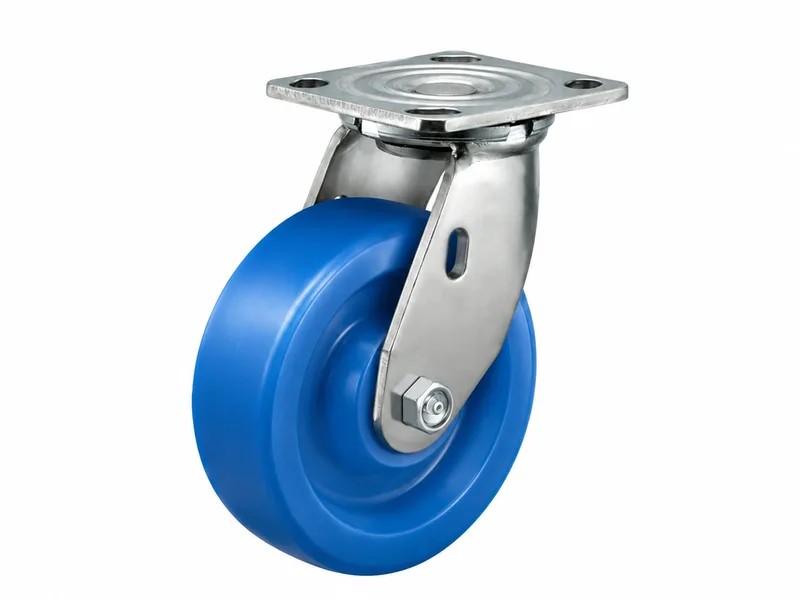
The series record identifies polyurethane on a steel core, cast nylon (PA6) and steel as construction options. They are not interchangeable and are not available in every combination by default. Confirm the exact wheel material and compound, diameter and width, bearing, bracket, mounting dimensions and brake arrangement for the configuration being quoted. Complementary models outside the confirmed RM-Medium scope may be supplied through coordinated sourcing and will retain their actual manufacturer and model attribution.
Specifications
| RM-Medium series band | 150–500 kg per caster (owner-confirmed series range; not a universal SKU rating) |
|---|---|
| Recorded construction options | Polyurethane (PU) on steel core · Cast nylon (PA6) · Steel; exact material and component combination confirmed for the selected model |
| Surface finishes | Zinc plating · Powder coating; confirm the finish and substrate for the selected bracket |
| Speed scope | Owner-declared baseline up to 4 km/h; up to 8 km/h only for the precision-bearing series/configuration and subject to exact-model confirmation. Do not transfer the higher-speed scope to a standard-bearing build. |
| Temperature scope | PU tread options only: standard PU −20…+80 °C; special PU −40…+120 °C. These are tread/family ranges, not complete-caster guarantees; confirm bearing, grease, bracket and exposure for the exact model. |
| Per-model rating and dimensions | Confirmed for the selected wheel diameter and width, bearing, bracket, mounting interface, speed and duty in the written quotation; no generic medium-duty class chart substitutes for the model record. |
| Quotation-planning lead time | RollMaster planning baseline: 15–20 days for standard catalog configurations; 30–40 days for special configurations. Confirm the actual schedule for the selected model and order. |
| Quotation-planning quantity | 200 pieces is the RollMaster planning baseline, not a universal per-model factory MOQ. Standard catalog configurations may be supplied in smaller quantities; confirm the actual quantity and terms in the quotation. |
| RollMaster commercial coverage | 18 months as RollMaster commercial coverage; scope, exclusions and order terms are stated in the written quotation. |
The 150–500 kg/caster band is the owner-confirmed RM-Medium series range. It is not a measured rating for every configuration. Final selection must use the rating for the complete quoted caster under the stated load, speed, floor and duty conditions.
Applications & Selection
Where RM-Medium fits
Use the RM-Medium band as the first screen for industrial carts, material trolleys, work-in-process racks and equipment that move regularly on factory or warehouse floors. The series is intended for the middle of the RollMaster load ladder: below the RM-Heavy tier and above RM-Light. If the calculated requirement is near a series boundary, do not select from the label alone; send the full load and duty details for confirmation.
The wheel construction changes how the caster behaves. PU on a steel core is a common route when buyers need a balance of rolling effort, tread resilience and load support; cast nylon is a harder construction whose suitability depends on floor finish, noise tolerance and impact conditions; steel is a distinct metal-wheel option and should not be treated as a drop-in replacement for a resilient tread. The exact material, compound, bearing and complete assembly determine the usable rating.
Size the complete caster, not just the nominal load
Start with the equipment mass plus maximum payload, then document how the load is distributed across the caster positions. For a four-caster cart on an uneven floor, a conservative initial screen often assumes only three casters share the load at a given moment; this is a screening assumption, not a substitute for checking centre of gravity, mounting stiffness, impact, turning and the manufacturer’s complete-assembly rating.
Record the worst route: floor material and joints, thresholds, ramps, debris, turning space, travel speed, starts and stops, operating hours and whether the cart is pushed manually or towed. A smooth-floor hand cart and a powered trolley with repeated turns are not the same duty, even when the static payload is identical.
Do not infer a 4–6 inch wheel requirement or a housing thickness from the phrase “medium duty”. Those are not RM-Medium universal dimensions. Wheel diameter, tread width, bracket construction, mounting height and swivel envelope must be selected together against the available clearance and actual route.
Own-production scope and complementary sourcing
RM-Medium is presented as an own-production core series within its owner-confirmed scope. Standard and available-stock configurations are confirmed by model and order. If a project calls for a construction or interface outside the confirmed RM-Medium range, RollMaster may coordinate supply from another manufacturer; the quotation identifies the actual manufacturer and model, and sourced products are not represented as RollMaster-manufactured.
A series band does not establish that every requested combination is already stocked or can be produced without review. Send the drawing revision, mounting dimensions and operating conditions so the selected production or sourcing route can be confirmed before order acceptance.
Quality & Verification
The spec values for Medium Duty Casters draw on 3 field-level source records — 3 tenant confirmed, 0 manufacturer reference, 0 industry reference.
| Claim on this page | How a buyer verifies it |
|---|---|
| Load rating | Catalog ratings bind one configuration. State wheel, bearing, speed and duty. Require that exact rating on the quotation. |
| Sample or test report | Request test data or certificates per SKU. Agree acceptance in writing before the order. |
| Materials and tread | Confirm material by certificate, not description. Unresolved options are fixed at quotation. |
| Bearings | Name the bearing type in the RFQ. "Standard bearing" is not a specification. |
| Standards and compliance | Name the standard and certify against it. An unnamed equivalent is not a certification. |
What this page cannot verify
- No figure on this page is our own lab result.
- The binding rating is the quotation figure.
- per-model dynamic rating, dimensions and complete-assembly test basis — not declared as a universal family value; confirm for the selected model and duty
Sources for this page
- [1] RM-Medium 150–500 kg/caster series band — tenant confirmed (first-party) — vertical.config.json product_series / owner load-series table
- [2] PU on steel core, cast nylon (PA6), steel; finish, speed and temperature scope — tenant confirmed (first-party) — RM-Medium series entry in product-catalog.json and owner technical_specs; per-model combinations remain quotation-confirmed
- [3] lead time, quantity baseline and RollMaster commercial coverage — tenant confirmed (first-party) — supplier owner_specs; presented as planning/commercial terms, not supplier or manufacturer guarantees
Frequently Asked Questions
What is the RM-Medium caster load range?
The owner-confirmed RM-Medium series band is 150–500 kg per caster. This is a series-level range, not one rating for every size or assembly. The quotation confirms the selected model’s rating with its wheel, bearing, bracket, mounting and stated duty conditions.
How should I estimate load per caster on a four-wheel cart?
Begin with the equipment mass plus maximum payload and the real load distribution. On an uneven floor, using three load-bearing casters as an initial conservative screen is common because one wheel may unload; it is not a universal calculation rule. Centre of gravity, mounting stiffness, impact, turning and the complete caster rating still need review.
What information should I include in an RM-Medium RFQ?
Provide total loaded weight, caster quantity and positions, target load per caster, wheel diameter and width if constrained, preferred tread, bearing and brake requirements, top-plate or stem dimensions, floor and obstacle conditions, manual or powered movement, speed, duty cycle, temperature and order quantity. Attach the drawing with its revision when available.
Ordering & Documentation
Model and document confirmation
The quotation identifies the selected RM-Medium configuration and its confirmed rating, dimensions, supply status and commercial terms. Drawings, inspection records or other technical documents are identified only when they are available and applicable to that model and order; a general product page is not a certification or test report.
Quotation
A useful quotation request includes the loaded equipment weight, load distribution, quantity and position of casters, wheel and mounting constraints, brake layout, floor, speed and duty cycle. The written quotation is the reference for the selected configuration, confirmed rating, production or stock route and delivery schedule.
Sample and supply
RM-Medium is an own-production core series. Stock availability and the production schedule are confirmed for the selected model and order. The 200-piece figure is a RollMaster quotation-planning baseline; standard catalog configurations may be supplied in smaller quantities. The 15–20-day standard and 30–40-day special windows are planning baselines, not unconditional delivery guarantees.
Receipt and installation
At receipt, compare the delivered model, quantity and visible dimensions with the approved quotation and drawing revision, and record any transit damage or mismatch before installation. Follow the applicable model and bearing instructions for installation, lubrication and storage; do not assume every configuration uses the same grease, preload, packaging orientation or maintenance interval.