
Product Catalog
Scaffold Casters — Stem-Mount Total-Lock Casters for Scaffold Towers
Third-party brand — supplied via our sourcing network
Product references on this page may come from more than one third-party source. A retailer or catalog is not necessarily the manufacturer. Where the original manufacturer or exact model/part number is not identified, it is not verified by this listing; confirm both in the written quotation. Any lead time, MOQ or warranty shown as our offer is a RollMaster quotation term, not a third-party manufacturer's published term.
Updated 2026-11
Scaffold casters are the ground contact of every rolling scaffold tower: heavy-duty swivel casters that mount not with a top plate but with a round stem, dropped into the caster socket at the bottom of each scaffold leg and held by a pin or a cross-drilled retention hole. The standard configuration pairs an 8 x 2 inch rubber-on-cast-iron wheel with a total-lock brake, because a scaffold is not a cart — it is an elevated work platform, and the four casters under it must become four rigid posts the moment workers climb.
The published class covers 8 x 2 inch wheels with two common stem families: a 1-3/8 inch round stem (4 inches long, with a 1/2 inch cross-drilled hole for a securing pin) for standard steel scaffold frames, and a 1 inch round stem (1 x 2-3/4 inches, with pin) for lighter towers. The collected evidence does not identify one manufacturer behind this entire class. These are sourced third-party product references supplied through coordinated procurement, not RollMaster-manufactured models. The 500 lb rubber-on-cast-iron reference is tied to retailer listing code 8UC8RB (not verified as a manufacturer MPN); the 950 lb polyurethane figure comes from a separate category guide and is not the rating of that same listing. The actual manufacturer, exact MPN, tread/core, stem, brake and applicable rating are confirmed for the quoted configuration.
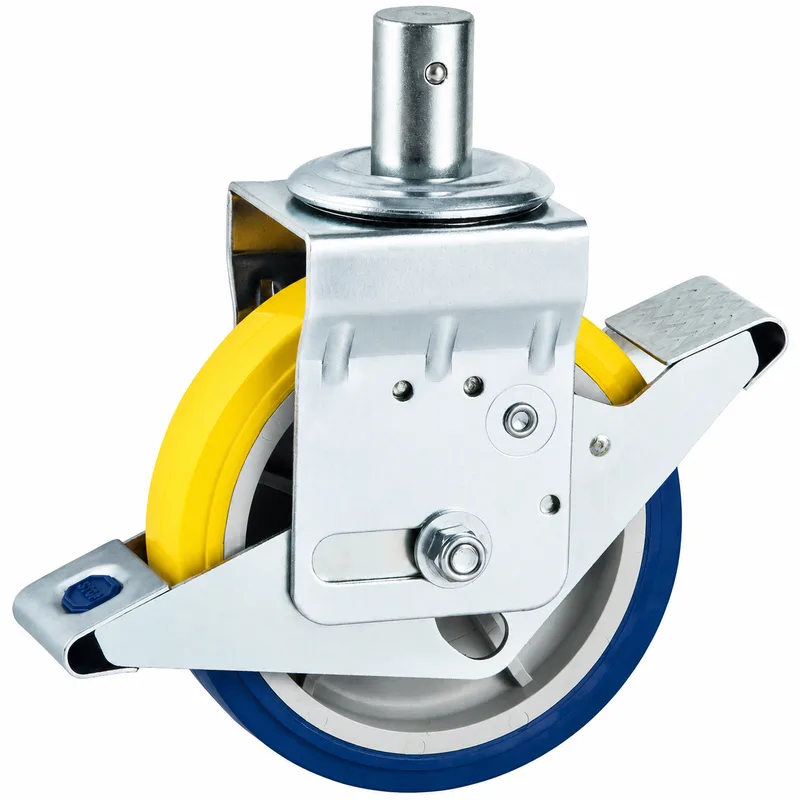
Specifications
| Type | Swivel caster with round stem mount and total-lock brake |
|---|---|
| Model-size reference matrix (separate publisher references; not a family size range) | These are separate publisher-specific configurations, not one family size range. Access Casters retailer listing 8UC8RB: 8 × 2 in rubber-on-steel wheel, 500 lb, roller bearing, 1-3/8 × 4 in stem and brake. HYW scaffold guide: a separate 8 × 2 in red-polyurethane variant at up to 950 lb with a 1-3/8 in round stem. These are not one manufacturer SKU or a combined rating; manufacturer identity and exact MPN remain unverified in the collected record. |
| Wheel | 8" × 2" |
| Wheel material | Rubber on cast iron |
| Stem options | 1-3/8" × 4" with 1/2" cross-drilled hole; 1" round (1" × 2-3/4") with pin; 1-3/8" round with pin |
| Separate published load examples (third-party references; not a family rating) | Access Casters listing 8UC8RB: 500 lb per caster for its specific rubber-on-steel product; HYW guide: up to 950 lb per caster for a separate polyurethane class variant. These are source-specific examples, not a shared manufacturer rating or a RollMaster family rating; exact manufacturer, MPN and rating are confirmed at quotation. |
| Brake | Total lock (wheel rotation and swivel) |
| Third-party brand — supplied via our sourcing network | Product references on this page may come from more than one third-party source. A retailer or catalog is not necessarily the manufacturer. Where the original manufacturer or exact model/part number is not identified, it is not verified by this listing; confirm both in the written quotation. Any lead time, MOQ or warranty shown as our offer is a RollMaster quotation term, not a third-party manufacturer's published term. |
| RollMaster quotation-planning quantity (not manufacturer MOQ) | 200 pieces is the supplier-level quotation-planning baseline, not a confirmed manufacturer minimum. The actual supplier minimum and sample availability are confirmed for the named supplier and exact model in the current written quotation. |
| RollMaster commercial coverage | 18 months as RollMaster commercial coverage; exact coverage, exclusions and order terms are confirmed in the written quotation. Any manufacturer warranty is separate and must be confirmed for the named manufacturer and exact model. |
Published ratings in this class are per caster and per tread: 500 lb is the specific rubber-on-cast-iron product rating, while 950 lb is the upper end of the class reached by polyurethane versions — the two figures are different claims and are never merged. Load rating and stem fit for your frame are confirmed at quotation.
Applications & Selection
Why scaffolds specify total-lock stem casters
A rolling scaffold tower must be prevented from moving while it is in use. Under OSHA 29 CFR 1926.452(w)(2), this may be achieved with positive wheel locks, wheel-and-swivel locks, or an equivalent means; the rule does not universally require a total-lock brake. A total-lock brake is one available configuration that also prevents swivel rotation, while a positive wheel lock may satisfy the stated stationary-use locking requirement when appropriate for the scaffold and its instructions. Select the brake against the scaffold manufacturer’s instructions and applicable site rules; a caster brake alone does not establish that the complete scaffold is compliant.
The stem mount is the other half of the specification. Scaffold frames carry a caster socket at the end of each leg, so the caster needs a round stem sized to that socket — 1-3/8 inch for standard steel frames, 1 inch on lighter aluminum and utility towers — and a way to keep the caster in the socket when the tower is lifted: the 1/2 inch cross-drilled hole or the supplied pin. A plate-mount caster is not a substitute unless the frame was designed for one.
Rubber on cast iron is the standard tread for jobsite floors because it pairs a floor-friendly rubber tread with a cast iron core that carries the load and resists the crushing that a jobsite full of debris inflicts on all-rubber wheels. Where the tower lives its whole life on smooth, finished floors and the priority is quiet, non-marking rolling, polyurethane-tread versions in the same class rate higher (up to 950 lb per caster in published lines) — at some cost in debris tolerance.
Selection points to settle before you RFQ
Measure the socket, not the brochure: stem diameter, stem length, and whether your frames retain the caster with the cross-drilled hole and a pin or only friction. State the stem option exactly — 1-3/8" × 4" with 1/2" cross-drilled hole, 1" round (1" × 2-3/4") with pin, or 1-3/8" round with pin — because stem mismatch is the most common reason scaffold caster orders do not fit.
Size the load per caster honestly. Divide the weight of the fully loaded tower — frame, platform, tools, personnel and material — by four, then remember that repositioning concentrates load: with only two or three casters briefly carrying during a move, and with imperfect floor contact, the working per-caster load is well above the static quarter. Published ratings here start at 500 lb per caster; the same divide-by-three discipline used in our caster load capacity calculation guide is the safe way to size.
Confirm the brake type and the scaffold manufacturer’s requirements by name. Total-lock provides wheel-and-swivel locking; a positive wheel lock or an equivalent method may also meet the stationary-use locking provision in OSHA 29 CFR 1926.452(w)(2), depending on the scaffold and applicable instructions. Separately verify the caster stem is secured in the scaffold leg and follow the rules for preventing tip-over when moving a scaffold. If your site has finished floors, state that too — tread choice follows the floor and debris conditions.
Quality & Verification
The spec values for Scaffold Casters draw on 4 field-level source records — 1 tenant confirmed, 0 manufacturer reference, 3 industry reference.
| Claim on this page | How a buyer verifies it |
|---|---|
| Load rating | Catalog ratings bind one configuration. State wheel, bearing, speed and duty. Require that exact rating on the quotation. |
| Sample or test report | Request test data or certificates per SKU. Agree acceptance in writing before the order. |
| Materials and tread | Confirm material by certificate, not description. Unresolved options are fixed at quotation. |
| Bearings | Name the bearing type in the RFQ. "Standard bearing" is not a specification. |
| Standards and compliance | Name the standard and certify against it. An unnamed equivalent is not a certification. |
What this page cannot verify
- No figure on this page is our own lab result.
- The binding rating is the quotation figure.
Sources for this page
- [1] materials / stem sizes / tread guidance — industry reference (https://hywproducts.com/blogs/resources/scaffold-casters-stem-size-capacity-guide) — stem-size and capacity guide, 2026-10-21 extract
- [2] size_range (8" × 2", stems) — industry reference — accesscasters.com / casterhq.com catalog lines via pack collection
- [3] load_rating (500 lb specific / 950 lb class max) — industry reference — audit disposition pass_documented: values retained separately, never merged
- [4] lead_time/moq/warranty — tenant confirmed (first-party) — owner answers 2026-10-26 (Foundation runtime/owner-answers-20261026.json)
Frequently Asked Questions
Are scaffold casters the same as scaffolding casters or scaffold jacks?
"Scaffold casters" and "scaffolding casters" are the same product: stem-mounted swivel casters with total-lock brakes for the sockets of scaffold frames. A "scaffold jack" is different hardware — a screw jack (base plate or swivel) used for leveling on uneven ground, without any rolling function. Leveling jacks and casters solve different problems, and towers that both roll and level use one of each. When you RFQ, state your frame\'s socket size and required stem — that identifies the product faster than the name.
Which stem size do I need — 1-3/8 inch or 1 inch?
Match the caster socket in your scaffold frames. Standard steel frames take the 1-3/8 inch round stem (4 inches long, with a 1/2 inch cross-drilled hole for a retention pin); lighter towers commonly use the 1 inch round stem (1 x 2-3/4 inches, with pin). Measure the socket\'s inside diameter and check how your frame retains the caster before ordering — a stem that is loose in the socket or unretained is a safety defect, not a fit nuisance.
What should my scaffold caster RFQ include?
Stem size and retention style (cross-drilled hole or pin), wheel size and tread (rubber on cast iron or polyurethane), required total-lock brake, load per caster with the tower\'s fully loaded weight, floor conditions, and quantity per stem type. State the required locking method and the scaffold manufacturer’s specification in the RFQ. If total-lock is required for your particular scaffold, name it; otherwise confirm whether a positive wheel lock or an equivalent method is acceptable under the applicable requirements. Also specify the stem retention method — the caster stem must be secured in the scaffold leg.
Ordering & Documentation
Documents
Order documents and any dimensional sheet for the quoted caster are confirmed with the written quotation. For stem-fit review, request the drawing or dimensional sheet showing stem diameter and length, cross-drill position, wheel size and overall height before placing the order; availability depends on the named supplier and model.
Quotation
A quotation needs: stem option, wheel and tread choice, brake type (total lock), load per caster, floor and site conditions, and quantity per stem type. The per-caster load rating for the exact configuration quoted is confirmed on the quotation — published class figures (500 lb specific rating, up to 950 lb class maximum) are sizing references, not the order commitment.
Sample & supply
Third-party brand — supplied via our sourcing network. Product references on this page may come from more than one third-party source. A retailer or catalog is not necessarily the manufacturer. Where the original manufacturer or exact model/part number is not identified, it is not verified by this listing; confirm both in the written quotation. Any lead time, MOQ or warranty shown as our offer is a RollMaster quotation term, not a third-party manufacturer's published term.
Storage & shipping
Confirm that the quoted supply configuration includes the required stem, retention feature and brake; do not assume these are bundled across every sourced model. Store casters indoors and keep stem surfaces clean and protected — rust or grit can affect the fit in the frame socket. Before each use, check that the retention pin is in place and the brake pedal returns freely; clean concrete dust from the mechanism rather than forcing it.