
Product Catalog
Spring-Loaded Casters — Shock-Absorbing Swivel Casters for Impact and Vibration
Third-party brand — supplied via our sourcing network
Product references on this page may come from more than one third-party source. A retailer or catalog is not necessarily the manufacturer. Where the original manufacturer or exact model/part number is not identified, it is not verified by this listing; confirm both in the written quotation. Any lead time, MOQ or warranty shown as our offer is a RollMaster quotation term, not a third-party manufacturer's published term.
Updated 2026-11
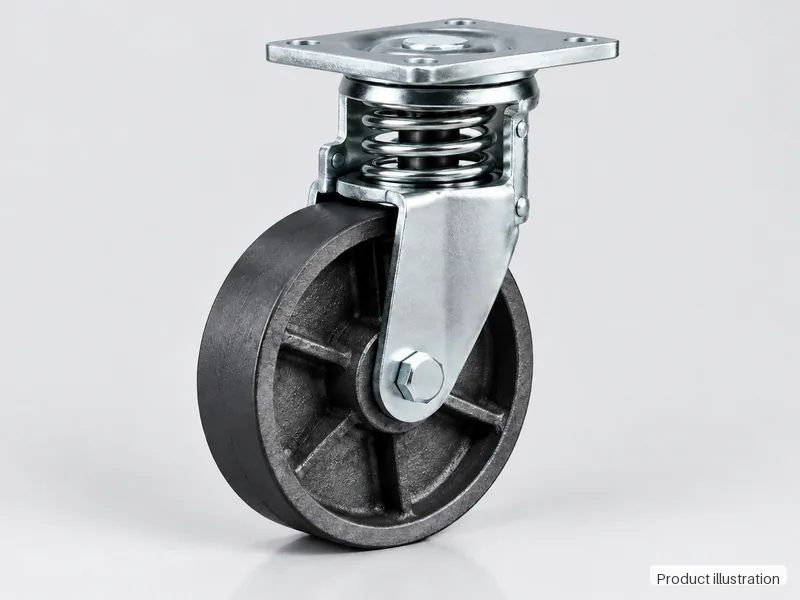
A spring-loaded caster places a spring between the mounting structure and the wheel. When the wheel crosses a joint or threshold, the spring deflects and temporarily stores elastic energy, then returns toward its original position. That suspension can reduce the sharpness of load transfer and help maintain wheel contact, but a steel coil spring by itself is not a guarantee that impact energy is dissipated: rebound, oscillation and the complete caster/tread system still matter. Manufacturer descriptions of reduced shock and noise are product-design claims, not a quantified attenuation rating. Typical applications include conveyor-drawn carts, bakery racks, production dollies and shock-sensitive loads.
A spring-caster load figure is incomplete without its deflection basis. Albion\'s S310/S410 product information, for example, lists capacity at 50% of total wheel deflection (21/32 in of 1-5/16 in); that is an Albion series condition, not a universal rating convention. RollMaster\'s spring-loaded family currently has no verified published spring rate, preload, end-stop force, travel or family capacity in the owner data reviewed here. Those values therefore remain configuration-specific quotation items, not inferred from Albion, Blickle or Hamilton.
Specifications
| Type | Spring-loaded (shock-absorbing) swivel casters; kingpinless spring construction available |
|---|---|
| Model-size reference matrix (industry chart) | Spring-deflection by diameter: Ø 6–8 in × tread width 2 in, 550–1,000 lb per caster, 4 × 11 in plate; publisher durometer figures on spring-loaded caster lines: Shore A 65 (±5) (TPR wheel), 75 Shore A (PU tread, Blickle ALST), 80 A (PU on aluminium, 41 series) — published chart rows, per-publisher reference for sizing, not supplier ratings; the binding rating is confirmed per configuration at quotation |
| Spring function | Spring suspension stores and returns elastic energy; actual impact/noise damping depends on the complete spring, tread and caster system and is not quantified for the RollMaster family |
| Capacity basis | No published family rating — spring-rated capacity depends on the deflection basis; confirmed at quotation |
| Industry rating basis (reference) | Albion S310/S410 list capacity at 50% deflection (21/32 in of 1-5/16 in total); this is a series-specific published condition, not a universal spring-caster rule |
| Construction (industry reference) | Heat-treated AISI 1045 steel top plate and yoke base, welded inside and out; zinc-plated finish |
| Pretensioning force | The force the load must reach before the spring starts to move; below it the caster behaves rigid. Manufacturers also call it preload force (AVO) or initial tension (Blickle) |
| Spring force | The force that compresses the spring to its end stop — AVO\'s final force, Blickle\'s spring tension. Blickle\'s chart of optimum caster selection puts the optimal static load at roughly half this figure |
| Spring travel | How far the mounting height drops between the resting, extended spring and full compression — Blickle\'s "change in the mounting height between an unloaded state and maximum compression" |
| Published spring force / pretensioning force / spring travel — Blickle ALTH series, inch/lb chart (one manufacturer, per model) | Swivel casters with top plate, spring force / pretensioning force / travel, inch columns. ALTH, inch/lb: LHF-ALTH 200K (Ø 8 × 2 in) 1,255 / 110 / 1; LHF-ALTH 160K (Ø 6 5/16 × 2 in) 1,255 / 110 / 1; LPFE-ALTH 150K (Ø 6 × 2 in) 1,100 / 90 / 1; LPFE-ALTH 127K (Ø 5 1/8 × 2 in) 1,100 / 90 / 1 — source row: 990 lb load capacity at 2.5 mph, Ø 5 × 2 1/8 in. One manufacturer\'s per-model table, not an industry range |
| Published spring force / pretensioning force / spring travel — Blickle GTH and GB series, metric chart (one manufacturer, per model) | Swivel casters with top plate, spring force / pretensioning force / travel with wheel Ø. GTH, mm/kg: LSFE-GTH 200K (Ø 200 × 50 mm) 500 / 50 / 25; LSFN-GTH 200K 570 / 75 / 25; LSFN-GTH 302K (Ø 300 × 80 mm) 1,000 / 150 / 45; LSFE-GTH 252K (Ø 250 × 80 mm) 1,200 / 200 / 25. GB, inch/lb: LSFN-GB 252K (Ø 10 × 3 1/8 in) 2,205 / 330 / 1 3/4; LSFE-GB 252K 2,645 / 440 / 1. Different Blickle series publish in kg and lb, so the two sub-tables are not converted into one unit. One manufacturer\'s per-model tables, not an industry range |
| Published travel figures, one manufacturer (reference) | Hamilton Caster AE Workhorse series, Spring 1: 5/8 in wheel travel with a 100 lb minimum load; Spring 2: 1/2 in travel with a 130 lb minimum load. One manufacturer\'s series, not an industry range |
| Spring rate | Not published by the pages cited here. Size the spring from pretensioning force, spring force and travel instead |
| Typical duty | Towed fixtures, uneven or damaged floors, vibration-sensitive loads, impact-heavy routes |
| Third-party brand — supplied via our sourcing network | Product references on this page may come from more than one third-party source. A retailer or catalog is not necessarily the manufacturer. Where the original manufacturer or exact model/part number is not identified, it is not verified by this listing; confirm both in the written quotation. Any lead time, MOQ or warranty shown as our offer is a RollMaster quotation term, not a third-party manufacturer's published term. |
| RollMaster quotation-planning quantity | 200 pieces is the supplier planning baseline; standard catalog items may be supplied in smaller quantities. The actual supplier minimum is confirmed for the named supplier, exact model and order quantity. |
| RollMaster commercial coverage | 18 months as RollMaster commercial coverage; exact coverage, exclusions and order terms are confirmed in the written quotation. Any manufacturer warranty is separate and must be confirmed for the named manufacturer and exact model. |
Spring capacity is only meaningful together with its deflection basis — the same caster rated at 50% deflection carries less before bottoming out than its stamped maximum suggests. Published manufacturer figures above are reference values for how the class is rated, not a RollMaster series rating; the spring rate and capacity for your load, speed and floor are confirmed at quotation.
Applications & Selection
Where a spring earns its place under the load
Every caster compresses a little under load — the tire squats, the bearing clears — but only a spring-loaded caster is designed to do it repeatedly and measuredly. The engineering problem it solves is transient force: a tow line snatching a train of carts, a loaded rack dropped off a dock plate, a corridor threshold hit at speed. Without a spring, each of those events arrives at the frame as a near-instantaneous load spike, and the weak point — a weld, a bearing race, the cargo itself — takes the hit thousands of times. A spring deflects and stores elastic energy during the event, then returns toward its original position. Do not assume the spring alone dissipates all impact energy or proves a quantified peak-force reduction; validate the full assembly and payload response.
The second potential benefit is acoustic: maintaining wheel contact may reduce chatter over joints, but the result depends on spring preload, available travel, tread, damping elements, speed, floor profile and payload. Do not promise a noise reduction or fewer loose components without a comparable test or documented field result for the exact assembly.
Know the trade: a spring remains compressed while the load is applied, consuming part of its available travel and changing mounting height and handling. Check both parked and moving loads so the assembly retains enough travel for the next disturbance; do not confuse normal elastic deflection with permanent spring set. Spring assemblies also add height and complexity. A rigid caster may be preferable where the floor is smooth and impact protection is unnecessary.
Selection points to settle before you RFQ
State the event, not just the load: what hits the caster — tow-line starts, dock plates, door thresholds — and how often. Spring rate and travel are chosen against the impact event as much as the static weight, so an honest duty description quotes correctly the first time. Give load per caster (divide total weight by three for a four-caster unit on imperfect floors), speed if towed, and floor condition.
Ask how capacity was rated. The industry convention on published spring-caster lines is to list capacities at partial deflection (one manufacturer states 50% of a 1-5/16 inch total deflection), because a spring worked to full compression stops absorbing and starts transmitting. If a quote does not state its deflection basis, ask for it — two casters with the same load number can behave very differently at the same 30% overload.
Size the spring on three published parameters, not one. Preload force (Blickle\'s initial tension) is the load the spring must see before it moves at all, so a caster whose preload exceeds the operating load behaves like a rigid caster. Spring force (Blickle\'s spring tension, AVO\'s final force) is what it takes to reach the end stop. Travel is the change in mounting height between rest and end stop. AVO and Blickle both put the optimal static load near half the spring force, because a spring working at its limit has no travel left to absorb the next impact. Hamilton states the same limit from the other side: its springs are pre-loaded, so a load under the minimum capacity may not produce any absorption of shock at all, and at maximum capacity the spring of the Champion series has compressed to roughly half its length.
Then confirm the mechanical envelope and duty: overall height at rest and under operating load, remaining travel before the stop, swivel sweep and brake clearance, wheel/tread and bearing, mounting plate and fasteners, tow speed, duty cycle and maintenance access. Do not assume a kingpinless design or a particular bearing is required above a universal load threshold; confirm the exact configuration and its published limits with the supplier.
Quality & Verification
The spec values for Spring-Loaded Casters draw on 17 field-level source records — 1 tenant confirmed, 7 manufacturer reference, 9 industry reference.
| Claim on this page | How a buyer verifies it |
|---|---|
| Load rating | Catalog ratings bind one configuration. State wheel, bearing, speed and duty. Require that exact rating on the quotation. |
| Sample or test report | Request test data or certificates per SKU. Agree acceptance in writing before the order. |
| Materials and tread | Confirm material by certificate, not description. Unresolved options are fixed at quotation. |
| Bearings | Name the bearing type in the RFQ. "Standard bearing" is not a specification. |
| Standards and compliance | Name the standard and certify against it. An unnamed equivalent is not a certification. |
What this page cannot verify
- No figure on this page is our own lab result.
- The binding rating is the quotation figure.
- spring rate / capacity / size for supplier line — no owner family data for this family yet — rendered as confirm-at-quotation; requisitioned, not speculatively filled
- spring rate (N/mm or lb/in) — not published by any collected page in manual-acquisition-20261110 or spring-series-round2-20261110; the rendered row says so and no figure is filled
Sources for this page
- [1] steel spring stability vs polyurethane spring creep and damping distinction — industry reference (https://www.blickle.com/wheels-castors/standard-range/spring-loaded-castors) — Blickle manufacturer guide: steel spring properties remain constant over time; polyurethane springs provide suspension plus damping but may creep and require readjustment; qualitative design comparison only
- [2] spring preload / end-stop force / maximum travel definitions and approximate static-load target — industry reference (https://www.avo.it/en/special-projects/spring-loaded-castors/) — AVO manufacturer selection guidance; approximate half-final-force target is AVO guidance, not a RollMaster rating or universal rule
- [3] suspension class taxonomy (suspension AGV casters mounted on a suspension system — spring/damping class in automated duty) — industry reference (https://casterwheelsco.com/Agv_casters_newsview320.html) — added 2026-10-28 provenance batch x21; corpus-located (knowledge.db parsed_segments)
- [4] channel taxonomy (Spring Loaded Casters — shock-absorbing category) — industry reference (https://casterhq.com/pages/how-to-select-casters) — added 2026-10-28 provenance batch x21; corpus-located (knowledge.db parsed_segments); existence-of-class evidence
- [5] spring-loaded design class / deflection rating basis (50% of 21/32 in of 1-5/16 in total) / AISI 1045 welded construction / noise-damping mechanism — manufacturer reference (https://albioncasters.com/series/s310-kingpinless-spring-loaded/) — Albion S310 series manufacturer reference — rendered as published industry rating basis and construction class, never as a supplier line rating; supplier load stays confirm-at-quotation
- [6] shock-absorption feature class (built-in shock absorbers for delicate equipment and uneven surfaces) — industry reference (https://thecasterguy.com/technical/a-comprehensive-guide-to-selecting-the-right-casters/) — second-publisher mechanism corroboration, qualitative only
- [7] lead_time/moq/warranty — tenant confirmed (first-party) — owner answers 2026-10-26 (Foundation runtime/owner-answers-20261026.json)
- [8] pretensioning force / spring force / spring travel (class definitions: preload force, final force, maximum travel) — industry reference (https://www.avo.it/en/special-projects/spring-loaded-castors/) — corpus manual-acquisition-20261110, source_id 2afea18437a17f1c0a5815f785f69af35ef17b73, s-spring-avo-en: "Preload force: the initial force applied to the spring to activate the suspension function" / "Final force: the force required to fully compress the spring up to the mechanical stop" / "Maximum travel: the height difference between the rest position and the fully compressed position"
- [9] pretensioning force / spring force / spring travel (second-publisher definitions: initial tension, spring tension, maximum spring travel) — industry reference (https://www.blickle.ca/en-ca/wheels-casters/standard-range/spring-loaded-casters) — corpus manual-acquisition-20261110, source_id 651ff54ca6630a69549f1bebd9e1bd8689cbf4c4, s-spring-blickle-guide: "The initial tension is the amount of force which is used to pre-tension the spring" / "The spring tension is the amount of force which is required to reach the end stop" / "The maximum spring travel is the change in the mounting height between an unloaded state and maximum compression"
- [10] travel figures 5/8 in / 1/2 in with 100 lb / 130 lb minimum load — one manufacturer only — manufacturer reference (https://www.hamiltoncaster.com/Casters/Shock-Absorbing-Casters/Aerospace-Casters/Aerospace-Shock-Absorbing-Workhorse-Casters/Configurator-Search-Results/SearchBy/Caster) — corpus manual-acquisition-20261110, source_id 8d8451345e7ce1d45fece6baf5bd00fd525ffadd, s-spring-hamilton-aero: "Spring 1 Specs: Wheel Travel 5/8” and a minimum load of 100 lbs." / "Spring 2 Specs: Wheel Travel of 1/2" and a minimum load of 130 lbs." — single-publisher series figures, never an industry range
- [11] published spring force / pretensioning force / spring travel per model — one manufacturer (Blickle) — manufacturer reference (https://www.blickle.ca/en-ca/wheels-casters/standard-range/spring-loaded-casters/spring-loaded-castors-alth-series) — corpus spring-series-round2-20261110 (content sha256 b149c951…1f448c, fetched 2026-11-10T14:24:43Z); raw fetch (sha256 c9696274…, path recorded in knowledge/db) — swivel table row "LHF-ALTH 200K 8 2 1,765 1,255 110 1" (model, Ø, width, load capacity at 2.5 mph, spring force [lbs], pretensioning force [lbs], travel [inch] per the page header); LHF-ALTH 160K "6 ⁵⁄₁₆ 2 1,655 1,255 110 1"; LPFE-ALTH 150K "6 2 1,100 1,100 90 1"; LPFE-ALTH 127K "5 2 ¹⁄₈ 990 1,100 90 1". Segments ab650a5d / 2c3a00c9 / 420f475b / 70916427 lost the model column at ingest; the per-model data row itself was also dropped by the parser (one-line Markdown table row), so the figures are re-derivable only from the raw fetch kept at that path (row re-extracted by model name 2026-11-11)
- [12] published spring force / pretensioning force / spring travel per model — same publisher, GTH series (metric) — manufacturer reference (https://www.blickle.in/wheels-casters/standard-range/spring-loaded-castors/spring-loaded-castors-gth-series) — corpus spring-series-round2-20261110 (content sha256 00e78884…473395, fetched 2026-11-10T14:24:48Z); raw fetch (sha256 352ccd8a…, path recorded in knowledge/db) — swivel table rows (model, Ø [mm], width [mm], load capacity at 4 km/h [kg], spring force [kg], pretensioning force [kg], travel [mm]): "LSFE-GTH 252K 250 80 1,800 1,200 200 25"; "LSFN-GTH 302K 300 80 2,000 1,000 150 45"; "LSFN-GTH 200K 200 50 1,000 570 75 25"; "LSFE-GTH 200K 200 50 1,000 500 50 25". Segments 87b9fe61 / d0f3b665 / b68ce940 / 40a5cfe5 lost the model column at ingest; the per-model data row was also dropped by the parser, so the figures are re-derivable only from the raw fetch kept at that path (row re-extracted by model name 2026-11-11)
- [13] published spring force / pretensioning force / spring travel per model — same publisher, GB series (inch/lb) — manufacturer reference (https://www.blickle.us/en-us/wheels-casters/standard-range/spring-loaded-casters/spring-loaded-casters-gb-series) — corpus spring-series-round2-20261110 (content sha256 cb4ac492…7d43dc7, fetched 2026-11-10T14:24:49Z); raw fetch (sha256 7024acb8…, path recorded in knowledge/db) — swivel table rows (model, Ø [in], width [in], load capacity at 2.5 mph [lbs], spring force [lbs], pretensioning force [lbs], travel [in]): "LSFE-GB 200K 8 2 2,205 1,100 110 1"; "LSFN-GB 200K 8 2 2,205 1,255 165 1"; "LSFE-GB 252K 10 3 ¹⁄₈ 3,970 2,645 440 1"; "LSFN-GB 252K 10 3 ¹⁄₈ 3,970 2,205 330 1 ³⁄₄". Segments 368bf13d / c6ca1657 / 1127dd0a / ed192834 lost the model column at ingest; the per-model data row was also dropped by the parser, so the figures are re-derivable only from the raw fetch kept at that path (row re-extracted by model name 2026-11-11)
- [14] static-load rule (optimal static load ≈ half the spring tension) — industry reference (https://www.blickle.ca/en-ca/wheels-casters/standard-range/spring-loaded-casters) — corpus manual-acquisition-20261110, source_id 651ff54ca6630a69549f1bebd9e1bd8689cbf4c4, s-spring-blickle-guide: "The optimal static load is roughly half the spring tension." — one manufacturer\'s chart of optimum caster selection
- [15] AVO statement of the same rule (ideal static load ≈ 50% of the final force) — industry reference (https://www.avo.it/en/special-projects/spring-loaded-castors/) — corpus manual-acquisition-20261110, source_id 2afea18437a17f1c0a5815f785f69af35ef17b73, s-spring-avo-en: "The ideal static load corresponds approximately to 50% of the spring’s final force"
- [16] Hamilton "about half its length at maximum capacity" — Champion (SPCH) series — manufacturer reference (https://hamiltoncaster.com/Casters/Shock-Absorbing-Casters/Standard-Shock-Absorbing-Casters/Shock-Absorbing-Champion-Casters/SearchBy) — corpus manual-acquisition-20261110, source_id c17b3d6f28a0471b3153a127fae623986262c400, s-spring-hamilton-champion: "At the maximum capacity, the spring will have compressed approximately one-half of its length." — SPCH series only, not the AE Workhorse series
- [17] pre-loaded-spring rule (below the minimum capacity no absorption) — manufacturer reference (https://hamiltoncaster.com/Casters/Shock-Absorbing-Casters/Standard-Shock-Absorbing-Casters/Shock-Absorbing-Champion-Casters/SearchBy) — corpus manual-acquisition-20261110, source_id c17b3d6f28a0471b3153a127fae623986262c400, s-spring-hamilton-champion: "Since the spring is pre-loaded, the minimum capacity is required to cause the spring to yield. (A load under the minimum capacity may not result in any absorption of shock.)"
Frequently Asked Questions
Are spring-loaded casters the same as shock-absorbing casters?
Not necessarily. “Spring-loaded” describes a suspension element that deflects under load; “shock-absorbing” or “vibration-damping” may be used as product-category language, but the name alone does not prove a measured damping level. A steel coil spring stores and returns elastic energy. A soft or viscoelastic tread, friction element or dedicated damper may dissipate additional energy. Ask for the exact spring/damping construction, load-deflection data and test conditions before comparing impact or vibration performance.
How is the capacity of a spring-loaded caster rated?
Read the capacity together with its deflection basis, load case, speed and test conditions. Albion S310/S410 provide one example: their listed capacity is at 50% of 1-5/16 in total deflection. That condition is specific to those series, not a universal spring-caster rule or a RollMaster rating. Near the mechanical stop, little suspension travel remains; once the stop is reached, further movement is constrained and load is carried through the stop structure. Calculate load from the actual support layout and uneven-load case. A three-of-four assumption is only a preliminary convention for a justified four-caster arrangement. Confirm preload, working deflection and remaining travel for the worst recurring event.
What is the difference between a steel spring and a polyurethane spring?
Blickle distinguishes steel spring elements, whose spring properties remain stable over time, from polyurethane spring elements that provide suspension plus impact damping but can experience creep and may need occasional readjustment. This is a manufacturer comparison, not a universal material guarantee. For either design, request the load-deflection curve, preload, end-stop force, maximum travel, permitted temperature and maintenance instructions for the exact series.
How should I compare spring force and usable travel?
Treat preload (initial tension), end-stop force (spring tension/final force) and maximum travel as three different values. The operating load must exceed the preload if suspension is to begin, yet remain far enough from the end stop to preserve travel for the next disturbance. Blickle and AVO describe an approximately half-final-force static-load target for their selection guidance; use it as a manufacturer reference, not a universal calculation or RollMaster specification. Request the supplier\'s load-deflection curve and the expected deflection at both parked and moving loads.
What should my spring-loaded caster RFQ include?
Total equipment weight and payload; measured load at each caster position or the justified support-point assumption; parked and moving load cases; impact source and frequency; tow speed and start/stop profile; threshold height, gap and edge shape; required wheel travel and permitted mounting-height change; spring preload/initial force, end-stop/final force and maximum travel requested; wheel diameter, tread and bearing; swivel/mount geometry; environment; and quantity. Include a route video or impact log where available. Ask the supplier to state the quoted capacity at its specified deflection and test condition. Photos or a short video of the route in service are the single most useful attachment — spring selection is about the ride, and the ride is visible.
Ordering & Documentation
Documents
Before order, confirm which documents the named supplier can provide for the exact model and shipment. Request the current dimensional drawing and revision, mounting plate/bolt pattern, overall height, swivel radius, spring travel and load-deflection data where available. Packing lists, commercial invoices, certificates and test records are order- and supplier-specific; they are not assumed to accompany every sourced configuration.
Quotation
A quotation needs: load per caster, impact event and frequency, speed if towed, floor condition, wheel material and diameter, bearing type, mount configuration and quantity. The confirmed quotation states the capacity and its deflection basis for your configuration — published class figures are sizing references, not the order commitment.
Sample & supply
Sourced models are supplied through coordinated procurement; they are not represented as RollMaster-manufactured items. RollMaster’s quotation-planning baseline is 200 pieces, while standard catalog items may be supplied in smaller quantities; the actual supplier minimum is confirmed for the exact model and order. The 15–20 day standard and 30–40 day custom windows are supplier planning baselines, not the source manufacturer’s production or dispatch promise. Confirm exact MOQ, availability, dispatch/production schedule, sample availability and manufacturer warranty against the named supplier, manufacturer where identified, exact model, quantity and written quotation. For critical duty, buyers should validate a sample on the actual route where the supplier can provide one; sample availability and any test documentation must be confirmed before order.
Storage & shipping
Follow the storage and handling instructions supplied for the exact manufacturer and model. Keep the assembly protected from moisture, corrosion, impact and contamination; do not disassemble a preloaded spring unit or alter its stops without the manufacturer’s procedure. Before installation, inspect for shipping damage, corrosion, deformation and abnormal movement, and verify the return action against the supplier’s instructions. Do not assume all spring assemblies ship pre-compressed or share one storage/inspection procedure.