
Product Catalog
Stainless Steel Casters — SS304/SS316 for Food, Pharma and Washdown Environments
Updated 2026-11
A stainless steel caster is defined by what survives the environment it lives in: daily caustic washdown, chlorinated cleaners, salt-laden air, blood, brine, acids. Our stainless line (RM-Clean) uses SS304 as the standard grade and SS316 where chlorides dominate — marine-adjacent plants, brine handling, aggressive sanitation chemicals — with passivated surfaces that keep the welds and machined areas as corrosion-resistant as the mill finish.
Where the environment is sanitary rather than merely wet, the design details matter as much as the alloy: smooth surfaces without crevices where soil collects, seal types that keep wash water out of bearings, and wheel materials that tolerate the same caustic chemistry as the fork. Industry references are consistent on the split: 304 (18% chromium, 8% nickel) is the workhorse sanitary grade, and 316 is specified where chlorides or reducing acids attack 304 over time.
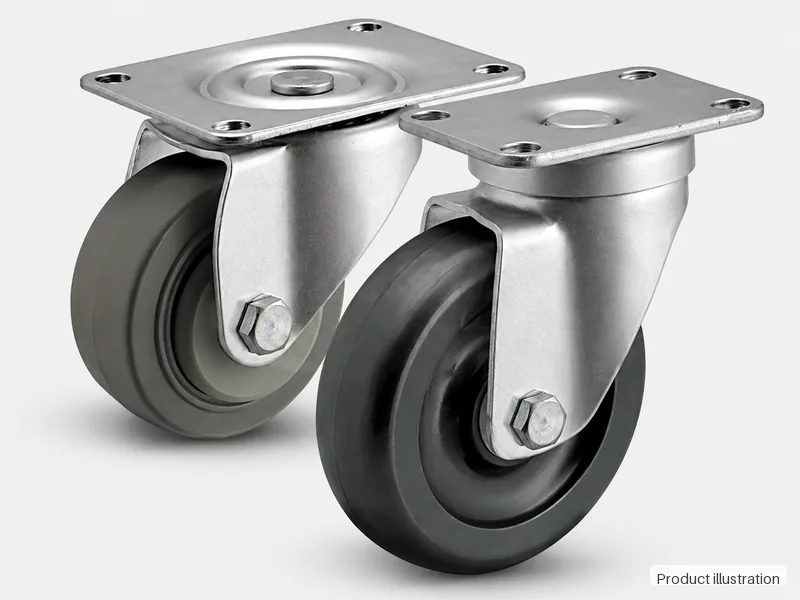
Specifications
| Materials | Stainless Steel 304 (standard) · Stainless Steel 316 (chloride environments) |
|---|---|
| Model-size reference matrix (industry chart) | Published catalog ranges: by diameter 3 / 4 / 5 in, wheel width 1-1/4–3 in, durometer Shore A 60-70 / 71-80 / 81-95 or Shore D 55-70 — published chart rows, per-publisher reference for sizing, not supplier ratings; the binding rating is confirmed per configuration at quotation |
| Surface finish | Passivated |
| Service envelope | Freezer to washdown temperature ranges (duty-specific range confirmed at quotation) |
| Size range | Ø 25–300 mm |
| Typical environments | Food processing, pharmaceutical, chemical, marine and washdown service |
| Lead time | 15–20 days (custom configurations 30–40 days) |
| MOQ | 200 pieces per model; trial orders negotiable |
| Warranty | 18 months |
Grade selection (304 vs 316) and the service envelope are application-dependent: the correct grade, seal set and wheel material for your chemistry, temperature and sanitation regime are confirmed at quotation. Load ratings follow the quoted wheel and configuration, not the frame alloy.
Applications & Selection
Choosing between 304 and 316 — and the rest of the wet-duty design
304 is the default sanitary grade, and it is the right answer for most food and pharmaceutical washdown duty: it tolerates daily caustic and acid sanitation cycles when rinsed and drained. Move to 316 when chlorides are part of the picture — brine and cure houses, coastal plants, cleaning regimes heavy on chlorine-based chemistry — because 304\'s Achilles heel is chloride pitting, and once pitting starts in a wet environment it runs. The grade decision is a chemistry decision, not a status decision: paying for 316 in a dry bakery adds nothing, and specifying 304 into a brine line buys a pitting failure.
The wheel and bearing complete the sanitation design. A stainless fork under a low-grade wheel or unsealed bearing still fails in the same wash water, so wet-duty builds pair the frame with wheel materials that share the environment (nylon, polypropylene, stainless-core PU, or 316 where loads demand metal) and with sealed or stainless bearings. Our washdown guide and the surface-finishes article cover the full material stack, including why crevice-free welds and passivation matter as much as the alloy label.
Temperature spans in this duty class are wide by nature — freezer rooms at the low end, clean-in-place steam at the high end — so state the actual temperature cycle in the RFQ. "Freezer to washdown" is the family envelope; the range that survives your specific cycle depends on the wheel compound and bearing seal set quoted.
Selection points to settle before you RFQ
Name the chemistry and the cycle: what is washed off (fats, blood, brine, acids), which sanitation chemicals at what concentration, how many washdown cycles per day, and whether there is soak time. This is the input that decides 304 vs 316, the seal set, and the wheel compound — a plain "washdown duty" RFQ forces the supplier to guess.
State the sanitation surface requirements if the equipment is audited: some regimes require crevice-free welds, specific surface roughness, or white/nondeposit wheel compounds for food contact adjacency. These change the build, and they are cheaper to specify than to retrofit.
Load and configuration last: per-wheel load by the three-of-four rule, swivel/rigid/brake layout (hands-free or touch-free braking is often a hygiene requirement — toe guards and central brakes quote differently), top plate dimensions, and quantity per size.
How a buyer verifies the grade — and what this page cannot verify
Grade verification starts with the quotation designation and ends with the certificate. Require the quotation to name the grade explicitly — SS304 or SS316, never just "stainless" — because the industry split is unambiguous: 304 is the most commonly used caster grade, chosen for the combination of rust resistance and affordability, while 316 adds molybdenum for chloride duty — independent corrosion guidance states that 316 contains molybdenum that resists chloride pitting far better than 304 stainless or zinc plating. On delivery, the practical check is the material statement read against that designation: a buyer cannot distinguish 304 from 316 by eye, and laboratory verification is disproportionate for a caster lot, so the certificate is the checkable artifact — which is why our documents list offers it on request. A supplier that will not put the grade and the seal set in writing is leaving the corrosion claim unverified, and it should be treated as unverified.
Corrosion claims are environment-relative, not absolute: even confident marketing language about stainless describes general duty, while chloride pitting of 304 under brine, salt air or de-icing salts is a real, published failure mode — it is the entire reason the 316 decision exists. The same relativity applies down the stack. Corrosion guidance is emphatic that in salt and washdown service the non-negotiable in every case is sealed bearings — open bearings are what seize first — and the frame alloy never raises the load rating: capacity follows the wheel, bearing and configuration, not the fork metal. What this page cannot verify: the delivered lot\'s alloy against its certificate, the passivation quality of individual welds, or the chloride concentration of your specific chemistry — all three are settled by your material review and sanitation audit, not here. Three boundaries do not bend: do not let a "stainless" label stand in for a grade designation — an unnamed alloy cannot be checked against 304 or 316 at all; never run an open-bearing caster in the brine or salt-spray duty you bought the stainless frame for — the frame survives water its bearings fail in; and do not treat corrosion resistance as extra capacity — no alloy grade lets a wheel carry beyond its quoted load.
Quality & Verification
The spec values for Stainless Steel Casters (RM-Clean) draw on 7 field-level source records — 2 tenant confirmed, 0 manufacturer reference, 5 industry reference.
| Claim on this page | How a buyer verifies it |
|---|---|
| Load rating | Catalog ratings bind one configuration. State wheel, bearing, speed and duty. Require that exact rating on the quotation. |
| Sample or test report | Request test data or certificates per SKU. Agree acceptance in writing before the order. |
| Materials and tread | Confirm material by certificate, not description. Unresolved options are fixed at quotation. |
| Bearings | Name the bearing type in the RFQ. "Standard bearing" is not a specification. |
| Standards and compliance | Name the standard and certify against it. An unnamed equivalent is not a certification. |
What this page cannot verify
- No figure on this page is our own lab result.
- The binding rating is the quotation figure.
Sources for this page
- [1] published S304 caster band (3-6 in wheels, TPR/PU/phenolic treads, 225-2,200 lb; S304 = 18-8/A2, washdown/medical/lab/salt-air/pharma applications) — industry reference (https://casterhq.com/collections/stainless-casters-s304-grade) — accessed 2026-10-28; channel reference band, rendered as industry context, never as supplier ratings
- [2] metal-to-exposure selection rule (zinc-plated indoors; stainless for salt spray; 316 for constant marine exposure) — industry reference (https://casterresource.com/caribbean/best-corrosion-resistant-casters-2026/) — accessed 2026-10-28; second independent publisher for the 304-vs-316 selection rule
- [3] materials (SS304/SS316), finish (passivated), envelope, size range — tenant confirmed (first-party) (owner://vertical.config.json (route A 2026-10-01)) — audit 2026-10-26 verdict pass_tenant_confirmed
- [4] 304 vs 316 selection context (18/8 composition; chloride duty) — industry reference (https://algood-casters.com/stainless-steel-304-or-316/) — corroborated by techincastor.com (accessed 2026-10-24) — context only, not supplier ratings
- [5] lead_time/moq/warranty — tenant confirmed (first-party) — owner answers 2026-10-26 (Foundation runtime/owner-answers-20261026.json)
- [6] grade-verification practice (316 contains molybdenum that resists chloride pitting far better than 304 stainless or zinc plating; the non-negotiable in every case is sealed bearings — open bearings seize first; rinse salt exposure) — industry reference (https://casterresource.com/caribbean/best-corrosion-resistant-casters-2026/) — added 2026-11-16 C44 deepen; corpus-verbatim ledger entry in packs/industrial-caster-wheels/model-evidence.json
- [7] 304 positioning (one of the most commonly used grades for casters, combination of rust resistance and affordability) and 316 chloride duty (chlorides such as de-icing salts and saltwater) — industry reference (https://techincastor.com/best-stainless-steel-casters-for-harsh-environments/) — added 2026-11-16 C44 deepen; corpus-verbatim ledger entry in packs/industrial-caster-wheels/model-evidence.json
Frequently Asked Questions
What is the difference between 304 and 316 stainless steel casters?
Chloride resistance. 304 (18% chromium / 8% nickel) is the standard sanitary grade and handles most food, pharma and general washdown duty well. 316 adds molybdenum, which is what stops chloride pitting — brine, marine air and chlorine-heavy sanitation chemistry. Industry references frame the choice the same way: 304 as the workhorse, 316 where chlorides or harsher chemicals attack 304 over time. Choose by chemistry, not by price or habit; the grade for your environment is confirmed at quotation.
Are stainless casters always the right choice for wet environments?
No — they are the right choice for corrosive and sanitary-wet environments. For plain water exposure without sanitation or corrosion pressure (an outdoor dock, a produce packing line), a zinc-plated caster with the right wheel and seals often does the job at lower cost. Stainless earns its premium where the chemistry is aggressive or audited: daily caustic washdown, blood and brine, pharma cleaning validation. Match the frame to the chemistry, then match the wheel and bearings to the same water.
What should my stainless steel caster RFQ include?
The chemistry and washdown cycle (what gets cleaned off, which chemicals, how often), grade preference or the environment so we can propose 304 vs 316, wheel material and load per wheel, temperature cycle, bearing and seal expectations, any audited sanitation surface requirements, mounting dimensions, brake layout and quantity. Chemistry plus temperature are the two fields that decide the build.
How do I verify the stainless grade on delivery?
Through the paperwork, not the surface. 304 and 316 are visually indistinguishable, and field spot-testing is lab work — so the checkable chain is: the quotation names the grade (SS304 or SS316, never just "stainless"), the material statement repeats it for the supplied lot, and your receiving file keeps both together. Industry references are consistent on the split — 304 the most commonly used grade for its rust resistance at lower cost, 316 the chloride grade whose molybdenum resists the pitting that destroys 304 in brine and salt spray. If the certificate and the quotation disagree, reject the lot; do not accept the casters and try to sort the alloy out after installation.
Does "stainless" mean the caster cannot rust?
No — that reading fails in exactly the duty stainless is bought for. 304 handles most washdown chemistry well, but chloride pitting under brine, salt air or de-icing salts is a documented 304 failure mode; published corrosion guidance puts 316 (with molybdenum) into those environments and is emphatic that sealed bearings — not the frame alloy alone — keep salt and moisture out of the moving parts, because open bearings are what seize first. Match the grade to your chemistry, insist on the sealed bearing set, and rinse salt exposure periodically with fresh water. A rusted stainless caster almost always traces to one of those three boundaries, not to the alloy label being false.
Ordering & Documentation
Documents
Every order ships with a packing list and commercial invoice. On request we provide the material statement for the quoted configuration (frame grade, wheel compound, bearing and seal types) and the dimension sheet (top plate, bolt pattern, overall height), so your sanitation review and equipment drawings can be checked before production.
Quotation
A quotation needs: environment chemistry and washdown cycle, grade (or the environment so we can propose one), wheel material, load per wheel, temperature cycle, bearing and seal set, mounting and brake configuration, and quantity. The confirmed quotation names the grade and seal set for your exact build.
Sample & supply
Standard configurations are produced to order with an MOQ of 200 pieces; trial-order quantities are negotiable; confirm availability and terms for the specified model in your RFQ. Lead time is 15–20 days for standard configurations and 30–40 days for custom 316 builds, plates or seal work. Samples ship freight collect and are refundable against a bulk order.
Storage & shipping
Stainless casters ship in cartons that keep them from rubbing against carbon-steel items — free iron transferred onto a stainless surface becomes a rust spot that the alloy underneath cannot fight. Store indoors, dry, and keep protective packaging on until installation; passivated surfaces keep best unpackaged only in genuinely dry storage. Bearings stay in their original grease until assembly.