
Product Catalog
Maintenance-Free Casters — Sealed Bearings, Hub Interfaces and Service-Life Boundaries
Third-party brand — supplied via our sourcing network
Product references on this page may come from more than one third-party source. A retailer or catalog is not necessarily the manufacturer. Where the original manufacturer or exact model/part number is not identified, it is not verified by this listing; confirm both in the written quotation. Any lead time, MOQ or warranty shown as our offer is a RollMaster quotation term, not a third-party manufacturer's published term.
Updated 2026-11
A maintenance-reduced caster is not defined by the phrase “sealed bearing” alone. The wheel bearing, swivel-head bearing, axle interface, seals or thread guards, lubricant, wheel hub and mounting hardware are separate interfaces. A sealed wheel bearing does not prove that the swivel head is sealed, that the whole caster is washdown-rated, or that the assembly needs no inspection. Specify each interface and the actual water, dust, chemical, speed and temperature exposure.
The term “maintenance-free” is not a universal bearing standard or a guarantee of infinite service life. Manufacturer guidance distinguishes plain bores, roller bearings, precision ball bearings, central sealed bearings and additional sealing options; each has different friction, speed, contamination and installation characteristics. The quotation should identify the exact bearing arrangement and seal option, plus the duty conditions and inspection/replacement basis. Do not infer that a sealed wheel bearing also seals the swivel head or the complete caster.
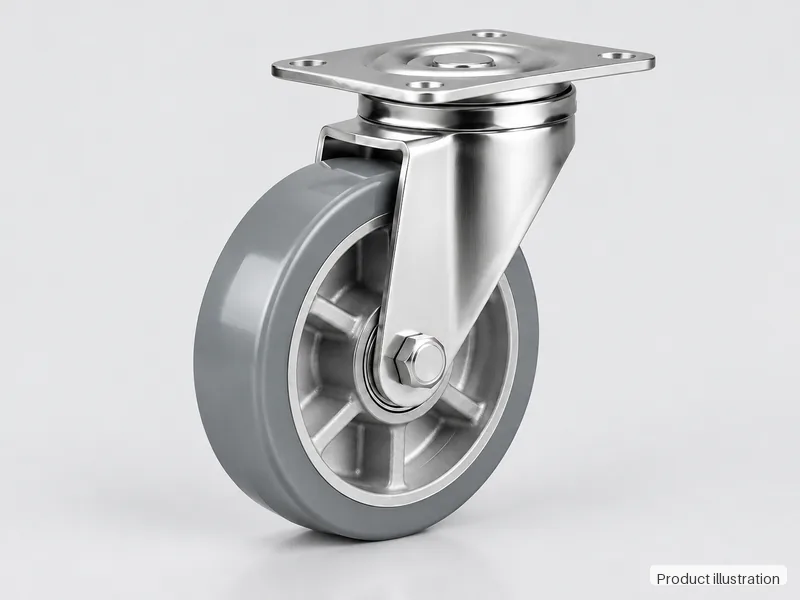
Specifications
| Type | Sealed swivel and rigid casters — sealed-for-life wheel and swivel bearings, no grease fittings |
|---|---|
| Model-size reference matrix (industry chart) | Flat-free by diameter (published tire-size decoding): 10 × 2.75 → Ø 10 in × tread width 2.75 in; 4.10/3.50-4 → tread width 4.10 in; publisher durometer figure for the class: Durometer 65D (rubber tread with polyurethane foam filler, Ø 9 in × 2-5/8 in, 290 lb) — published chart rows, per-publisher reference for sizing, not supplier ratings; the binding rating is confirmed per configuration at quotation |
| Maintenance design | No re-greasing, no kingpin re-tightening (industry design class); duty-basis expectation stated per quotation |
| Bearing class | Sealed ball bearings, kept free of contaminants (dust, moisture, debris, fibrous chop) |
| Capacity | No published family rating — confirmed per configuration at quotation |
| Duty-life basis | No universal operating-hour threshold establishes bearing life; request the exact bearing, seal, grease, speed, load, temperature and contamination conditions behind the supplier service-life statement |
| Typical duty | Continuous-use carts and AGV-adjacent fleets, food service and pharma-adjacent wash-down-adjacent areas, anywhere a missed lube round becomes a failure |
| Bearing and hub interface | Confirm bearing construction (plain bore, roller, grooved ball, central ball or spherical roller), seal/shield arrangement, axle bore, hub length, spacer sleeve, thread guard and grease access as separate model-level fields; no single bearing hierarchy applies to every wheel and duty |
| Manufacturer model comparison (reference only) | Manner LI-100 N / N/R / N/K: 100 × 36 mm, 46 mm hub, 10 mm bore; plain/roller/sealed-ball versions list 180/180/200 kg per wheel. Manner LI-200 N / N/K: 200 × 50 mm, 59 mm hub, 13 mm bore; plain/sealed-ball versions list 450/750 kg per wheel. These are Manner wheel-model values, not RollMaster or complete-caster ratings |
| Maintenance boundary | A 2RS sealed bearing is not to be re-greased unless its manufacturer explicitly specifies a service procedure; confirm whether the wheel hub, thread guard and swivel head have separate seals |
| Third-party brand — supplied via our sourcing network | Product references on this page may come from more than one third-party source. A retailer or catalog is not necessarily the manufacturer. Where the original manufacturer or exact model/part number is not identified, it is not verified by this listing; confirm both in the written quotation. Any lead time, MOQ or warranty shown as our offer is a RollMaster quotation term, not a third-party manufacturer's published term. |
| Third-party brand — supplied via our sourcing network | Product references on this page may come from more than one third-party source. A retailer or catalog is not necessarily the manufacturer. Where the original manufacturer or exact model/part number is not identified, it is not verified by this listing; confirm both in the written quotation. Any lead time, MOQ or warranty shown as our offer is a RollMaster quotation term, not a third-party manufacturer's published term. |
| RollMaster commercial coverage | 18 months as RollMaster commercial coverage; exact coverage, exclusions and order terms are confirmed in the written quotation. Any manufacturer warranty is separate and must be confirmed for the named manufacturer and exact model. |
"Maintenance-free" is not a standardized industry term — the honest question is how long the sealed rating applies under your load, speed and wash conditions. Published class claims above are industry references; the sealed-bearing basis and expected service conditions for your configuration are stated on the quotation.
Applications & Selection
What "maintenance-free" actually removes from your schedule
Separate the wheel hub from the swivel head when planning maintenance. A wheel may use a sealed precision ball bearing while the swivel head uses a different bearing race and seal arrangement; a thread guard protects the hub opening from wound fibres but is not automatically a water seal. Likewise, a grease nipple on a wheel or swivel component indicates a lubrication point, not a sealed-for-life assembly. Ask for a cross-section or parts list identifying which bearing sits at each interface.
Seal selection is a contamination-control decision, not a binary sealed/unsealed label. A non-contact dust cap, a contact seal, an added labyrinth/clearance seal and a thread guard do different jobs. Blickle describes additional sealing for water spray and dirt, including machine-washable wheel versions, while noting that the added rubbing seal slightly increases rolling resistance. That does not establish suitability for every pressure-wash direction, detergent or temperature: request the exact manufacturer option and its stated cleaning conditions.
Maintenance-free does not mean damage-proof. Seals age, abuse (pressure washing past the seal rating, loads several times the rating, towed speeds beyond spec) still ends service life early, and a wheel tread still wears with mileage. What the design buys you is a fleet whose performance does not depend on a lubrication round happening on time — and a predictable, plan-able replacement rhythm instead of emergency failures.
Selection points to settle before you RFQ
State the duty basis first: hours per day, load per caster, speeds, wash-down frequency and chemistry, and ambient temperature at the wheel. Lifetime-sealed bearing classes are positioned for continuous-duty applications in published guidance, but the seal compound and grease (factory-packed for life) must match your wash chemicals and temperature band — that match is what the quotation commits to.
Then verify the mechanical stack-up: axle diameter and tolerance, wheel bore, hub length, inner-race spacer length, washers or flanged bushes, fork inside width and axle shoulder/bolt arrangement. A wheel can have the correct nominal bore yet bind when the inner races are clamped without the correct spacer, or move laterally when the hub/washer stack is too short. Confirm the wheel can rotate freely after the axle is tightened to the specified torque; do not use the axle bolt to compensate for a missing or incorrect spacer.
Finally, ask the boundary question in the RFQ, not after the failure: how long does the maintenance-free rating apply at my duty? A supplier who can answer with duty hours, load and wash conditions is selling an engineering basis; one who cannot is selling an adjective. The fleet-sized payoff is real either way — you are buying the removal of a schedule, so make the basis explicit and hold the quote to it.
Failure modes to design out — and where maintenance-free is not suitable
Underspecifying a sealed caster fails it the same way underspecifying any caster does — the seal just moves where the abuse lands. Published field guidance on the design class names the failure modes that void the claim before the calendar does: pressure washing past the seal rating, loads several times the rating, and towed speeds beyond specification. The deeper limitation is chemical and thermal: the seal compound and the factory-packed grease must survive your wash chemistry and ambient temperature at the wheel, which is exactly why the quotation states the sealed rating basis instead of letting the adjective stand alone. Seals also age like any elastomer, so a caster rated maintenance-free is rated for a service life, not for immortality.
There are environments where the honest answer is that a conventional construction is not suitable — and the design class is chosen for a reason. Cleanroom guidance warns that unsealed bearings may let lubricant migrate onto the floor as a contamination source, and that hollow yoke frames, open stampings and unsealed components create crevices where dirt and biofilm accumulate; a lightly sealed caster on an open frame is the wrong answer there, which is why the cleanroom tiers pair sealed bearings with 316L or 304 stainless. And where your fleet\'s historical failure has been swivel loosening rather than lubrication, no seal fixes that — kingpinless construction is the structural answer, so ask for it quoted alongside the sealed standard.
Compared: matching construction to duty and environment
Do not treat bearing options as a universal ranking. The Manner LI wheel table shows why exact-model comparison matters: at 100 × 36 mm the plain and roller variants are listed at 180 kg while the sealed-ball variant is listed at 200 kg; at 125 × 36 mm the roller variant is listed at 180 kg while plain and sealed-ball variants are listed at 240 kg. Those are manufacturer wheel-model values, not a transferable percentage uplift. Choose by the actual load, speed, starting resistance, contamination, service access and the manufacturer\'s stated test basis.
Environment decides the pairing more than duty does. Wash-down service calls for stainless or sealed polyurethane wheels; AGV and towed fleets pair kingpinless construction with sealed precision bearings and hard polyurethane on iron. Cleanroom tiers are graded, not binary: at ISO 5/6 the published expectation is 316L stainless with sealed maintenance-free bearings and near-zero tolerance for particle generation or lubricant migration; at ISO 7, sealed bearings and non-shedding wheels remain standard with 304 or 316L chosen by chemical exposure, and double-sealed stainless ball bearings are the preferred option for pharmaceutical cleanrooms — operating maintenance-free not as a marketing line but as a contamination-control requirement. Hold every one of these pairings against your own duty statement in the RFQ: they are published guidance, and the quotation is what binds.
Quality & Verification
The spec values for Maintenance-Free Casters draw on 6 field-level source records — 1 tenant confirmed, 3 manufacturer reference, 2 industry reference.
| Claim on this page | How a buyer verifies it |
|---|---|
| Load rating | Catalog ratings bind one configuration. State wheel, bearing, speed and duty. Require that exact rating on the quotation. |
| Sample or test report | Request test data or certificates per SKU. Agree acceptance in writing before the order. |
| Materials and tread | Confirm material by certificate, not description. Unresolved options are fixed at quotation. |
| Bearings | Name the bearing type in the RFQ. "Standard bearing" is not a specification. |
| Standards and compliance | Name the standard and certify against it. An unnamed equivalent is not a certification. |
What this page cannot verify
- No figure on this page is our own lab result.
- The binding rating is the quotation figure.
- supplier sealed-bearing duty basis / capacity ratings — no owner family data for this family yet — rendered as confirm-at-quotation; requisitioned, not speculatively filled
Sources for this page
- [1] maintenance-free design class (sealed ball bearings keep contaminants out; no grease fittings or kingpin re-tightening; AGV/continuous-use positioning) — manufacturer reference (https://www.casterconcepts.com/maintenance-free) — Caster Concepts manufacturer line reference — rendered as published design class, never as an unqualified supplier promise
- [2] lifetime-sealed bearing class positioning for continuous-duty (8+ hour daily) applications — industry reference (https://casterhq.com/pages/how-to-select-casters) — second-publisher class claim; the 25% force figure in the same source row is not carried to this page
- [3] cleanroom grade guidance (ISO 5/6 vs ISO 7 constructions, 304/316L stainless pairing) — industry reference (https://atlantacaster.com/blog/pharmaceutical-and-cleanroom-caster-selection-gmp-fda-and-contamination-control-requirements/) — second-publisher cleanroom tiering; rendered as published guidance, not a supplier cleanroom certification
- [4] lead_time/moq/warranty — tenant confirmed (first-party) — owner answers 2026-10-26 (Foundation runtime/owner-answers-20261026.json)
- [5] bearing construction, seal variants, 2RS lubrication warning, spacer sleeve and added sealing trade-off — manufacturer reference (https://www.blickle.us/en-us/guide/wheel-bearing-types) — Blickle G16 catalogue printed pp.84–85; reference for construction and interface distinctions, not a RollMaster specification
- [6] Manner LI wheel exact dimensions and per-wheel capacities by bearing option — manufacturer reference (https://www.servicecaster.com/caster-brands/Manner_Catalog/Manner_Catalog.pdf) — Manner Industrial Castors catalogue, LI wheel table; manufacturer model values only
Frequently Asked Questions
Are maintenance-free casters really maintenance-free?
They are maintenance-schedule-free, which is the useful part: no re-greasing, no kingpin re-tightening, sealed bearings that keep lubricant in and contamination out for their designed service life. But the term is not standardized in the industry, and honest trade guidance says to ask any supplier how long the rating applies. Treat it as an engineering claim with a basis — duty hours, load, wash conditions — and the quotation should state that basis. Tread wear and abuse damage still exist; what is gone is the lubrication round your fleet used to depend on.
Does a sealed wheel bearing make the whole caster maintenance-free?
No. The wheel bearing, swivel-head bearing, axle interface, thread guard and brake mechanism are separate components. A sealed wheel bearing does not prove that the swivel head is sealed or that the complete caster is suitable for washdown. Ask for the bearing and seal arrangement at each interface, the cleaning limits and the inspection/replacement basis.
What should my maintenance-free caster RFQ include?
Load per caster, duty hours per day and speeds, wash-down frequency and chemicals, ambient temperature at the wheel, floor type, wheel material preference, swivel vs rigid and brake positions, mount type and plate size, and quantity per configuration. Add the question that defines the term: "what duty basis does the maintenance-free rating carry, and what voids it?" — the answer belongs on the quotation, not in a brochure.
Ordering & Documentation
Documents
Every order ships with a packing list and commercial invoice. The sealed-bearing specification (bearing class, seal type, factory-packed lubricant) and the duty basis for the maintenance-free rating are stated on the quotation and repeated on the order documentation; dimensional drawings are available on request.
Quotation
A quotation needs: load per caster, duty hours and speeds, wash-down and temperature conditions, floor type, wheel material, bearing class, mount configuration and quantity. The confirmed quotation states the capacity and the sealed-rating basis for your configuration — published class claims are references, not the order commitment.
Sample & supply
Third-party brand — supplied via our sourcing network. Product references on this page may come from more than one third-party source. A retailer or catalog is not necessarily the manufacturer. Where the original manufacturer or exact model/part number is not identified, it is not verified by this listing; confirm both in the written quotation. Any lead time, MOQ or warranty shown as our offer is a RollMaster quotation term, not a third-party manufacturer's published term.
Storage & shipping
Sealed casters ship ready to run — no pre-lubrication, no commissioning grease. Store cartoned, dry, and out of direct sunlight; seals and treads age under UV like any elastomer. Before installation, cycle each swivel by hand: it should turn smoothly with consistent resistance. A unit stored for a long period needs nothing but that check — which is rather the point of the design.